The post The Emperor Has No Clothes appeared first on The Chronicle of the Horse.
]]>I know I am not alone in my unending desire to learn more, see more and experience more with my horses. It’s a common theme that seems to speak to us all, proven to me in the hours we work to facilitate our relationships with our horses and friends in the equine world.
Most of us have the disease, if you will, and as life goes on, we constantly evolve in both our understanding of horses as well as our approach to them and the life around us, but we never seem to change the core force of what drives us.
We watch as the sport changes, even though our love for horses always stays the same, but I wonder if we truly realize how much we change in that same process, and if we are even aware of the sport’s evolution. Most of us in the industry start talking in terms of decades instead of years or seasons at a certain point, and it is without a doubt that over decades, things change. Within a season or a year or two, some of the changes don’t seem to be that noticeable, especially the small ones; they’re adapted to quickly, often passing by unnoticed, but sometimes insidiously becoming a new trend that everyone takes up, sometimes purposefully and sometimes completely unaware of that new adaptation.
A few weeks ago, I saw an advertisement with a rider in a top hat, and I was thinking how much uproar there was when the “look” was going to change as helmets became requirements. Fast-forward 10 years, and now a photo with a top hat-clad rider seems ancient, grainy and very outdated.
That was one of the noticeable changes, but there have been many small, seemingly insignificant ones that have also occurred. I wonder if we ever stop to think about how these changes have affected our sport and art, or are we just rolling with the punches, adapting and absorbing, dodging and swinging as needed, but nonetheless accepting them in the end for good or for bad?
A friend recently sent me an ad her trainer published of a young horse that she is selling, and I was taken aback at the photos used for the ad itself. The horse was clearly behind the vertical, low in the poll and high in the croup in all the photos, with a very poorly adjusted, low-fitting drop noseband. But at the same time, the horse looked gorgeous: muscled and shiny, with a nicely dressed rider who was decked out in sparkles and matching-colored show clothes.
It has become so incredibly commonplace to see horses in this condition, and the younger trainer, I am assuming, thinks the photos are great.
When did that evolution happen—the one where we look at a bad photo and think it’s great because it’s pretty? I know the age-old argument of, “One photo is just a moment in time,” but in this case it was multiple photos. It always seems to be the same group of people who hide behind that statement, and they’re the same people that always want to say that our new technology is so much better than the old: The breeding is better; the saddles are better, and the clothing is better. But I would be remiss if I didn’t point out: The cameras and the photographers are also better.
I have book after book in my library with extensive photos, some newer, some older, some dating back to the 1920s, all with absolutely stunning images of correct work and movement. We could still use them today as how-to images of what is correct. Back in those days, shutter speed and film development were very limiting factors in the amount of pictures a photographer could take at home or at a show. Why is it so easy to go back to the days of old and find such beautiful photos and classic examples of what is correct, and today they are few and far between?
How can we say it is a bad moment when that is the best moment the photographer can get with a rapid-fire shutter?
“How can we say it is a bad moment when that is the best moment the photographer can get with a rapid-fire shutter?”
Or is it that the rider just keeps producing those bad moments—telling themselves it was just a moment in time and trying to get us to believe that as well? I don’t think any photographer is out to snap a bad photo of a horse. Those don’t sell, and no one wants them, so it is never in a photographer’s interest to keep catching the bad moment. Those bad moments are just extremely commonplace, so they are very easy to catch.
These days there is a lot of outcry on photos like that, with people saying the rider is abusive based on a photo, which is a fallacy but can be a truth at the same time. If we look at it as a way of life and a style of riding and see photo after photo, show after show, of similar images of a particular rider reproducing the same image on horseback, that argument can in fact stand. Not to mention, if that is the best they can produce in public, what are they producing and how are they riding at home?
Horse welfare is on everyone’s mind these days; it is unavoidable and everywhere. Using photos like the ones in this sale ad do not do our sport any justice or give us a leg to stand on in defense of our practices. Our sport is in turmoil right now, and there is a shift taking place, whether welcomed or objected to from those in the sport. The problem is the evolution has shifted, skewed and adjusted our ways of thinking and viewing the sport and the horses to such an extent we don’t always see, or want to see, the endemic problems that are here at our doorstep.
One recent example is that a very well-known bridle company from Germany started making a crank version of a drop noseband. Much like the old, studded cavesson nosebands that one can still purchase, they really have no place in our industry. If the bridle maker had horse welfare in mind, they wouldn’t make a crank drop noseband, since they would understand the purpose of that kind of noseband, and the pain that a tight drop noseband can produce, and they’d understand the damage that can be done when misused. This company is adding to the welfare issues seen by the public in production of a noseband like this. Shame on them for making one, and shame on us for buying them, and in turn letting them become part of this insidious evolutionary change.
Welfare And Art
These changes are again going on right under our noses, no pun intended, while we just keep talking about how great the sport is, how much we love our horses, and all the while, trying to silence the critics. We keep getting told by the royalty of the sport that they know better than the novice riders, and they love their horses. The public keeps hearing from the stars of the horse sports that these things are being blown out of proportion, and the public just isn’t educated. I very much beg to differ.
It has become so commonplace to have extremely tight nosebands as a way of life and training that these star riders, who are supposed to be the best and biggest advocates in our sport for equine welfare, are up in arms over having a device that can measure the tightness with a standardized gauge to tell us what common sense should really be telling us. I don’t understand the objection to the idea of a measuring device, and why people can’t get behind standardization, especially when they love the horses so much.
But just to be clear, tight nosebands are not actually the enemy here; not understanding that the tight noseband, blue tongue or strong contact isn’t fair to the horse is. This is a rider accountability issue. If welfare was a foremost concern to these riders, why aren’t they coming up with ways to better work with the higher-ups to be compliant and transparent with their practices? Why don’t they desire to better the sport with kindness toward their steeds and common sense to their approach? Where has the empathy gone, if it ever did exist, and how can some of these riders look at their own horses, or the horses of some of the other riders, and think, as the Fédération Equestre Internationale so daftly puts it, that those are “happy athletes”?
I am reminded of the fable, “The Emperor’s New Clothes,” with the basic moral being it’s important to speak the truth and not be afraid to challenge authority, even when it’s uncomfortable or unpopular. The story shows how people are often afraid to speak the truth, even when they see something is clearly wrong, because they fear being judged or ostracized. It demonstrates how vanity and a desire to maintain appearances can lead to deception and blind people to the truth. The little boy’s honest declaration that the emperor is wearing no clothes exposes the charade and reveals the emperor’s true state, demonstrating the power of truth. In the end, it is a cautionary tale about blindly following the authority or group thinking, and the importance of independent thinking and critical evaluation. The story sums up the way gaslighting works, which is a modern-day word used to basically describe the entire fable.
When lines of welfare start becoming blurred, the art gets lost, and in that loss, the correctness of form goes with it. Welfare and art go hand in hand, so if we lose the welfare, we lose the art, and we seem to be losing the welfare to the evolution that is taking place right in front of us.
“When lines of welfare start becoming blurred, the art gets lost.”
Somewhere in the performance and in the work, there has to be a willingness on a horse’s part to be our partner. The art of the sport is both in bettering the horse’s natural way of going and preserving and showcasing their character. Dressage that doesn’t do this simply isn’t dressage on a level that we should be striving for, agreeing with or believing in.
Every few years someone seems to have a new revolutionary idea on how to blend art and sport together, but unfortunately those ideas always seem to lean heavily on gaslighting, crowd approval, TV ratings, excitement or dilution to make the sport more appealing to a larger audience. This also ends up feeding the bad and incorrect evolutionary change.
As one simple example: The Grand Prix test lengths have been shortened over the years, so the audience doesn’t get bored, and we can fit more riders into a day. We make the tests easier and lean more heavily on the excitement and drama far more than the harmony and training, which can now be added to the list of welfare issues for the horse.
It isn’t a new argument or a new problem. But there does seem to be a battle that is creating polarization all the way down to the grassroot levels. This battle is raging, and each team and side keeps pushing their beliefs and defending their own way of life. Some are more science-based and fact-driven, others speak purely from the heart, and then there are some from the side of human stubbornness—just not wanting change. The judges believe they are right in what they are scoring; the riders believe they are right in how they are training, and the people at home have yet another core value of beliefs that they hold strongly. No one wants to give in, since that either means a change in your sport, or a change in your art, and either way in the end, a change in our way of life with horses.
We often point a finger at the people at home or on the internet and say they don’t know since they are not out there doing, but they are not always wrong, and their opinion cannot always be invalidated because they haven’t cantered into a stadium at an Olympic Games. It is extremely naïve of us riders, trainers and judges to think we are the only ones with eyes, and sadly for that argument, we as a group often wear rose-colored glasses talking of the queens and kings of the sport, unwilling to see the big picture and go against the popular crowd.
We’ve all seen an uptick in the amount of comments and posts online, on both social media accounts and various websites, speaking out about welfare-related issues.
Everyone is fast to condemn someone speaking up or speaking out as crazy or vindictive, uneducated or stupid, often saying, “We haven’t seen you ride or compete at that level,” and in turn trying to invalidate what the commenters are saying. If the argument of, “You must have competed at a level to judge,” holds value, why do we have some upper-level judges that have not competed at the Olympics or World Equestrian Games? I don’t understand the hypocrisy there.
I am in the minority in the belief that you do not have to have ridden to that level to see what is correct and what isn’t—or at least I can respect someone’s educated opinion on why they think something is right or wrong.
To me, the only caveat to having an opinion on a subject is having an education on that subject, and I have to say, I am hearing a lot of educated opinions on the internet these days that we just can’t keep ignoring or blowing off because we haven’t seen these people ride horses. Not all these people are wrong.
Being in the sport for a long time, you see these changes taking place, and they will continue to do so. Much like the tide at the beach, it ebbs and flows, and with each wave, you see the landscape changing before your eyes. Slowly, steadily, it changes. We can get on board with these changes, or we can leave it up to the current and the weather to make these changes for us, later trying in vain to redirect the erosion.
It will be interesting to see where the future of our sport heads with welfare on the forefront. There’s a vocal majority acting like the changes are egregiously pushed upon them, and then what seems like a minority feeling they’re a welcomed relief, since we all want to see horse sports stay relevant and included in a world where we can all continue to ride, love and hedonistically enjoy our equine partners.
Grand Prix trainer and competitor Jeremy Steinberg was the U.S. Equestrian Federation national dressage youth coach from 2010 to 2014. A 1996 FEI North American Young Rider Championships individual dressage medalist, he is a former U.S. Dressage Federation Junior/Young Rider Clinic Series clinician. He credits much of his dressage education to the late Dietrich von Hopffgarten, his longtime friend and mentor. Today Steinberg runs a boutique-style training business in Aiken, South Carolina, and travels the country giving clinics. Learn more at steinbergdressage.com.
The post The Emperor Has No Clothes appeared first on The Chronicle of the Horse.
]]>The post From Rescue To Ribbons: Chronicle Cover Horse Made Dreams Come True appeared first on The Chronicle of the Horse.
]]>Fylicia Barr may be a five-star eventer now, but she got her start in the sport aboard the most unlikely of mounts. Her first event horse was a gray Arabian gelding named Zanzibar, with whom she did a bit of everything: 4-H, barrel racing, English and western pleasure, and even a little reining. A painting of him—dished nose, delicate ears and kind eyes, standing in a field of flowers—graces the cover of this month’s issue of the Chronicle.
When Barr, 30, first met “Z,” he was an emaciated, rough-looking youngster at a low-end auction in western New York. Barr was just 10 years old, and she had a total of three riding lessons under her belt. Barr’s mother, Shannon Barr, bought Z on an impulse, despite the fact that neither she nor her young daughter had the requisite skills or experience at that time to manage an unknown horse from auction.

However, in the years to come, Z (named by Fylicia in honor of the main equine character in the “Phantom Stallion” series) would pay back his rescuers in dividends. Not only did Fylicia ultimately event him through training level, he carried multiple young riders to 4-H competitions, and later came out of retirement to become the first event horse for Chronicle cover artist Josie Buller, who took him all the way to the 2021 USEA American Eventing Championships.
“It felt like he just wanted to do right by us,” Fylicia, of Unionville, Pennsylvania, said. “We saved him, and I think he knew that, and he always tried to do everything he could for us. There were definitely moments where he could have said no, but he gave us everything he had. We both did a lot for each other.”
We Meant To Buy A Saddle…
On the day Shannon and Fylicia met Z, they had gone to the auction with a friend, intending to buy a saddle. Instead, they bought a horse with an unknown past, paying just $800 for the gelding—one dollar a pound.
“We saw him, and he was so sad, and so thin—he just looked at us, and we knew we had to try to make something happen,” Fylicia said. “It was truly the blind leading the blind. At auction, you don’t get much info on them, and we saw him with a saddle on and assumed he was saddle broke.”

But when they got him home—to a facility Fylicia describes as a “backyard barn sort of set up,” they found out Z was perhaps only 2 or 3 years old.
“He was young, and not really broke at all,” Fylicia said. “It was a bit of a set up for disaster. I didn’t know what I was doing, he didn’t know what he was doing, but we found our way, together.”
Nursing Z back to health required nothing more than correct, basic care. Over the next several years, Fylicia slowly got him started under saddle. Although she took occasional lessons on other horses, she didn’t have much help with Z; looking back, Fylicia admits she made many mistakes.
“Now, as an equestrian professional, I’m horrified at some of the things he put up with,” Fylicia said. “But he never complained. He used to buck me off for sport, but he gave me a really good seat that I still have to this day, and it was always with a smile on his face. It was a game for him, more than him wanting to hurt me. He’d just sit and wait for me to get back on.
“He made me fearless,” she continued. “He made me feel like I could ride anything. He was always a really, really good boy.”
When Fylicia learned about eventing, she was instantly hooked. She and Z debuted in U.S. Eventing Association competition in August 2011 at the Erie Hunt and Saddle Club Horse Trials (Pennsylvania), where they ran beginner novice. At the same competition a year later, they competed at training level. By then, Fylicia was 17 years old and had acquired a mare named Galloway Sunrise, whom she purchased off Craigslist as a semi-feral 2-year-old. Fylicia began thinking it might be time for Z to step down a level as she continued her own progress forward.

“At training level, the jumps got a little big for him,” Fylicia said. “So we leased him to a couple of young riders that did 4-H shows with him. He was the perfect babysitter.”
Although he was sound and in good health, when his final 4-H lease ended, the Barrs took advantage of an opportunity to retire Z to a farm in western New York. For several years, he lived “his best horsey life” there, while Fylicia continued her own eventing journey with “Sunny,” eventually making it all the way to the five-star level. She attributes her tenacity in working with the quirky mare, and other challenging mounts, to the lessons she initially learned from Z.
“He taught me not to give up on the difficult ones,” Fylicia said. “If you put enough time and effort into trying to understand the tricky horses, you can come out the other side with a really quality partner—if you’re patient, and take the time to understand where they’re coming from.”
It was after Fylicia relocated to Unionville and established her business that she met 12-year-old Buller, who wanted to get started in eventing—but who didn’t have a horse. Fylicia immediately thought of Z.
“When Josie came into my program and needed something to ride, I thought, ‘Let me see if the old man has got a little bit left in the tank,’” Fylicia said. “And he absolutely gave her everything.”
From Starter To The Bluegrass
Buller is now an 18-year-old freshman at Hamilton College in Clinton, New York, but she still vividly remembers the day six years ago when Z and his friends moved into the new home of Fylicia Barr Eventing.
“People were putting up white boards by the stalls with the horse’s and owner’s names, and Z’s little white board had my name listed below his, even though I was not the owner,” Buller, of Coatesville, Pennsylvania, remembered. “Fylicia very generously let me do a free lease on him, and act like he was my own horse. The stars kind of aligned, and Fylicia knew Z would be the best teacher for me—and he really was.”

Buller had gotten her start taking lessons a local hunter/jumper program, but when she learned about eventing, decided to shift her focus. Working with Fylicia and Z, she went from being a “rusty” crossrail rider to competing at novice. After gaining mileage at the starter level in schooling horse trials and learning the basics of dressage, the pair moved up fairly quickly. In June 2020, after eight years away from sanctioned competition, Z returned to the sport at the Plantation Field Horse Trials (Pennsylvania) at beginner novice —with Buller in the irons.
“I made a lot of mistakes—I got left behind plenty of times—but he was so, so tolerant,” Buller said. “I always felt untouchable on Z. He’s just the best partner, and we had lots of fun. I’d never really shown, so I did all my ‘firsts’ on Z.”
When Buller was 15, she decided to set a big goal: to qualify for and compete at the 2021 AEC.
“It can get pretty competitive in Area II, and Z, being an Arabian, would stick his head up in dressage, and I didn’t always quite know what to do,” Buller said with a laugh. “But we got a second place at Bucks County [Pennsylvania], and we got to go to AEC.”
Buller describes the experience of competing Z at the AEC, held that year in Lexington, Kentucky, as “magical.” She admits he even was “a little wild” on cross-country after being stalled for so many days. The pair finished 31st of 38 in the junior novice, 15 and under, championship—and earned the best-scoring Arabian award.
“He was the only Arabian in the class,” Buller laughed. “Some people would say, ‘Oh, you ride an Arabian?’ Well, he’s the best cross-country horse you’ll ever find. A horse you truly care about will always give 110% to you.”

Watching her first horse gallop over the Kentucky bluegrass with Buller made Fylicia feel as if Z’s story had come full circle.
“Obviously, Z and I did not make it to the Kentucky five-star,” Fylicia said with a laugh. “That was my dream growing up, even though I was a 10-year-old kid on an Arabian pony we’d bought for nothing. But watching him and Josie go down the ramp into Rolex stadium, and gallop through the Head of the Lake—that was so special. He made her dreams come true, and my childhood dreams came to life through them at that moment, too.”
Although Buller and Z competed one more time that season, the AEC proved to be their swan song together.
“We don’t know his exact age, but he is 20-ish, and he had held himself together,” Buller said. “It felt like he was trying really hard, and he didn’t need to keep competing, where I wanted to keep moving up.”
Inspired by her trainer’s work in producing her own horses, Buller moved on to a former Thoroughbred race horse named Lee, whom she competed through training level. But Z remained in Fylicia’s barn, and Buller would still trail ride him once in a while just for fun.
“Most of the time, I didn’t even bother putting a saddle on him,” Buller said. “I’d just hop on, and we’d get going.”
Behind The Cover Painting
As Buller neared high school graduation, she knew that her time with Z was drawing to a close. Fylicia had made the decision to send him to enjoy a final, official retirement with her mother in western New York, and Buller was preparing to head to college. When she painted a watercolor and gouache portrait of him standing in a field of flowers, which she included in her senior gallery, it was intended as a dedication to the horse who changed her life.
“He absolutely is my heart horse,” Buller said. “Middle school was a pretty rough time for me, and having Z … I went to the barn every day after school, and I felt like I had him in my corner all the time. If I had a really bad day, and I got off the bus in tears, we’d just go out for hours and hours on the great hacking trails around the barn. I kind of felt like every time I stepped into the saddle with him, I got to leave everything on the ground.”
Buller loves floriography, a tradition which looks at the symbolism of flowers and colors. In her tribute to Z, each flower she painted in the field he’s standing in was chosen specifically to convey Buller’s appreciation for all that he means to her—the sweet peas at the front mean “thank you for a lovely time,” the zinnias symbolize everlasting friendship, the heather is for protection, and the Queen Anne’s lace for sanctuary.
When the Chronicle put out a call for submission to its annual Junior Art Gallery (see more submissions from young artists here), she sent it in. Chronicle staff chose the piece to grace the cover of the 2025 Young Rider issue.
“I’m so happy it got on the cover, because if any horse deserves to be on the cover of the Chronicle, it’s Z,” Buller said. “He has given so much, to so many people. He was Fylicia’s first horse, and now she’s a five-star rider. He helped me through so much in middle school and made me into the rider I am today.

“I think it is so important, on so many levels, for all people to know that every single horse deserves a second chance,” she continued. “Horses always seem to give back, especially those who get into a really good situation after having been in a not so great one. They give you their whole heart, and there is a lot of value in having a horse you’re just really close with. With the right people, no matter what their breed, a horse can do anything.”
The post From Rescue To Ribbons: Chronicle Cover Horse Made Dreams Come True appeared first on The Chronicle of the Horse.
]]>The post 2025 Junior Art Gallery appeared first on The Chronicle of the Horse.
]]>This article originally appeared in the August 2025 issue of The Chronicle of the Horse. You can subscribe and get online access to a digital version and then enjoy a year of The Chronicle of the Horse. If you’re just following COTH online, you’re missing so much great unique content. Each print issue of the Chronicle is full of in-depth competition news, fascinating features, probing looks at issues within the sports of hunter/jumper, eventing and dressage, and stunning photography.
The post 2025 Junior Art Gallery appeared first on The Chronicle of the Horse.
]]>The post Advice For Young Riders With Big Goals appeared first on The Chronicle of the Horse.
]]>I’m helping people at a stage in their career where, in theory, they know how to ride. The technical basics of riding have been perhaps not mastered but definitely taught. I want to help them refine those skillsets to the highest levels that a particular rider can achieve. They also have to combine those technical skills with learning how to manage a competitive career, which are two quite different things.
The biggest challenge I see for riders making the leap from their young rider career to the top levels is in putting it all together. In all sports, it’s one thing to be talented; it’s another thing to be less talented and hardworking, gritty and determined. Those are all valuable qualities that will carry you so far, but now you have to combine those skillsets with abilities outside of riding that will help connect the dots to get you where you want to be. How do you create opportunities? How do you get mounted on good horses? How do you sell yourself to people so that they feel engaged and want to support your journey?
Those are the things that have a lot to do with who makes it to the top. I get frustrated when I hear a lot of rhetoric about the idea that if you’re not a billionaire, you can’t make it. And then I look at the top 10 riders in the FEI Longines World Rankings, and none of them come from that background. If you go down the world rankings, there are a few very wealthy people. I’ve had enough experience with people who come from very affluent backgrounds to know that that comes with a whole different set of challenges, which aren’t always that easy.
I get frustrated when I hear a lot of rhetoric about the idea that if you’re not a billionaire, you can’t make it. And then I look at the top 10 riders in the FEI Longines World Rankings, and none of them come from that background.
Riding well, being a better horseperson, and learning how to compete are all givens for getting to the next level. But there’s also the aspect of managing a career—finding sponsorship, finding owners, creating opportunities—that’s so essential.
Take Chances
Kent Farrington and I talk all the time about how for many years we never missed a five-star grand prix. That’s not because we always had the biggest sponsors or best horses of our lives in those moments. We made it a priority to be in those classes. At times, we bought horses ourselves to keep us at the top level, or we’ve talked to people and said, “Can you send me that horse, or let me work on that horse? I think I can make it better.” We scrapped to find a mount. A lot of people sit back and think, “I’m talented; people will give me horses to ride.” That’s not how it happens.
I can’t tell you how many riders I’ve had come to work for me whose main concern is their living accommodations and what brand of car they’ll be driving. I’ve been lucky enough that things have worked out very well for me, but that’s been 35-plus years of grinding at it and thanks to a lot of opportunities along the way from a lot of people. I never chased the economics of it. That comes with success, and that’s a nice perk. But the focus shouldn’t be on financial success; it should be on getting the opportunity to ride top horses.
You can’t have success if you’re not competing. I always wanted to know, “How am I going to be in the grand prix next week with a competitive horse?”
When you take a job as a second or third rider at a big stable, flatting horses, you get a nice paycheck every week, and that’s very safe. But people who take the risks are the ones who are going to create good opportunities for themselves. Sometimes that feels really unsafe, and it’s uneasy territory, right? But you need to be willing to take educated, smart risks if you want to really succeed. Some people say, “Oh, I’ll do anything for it,” but then actually find out they won’t really do anything for it.
Be Resilient
Our sport can be very difficult, challenging and heartbreaking, with horses getting injured or not performing, or getting injured yourself. But, to some degree, if this is going to be your career, you need to accept that the challenges are part of it. Sometimes it feels like the bad luck comes in runs, but you have to keep putting one foot in front of the other, looking for the next opportunity.
Frustration can come from anything, if you allow it to dominate your outlook. I happen to focus on thinking that one step sideways will maybe lead to three steps forward, and they’ll be steps that I probably wouldn’t have taken otherwise. Maybe that’s something that’s just a little bit internal in me. Maybe it’s a confidence that’s been built because things, to some degree, have worked out for me. But that mentality also probably played a role in things working out. When I missed getting a horse or a horse was injured or an opportunity didn’t come to fruition, I believe something else positive came about in its place.
I think that across the board, when you see people who have been successful in any walk of life, you notice that they don’t get overwhelmed by the setbacks. They just accept them as redirections. You have to digest them. You have to learn from them. And then you have to wake up the next day and go after the next opportunity.
Build A Village
There are some realities that have evolved as the sport has grown. I think a top rider has to have a knowledgeable, strong team in the barn backing them—barn manager, veterinarian, farrier, grooms and more. I look at other sports teams, and there was a time when the coach also played, in addition to being the strength trainer and the infield trainer and the first base coach and all the other different roles. And that’s evolved, right? Now there are experts supporting the team, from medical personnel to strength training to game logistics. Our sport is no different.
“When you see people who have been successful in any walk of life, you notice that they don’t get overwhelmed by the setbacks.”
The growth of the sport at the highest level has made it somewhat impossible to be the well-rounded horsepeople that the generation before were. I cannot shoe my horses, feed my horses, groom my horses, train my horses, fundraise the sponsorship dollars, interact with the clientele and compete at the Olympic level. Something has to give. What you see in the very successful big operations now is riders who have a thorough understanding of horse care, but who then surround themselves with the best people for each expertise. The riders are engaged and involved with all the decisions, but they allow those experts to do what they know best.
The idea that the only way to be successful is if you start in the morning mucking stalls and drive the truck to the show and braid your horse isn’t realistic. There’s nothing wrong with any of that, but when riders are aiming for the very top level, they have to prioritize their time wisely. They need to manage their responsibilities, and, in turn, manage people around them. That’s what leadership is. I have often said that the generations that I learned from were better all-around horsemen than I am. They knew horses better.
That knowledge is enormously important and to be respected, but I choose to trust the experts on my team to have that expertise, leaving me the time to focus on other priorities.
Develop As A Human Being
I continue to learn through these experiences with young riders, as well as from my own experiences in the sport and in life. Being a successful rider is definitely one part of it, but living a rewarding life as a human also has a lot to do with success.
I’ve been privileged to work with young riders at an incredible time in their life. They can really focus on the sport, but they also should be really focused on developing who they are as a person. I very much respect that I get to be a large influence on a pretty influential period in their life. At the end of the day, most of these young riders are pretty exceptional. I’ve grown tremendously as a person by being around them, and probably also as a competitor.
Anybody that I’ve had influence over, I always push them to work on every single possible asset that could improve them as a competitor and as a person. As I push them to go after all of these things, I share with them very openly what my journey has been. I think most of them are very surprised that it’s not what they think it is from watching from the outside.
I am checkered by vulnerabilities, insecurities, missteps and mistakes, but yet I found a way to try to overcome most of them and live a successful life and have a successful career. I think that sharing that experience allows them to open up and say, “I’m in a tough spot here,” when they need to.
Vulnerability is really where you grow. I also try to open people’s eyes to the different tools that will help, like sports psychology, physical training, and finding some balance in your life.
A stalwart of the U.S. jumping team for decades, McLain Ward, 49, won team gold medals at the 2004 and 2008 Olympic Games and team silver at the 2016, 2021 and 2024 Games. He also earned team gold at the 2018 FEI World Equestrian Games (North Carolina), team silver at the 2006 WEG (Germany) and team bronze at the 2014 Alltech WEG (France). Ward also won the 2017 Longines FEI World Cup Final (Nebraska) and has spent time atop the Longines FEI World Show Jumping Rankings. He operates his family’s Castle Hill Farm in Brewster, New York.
This article originally appeared in the July 2025 issue of The Chronicle of the Horse. You can subscribe and get online access to a digital version and then enjoy a year of The Chronicle of the Horse. If you’re just following COTH online, you’re missing so much great unique content. Each print issue of the Chronicle is full of in-depth competition news, fascinating features, probing looks at issues within the sports of hunter/jumper, eventing and dressage, and stunning photography.
The post Advice For Young Riders With Big Goals appeared first on The Chronicle of the Horse.
]]>The post Manhattan Saddlery: A Tack Shop Outside Of Time appeared first on The Chronicle of the Horse.
]]>Amid the modern bustle of 24th Street in Manhattan stands a three-story relic of old New York—a shop that calls back to a time when city noise included hooves clattering on cobblestones. Founded in 1912, Manhattan Saddlery has been outfitting equestrians since horses were an integral part of daily life and the street was nicknamed “Old Stable Row.” It’s now the last shop of its kind in New York City.
“It’s of course really easy to forget—as I look out my window now and I see nothing but concrete, steel and glass and a bunch of cars—but I think it’s always been in the back of my mind that there’s a pretty rich equestrian past in New York City,” said Manhattan Saddlery owner Nick Tsang. “The National Horse Show was here, Madison Square Garden … and going back many, many decades, the city was all horse-powered over 100 years ago.”
The tack store, formerly called Miller Harness Shop, isn’t just a part of the historic landscape of Manhattan. For Tsang, the building holds a meaningful place in his own family history: Miller’s was a favorite destination for Tsang’s late mother, Yuen-Ron “June” Tsang.

“My brother, [who’s] six years older than me, is intellectually disabled, and my mom was kind of an early adopter to the idea of therapeutic riding,” Nick said. “She wanted us to ride as a family.
“Pretty soon I lost interest; my brother lost interest; my dad lost interest,” Nick continued. “And my mom really got into it. She ended up buying a horse, which became two, which became four.”
As her dressage obsession took root, June would regularly pop into Miller’s. During one visit in 2002, she was surprised to find merchandise dwindling and shelves bare; the store was closing. Nick says June wasn’t one to act on a whim, but she had the idea that owning her favorite shop “might be interesting.” She and Nick’s father, Kock-Yen Tsang, bought the store, which they later renamed Manhattan Saddlery. June fell ill in 2007 and Nick, who had recently graduated college, took over running the store. After his mother’s death a few years later, he remained devoted to keeping the shop open for the long haul—even if Nick isn’t the same equestrian that his mom was.
“The running joke is that I cannot think of another human on Earth who doesn’t actively touch horses, but who knows every single brand and owns several hundred thousand dollars’ worth of inventory,” said Manhattan Saddlery manager Laura Ratliff.
He may not be an active rider anymore—“I’m deeply allergic to horses; I can only be at the barn for so long, even if I’m stuffed to the gills with Allegra,” he said—but Nick, along with Ratliff and the Manhattan Saddlery staff, will happily talk shop.
“There’s a saying in the investment world, ‘You don’t want to be selling buggy whips in the age of the automobile,’ and as New York City’s pre-eminent seller of literal buggy whips, I think the challenges are obvious,” Nick said with a laugh.
When people drop in, Ratliff says they’ll often share how the long-standing store has played a role in their lives. “We get customers who come in and say, ‘Oh, my mother shopped here in the ’70s,’ or, ‘I got my first tall boots here in 1986,’ ” she said. “The store was kind of the go-to.”
Even Ratliff, who spent her childhood thousands of miles away from New York City, was aware of the legacy of the original shop.
“The Miller’s catalog was kind of like the Sears catalog growing up, right?” she said. “I grew up in Texas, but I remember flipping through it and circling things.”
Now, getting to help run the store today, she feels the magic first-hand that once endeared her to the store from afar.
“I think it has a really unique atmosphere that can only be attributed to it being in New York City,” Ratliff said of the shop’s charm. “I always joke that when I turn the lights off at night, it kind of feels like ‘Night At The Museum’ to me. There’s just this ethereal glow. I always think it looks beautiful from the street. I’m just kind of humbled when I close the store down at night.”
Nick, who also works as a real estate developer, appreciates the responsibility of preserving the store’s old New York charm.
“I think it has this feeling where the store hasn’t been touched for a while—but in a good way,” Nick said.
“You know, it’s like you walk through the doors, you get buzzed in, and it’s really different from the streetscape and the surroundings outside.”
Being in a fashion- and film-centric city, not every Manhattan Saddlery shopper is an equestrian. It’s also frequented by stylists to source props for the occasional television show with a riding scene, or a magazine shoot with a preppy feel.
“We’ve had a stylist for ‘[Law & Order] SVU’ who comes in pretty regularly,” said Ratliff. “The most recent set was two stylists from the new Jon Hamm show called ‘Your Friends & Neighbors.’ ”
They’re happy to share the store with New York—whether stylists or riders, tourists or locals. But inside the shop, however much the city changes around it, there are a few things that will also never be for sale: a cast iron horse gifted to founder Jack Miller; four antique carousel horses frozen in their gaits; and June’s personal collection of Chinese horse statues.
“People routinely ask to buy them, too, and get rebuffed … There are some things in that store that, for Nick, absolutely do not have a price,” Ratliff said.
This article originally appeared in the July 2025 issue of The Chronicle of the Horse. You can subscribe and get online access to a digital version and then enjoy a year of The Chronicle of the Horse. If you’re just following COTH online, you’re missing so much great unique content. Each print issue of the Chronicle is full of in-depth competition news, fascinating features, probing looks at issues within the sports of hunter/jumper, eventing and dressage, and stunning photography.
The post Manhattan Saddlery: A Tack Shop Outside Of Time appeared first on The Chronicle of the Horse.
]]>The post Flora Baptiston’s Course Decorations Add Color To The Canvas appeared first on The Chronicle of the Horse.
]]>“He said, ‘I’m pretty sure that they could use some help with decoration and landscaping,’ ” Baptiston remembered.
“ ‘You are an architect; you do landscaping. Why don’t you send them an email and volunteer yourself for that?’ ” Baptiston, who grew up in São Paulo, sent the email, and after hearing back that her help was welcome, she booked her own airfare and hotel, excited to have an international competition experience. “For me, it was just [about] absorbing something new,” she said.
So when she arrived at the venue and introduced herself to the ground crew to ask who she would be assisting, she was shocked by their reply.

“They said, ‘You’re not assisting anybody. Here: Your guys are on the trailers, and I’ll show you where your plants are,’ ” she said.
Accustomed to planning every detail of her creative projects, Baptiston had to improvise, learning the specialty on the spot. But by the end of the competition, she’d been asked to help with decorations on the Florida circuit for the upcoming season. Within a few years, Baptiston’s skills would take her all the way to the equestrian sports at the 2008 Olympic Games, held in Hong Kong. Her trial-by-fire in course decorating marked the start of a lasting career.
In the decades since, the veteran course decorator has leaned into her creativity and architecture education, playing with the blank canvases of jumper and hunter courses.
Baptiston likes the challenge that each venue presents, where designers ask her to give a jump a certain personality or purpose within the context of the course. She’s had requests to create everything from sparse styles that incorporate concrete, to greens so lush “you feel like you’re in the jungle.”
For jumpers, she’s often asked to add elements that make a fence more challenging. For hunter courses, her work is to bring in natural, inviting elements that echo the sport’s roots in foxhunting.
“My projects normally start on paper, the same as when I’m designing a house. You plan ahead; you have a conversation with your client, and you know what they need,” Baptiston said. “My clients—or in my case, the course designer—explain: ‘I don’t want the turn here.’ ‘I want this to be inviting.’ ‘Can you extend this down the side of this jump?’ ‘Can we just tuck it in a little bit?’
“You need to make it inviting for the horses and pleasant to the eyes for people,” she continued. “So we are trying to comply with both. That’s the beauty of it.”
In addition to the design challenges, Baptiston also comes up against logistics specific to each competition, whether that’s tracking down plants that can survive desert heat or overnight temperature drops, being resourceful on a tight budget, or navigating a language barrier with local vendors—as in Hong Kong, where Baptiston remembers communicating with nursery owners through photos.
Baptiston, who now lives in Querétaro, Mexico, has traveled the globe in her capacity as an FEI judge. But even when she’s on show grounds as an official, she can’t quit thinking about flowers, colors and design. She uses these travel opportunities to absorb the world around her.
“Every year, they give us an appointment as a foreign judge; at all the international shows, one of the judges needs to be foreign,” she said. “It’s good, too, because it gives me the chance to see different things, different environments. I like to see different things and see how I can apply them to the special events that I go to decorate.”
In a collaboration much less spontaneous than her initiation into course decoration, Baptiston teamed up with hunter course designer Kevin Holowack to outfit the ring at the Baran Global Hunter Classic, held in Valkenswaard, the Netherlands, July 11-13.
“Flora is quite famous in the industry,” Holowack said. “I think that as the horse industry knows riders, officials know Flora.”
He says that part of the reason the duo works so well together—in addition to their shared backgrounds in architecture—is that they are equally committed to bringing their plan into reality.
“I’m usually the last one in the ring fluffing a fern or moving a red flower because it’s not in the right place,” Holowack said. “And when you look across the ring, and Flora is still there doing that same thing, you realize, OK, you have someone that has that same vision and will work to the end.
“It truly is a passion, and I think Flora is that same way,” he continued. “That finished look is something that you step back, and you’re proud of. You look at the ring that day, and you say, ‘This was a vision that came together.’ Plus or minus maybe one flower, this was the look that we were going for.”
At the Baran Hunter Classic, which was held alongside the Longines Tops International Arena Summer Classic CSI4*, the duo planned a course aesthetic inspired by the country’s trademark tulip.
“It’s almost minimalist,” Baptiston said of the design concept. “You work with the beauty of the tulip, and that [was] the look that we were aiming for.”
Behind the scenes, Holowack worked with Baran co-founders Kristen Baran and Andrew Lustig to land on the project’s overall style. He then sent over the blueprint for the jumps and course to Baptiston, and together they collaborated on details around color, vegetation and materials. At the event, Chris Boyle also joined the design team on the ground to assist Holowack and Baptiston in building out the course and finalizing decorations.

What comes together in the arena for one day takes months of preparation behind the scenes, which for the Baran included sourcing live and silk plants, importing custom jumps from different makers around the world, and working with the jumper course designer to create dual-purpose elements that could be turned over quickly for the hunters.
“We pulled pieces from all over the world too, and pieces that we [thought] would go nice together,” Holowack said.
In Baptiston, Holowack says he’s found another creative who can see stripped-down elements—like a forgotten bench or gazebo on the backend of a showgrounds—and incorporate that inspiration into the final look.
No matter the venue, the weather or the budget, there’s always one part of the decorating process that is hardest for Baptiston: walking away. With her careful attention to detail, she can always find one more thing to do before the first round begins.
“I’m a perfectionist,” she said. “Sometimes, I need to just turn around and say, ‘It’s good the way it is.’ ”
This article originally appeared in the August 2025 issue of The Chronicle of the Horse. You can subscribe and get online access to a digital version and then enjoy a year of The Chronicle of the Horse. If you’re just following COTH online, you’re missing so much great unique content. Each print issue of the Chronicle is full of in-depth competition news, fascinating features, probing looks at issues within the sports of hunter/jumper, eventing and dressage, and stunning photography.
The post Flora Baptiston’s Course Decorations Add Color To The Canvas appeared first on The Chronicle of the Horse.
]]>The post Cooper And O Romeo S Earn Rare Dressage World Young Horse Finals Placing For US appeared first on The Chronicle of the Horse.
]]>“We had spent a lot of years together,” said Cooper, who was hoping the Totilas offspring would be her next big-time horse after the retirement of her other Grand Prix mount, Flynn PCH, in 2024. “We did the Developing Grand Prix, and he was super special—a little quirky but just absolutely amazing piaffe and passage, and we had really created an incredible partnership. It was just horrible, as it always is, for anyone who loses a horse.”
Though she was grieving her partner and their promising future, a new door opened when she was asked last August to ride O Romeo S, a now-6-year-old Dutch Warmblood stallion (Charmeur—Evanta III MMW, UB 40) owned by Tammy Richard, Mark Richard and McKenzie Dicks. Bred by Sonnenberg Farm in the United States and started by Caroline Roffman, “Ollie” will eventually become a schoolmaster for Richard’s granddaughter, Kenzie Dicks. For now, Cooper is giving him lots of show ring experience, and over the winter season in Florida, they earned four wins out of six starts in the CDIYH 6-year-old tests in Florida.
In June, they were named as one of three combinations—along with Roffman (Onassis) and Rebecca Rigdon (Stay Cool), although Roffman ultimately did not compete due to a poorly timed hot nail for Onassis—to represent the U.S. at this year’s FEI WBFSH Dressage World Breeding Championship for Young Horses, held Aug. 5-10 in Verden, Germany.
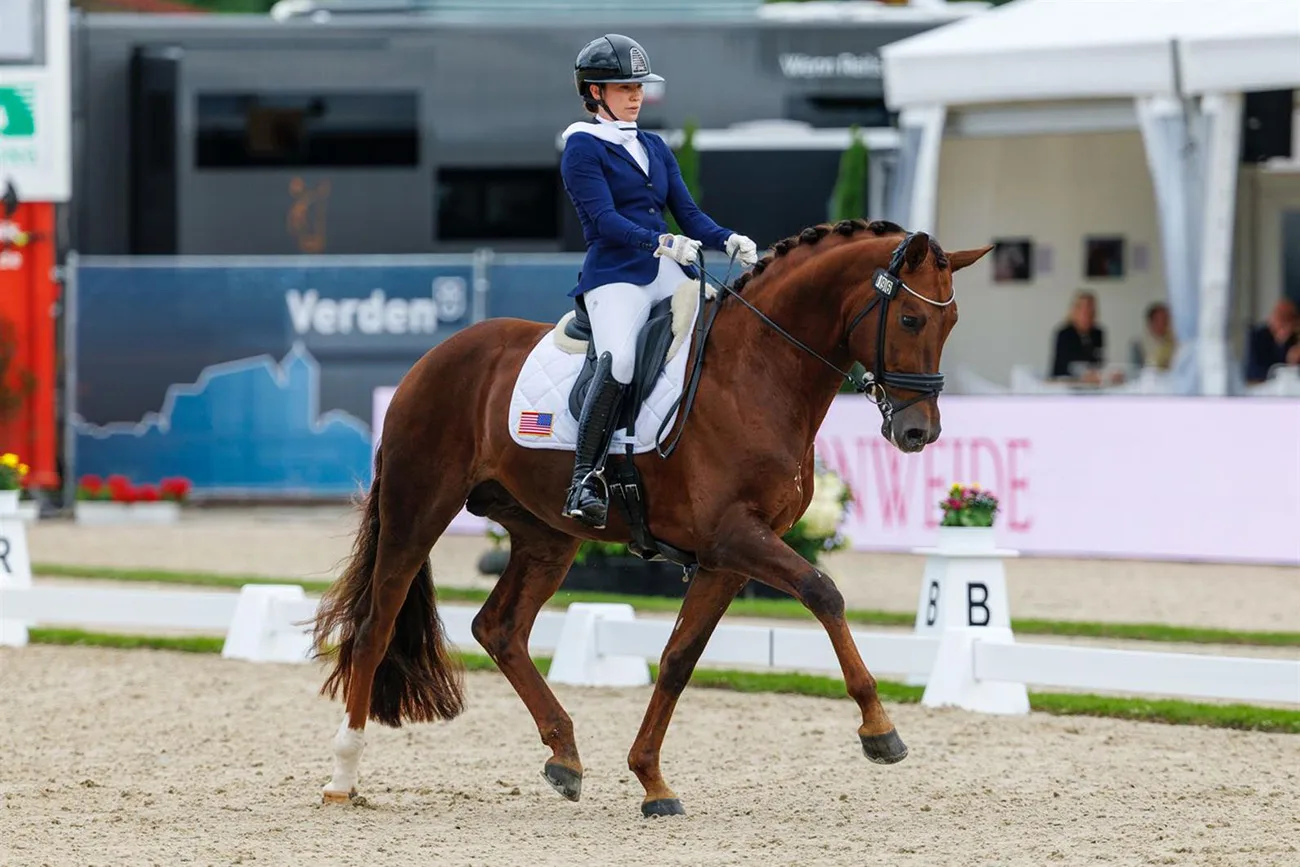
The pair made it to the 6-year-old finals, where they finished 12th on a score of 82.40% behind winners Dinja Van Liere and Red Viper of the Netherlands (90.40%).
Cooper, 28, admitted to being nervous on the first day of competition, representing her country for the first time since her U25 years. But she needn’t have worried; Ollie was thrilled to find himself in front of the knowledgeable, enthusiastic German crowd.
“He really feels like, the bigger the crowd, the better for him,” Cooper said. “We do a lot of talking in our sport about, do the horses love what they do? What are we asking of them? And I have to say, showing a horse like that, especially in front of a big crowd, it makes me feel like he absolutely loves his job. He just showed up and was like, ‘I’m showing off, whether you asked me to or not.’ He really did the job for me, even as a 6-year-old.”
Their Day 1 score of 83.40% put them in 12th place out of 40 entrants and qualified them for Saturday’s large final—a rare accomplishment for a U.S. pair at the world young horse championships. That confidence-boosting placing gave Cooper a whole different mindset for the final, she said.
“I was just over the moon,” she said. “On the last day, we really were able to just show off, because I feel like I was less nervous, I was more confident, and I was just like, ‘We’re both meant to be in here.’ ”
As a rider and trainer, Cooper said the experience of competing against the best in the world, in front of a large, supportive crowd, was something she’ll carry forward with her.
“It was totally an honor to be competing in that stadium, and also with the caliber of horses and riders that were there,” she said. “To have that many people in the stands, it really makes you feel like the sport is so appreciated for what it is, and the beauty of it, and the harmony between horse and rider. I really feel like the people in the stands really appreciated that; it was just an atmosphere of love for the horses and love of the sport.”
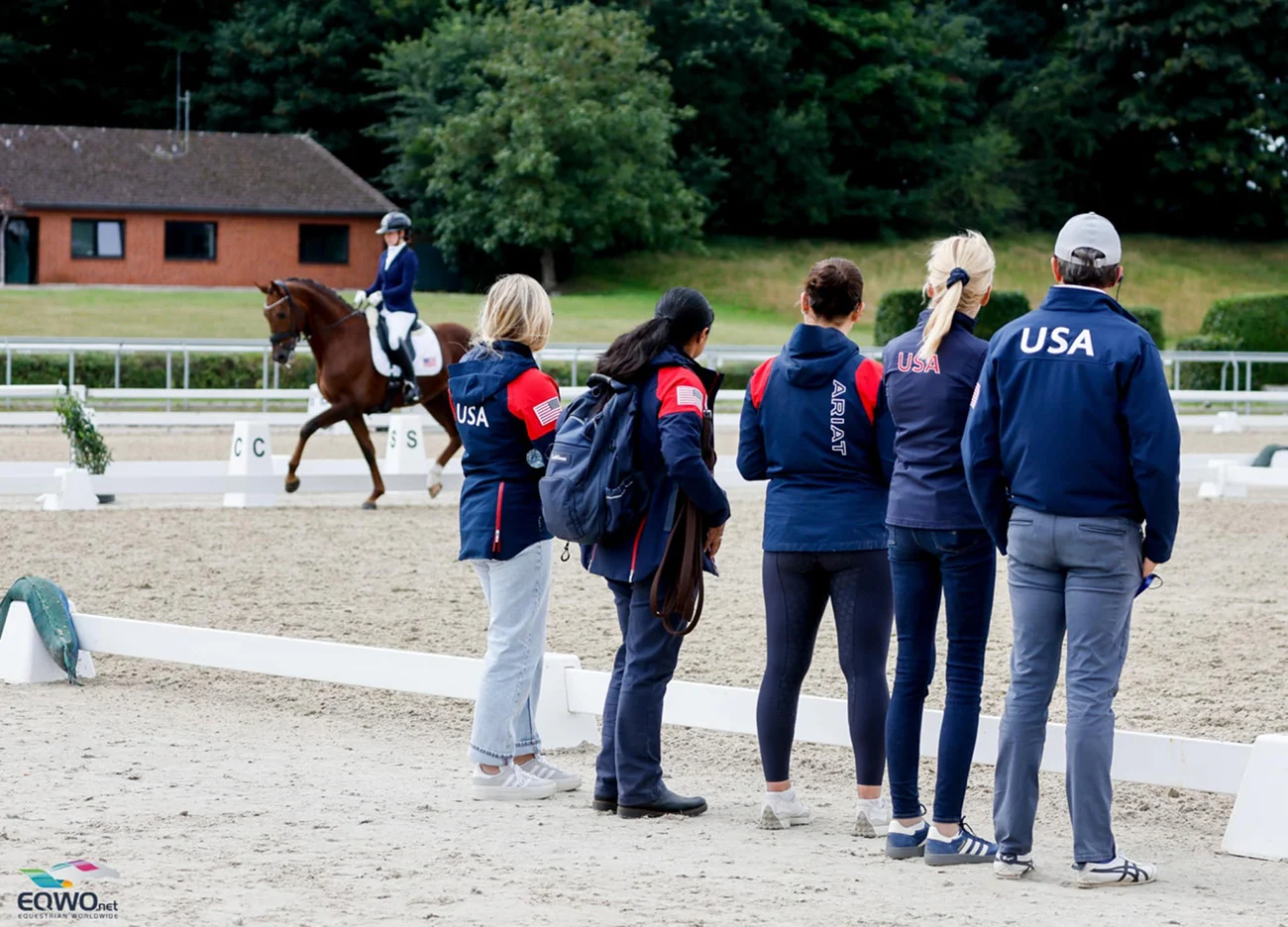
Cooper hadn’t previously had the chance to campaign in the FEI young horse classes much and saw the opportunity to go to Verden as a steppingstone in her own and Ollie’s career.
“I have had a few 4-year-olds in my career so far, and then it wasn’t the focus, and then some of the more successful horses that I’ve had are honestly horses that didn’t come with any training but were kind of older,” she said. “Maybe they had a change or something, but they were bought for like, a third level adult amateur, and then it kind of turned out as they learned the rest of the work that they were talented in the Grand Prix work.
“I haven’t had an opportunity like this before, with a horse like this and a family that’s this supportive,” she continued. “I think that’s a key thing in the sport, is that we have really supportive owners, too, and I am just beyond appreciative to them to let me have an opportunity like this.”
When Cooper got the ride on Ollie, she wasn’t sure what their goals would be, but with help from her trainer, German Grand Prix rider Christoph Koschel, and her mother, Grand Prix rider Jane Karol, the pair started racking up top placings and scores.
“We were expecting to have fun and to go out there and see what happened,” she said. “And then he really blew us out of the water. We started a little bit in the national ring. It took me a second to sort of figure out how much to ask in the ring, because he can be a hotter horse. And then once I sort of figured out and built a relationship with him, we went into the CDI ring and seemed to really get rewarded for how willing he is. He has three really good, correct gaits, and he’s just strong in his body in a really nice way. There’s no extra riding that I have to do in the arena. He’s just attentive and happy to go with very little aids and questions.”
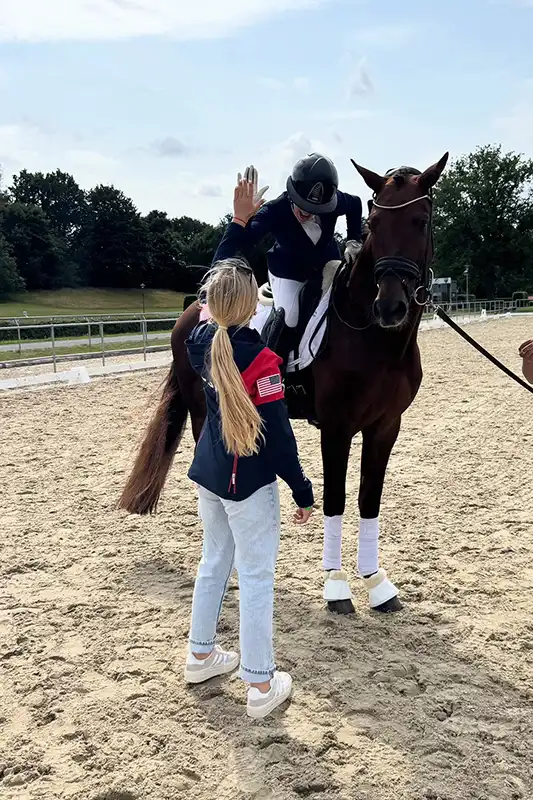
Roffman got to know Cooper over the past year. She’s been following their progress closely and is thrilled with their accomplishments.
“She was the first to reach out to me and tell me what a great horse it was and how great of a job we had done producing him,” Roffman said. “Then we just kind of bonded and stayed in touch. What’s better than to root on a horse that you believe in, and a rider that you know is making it happen?”
Roffman and her team got Ollie when he was 2 and backed him. Sometimes they’d play bridleless or bareback. “He was a really good boy,” said Roffman. “It’s funny because he is of a bloodline that a lot of people are very superstitious about. He comes from a horse called Charmeur, and if you ask most people, I think they would tell you Charmeurs are very difficult, and [Ollie] really was not, even as a stallion.”
Cooper is very appreciative of the job Roffman and her team did with Ollie. “It’s a real testament to her and her program and how she trains horses and the level of confidence that Ollie had coming up as a young horse,” she said.
“It’s nice when the horse has such nice basics, and you can just sort of make him your own, tune him to your own feeling and train him the rest of the way up the levels.”
Cooper describes Ollie as a goofy type on the ground.
“Once he has the relationship with you, he is just beyond willing to go above and beyond what you’re asking and try with his whole heart every ride,” she said. “He genuinely seems like he loves the work. He’s just a funny guy. He always has a sense of humor. He’s very confident. He’s maybe over-confident a little bit. He’s just always adding his flair a little bit into learning new things but always so willing.”
In the barn, groom Josie Zeeb and Cooper are the horse’s primary caretakers. Cooper also credits her former groom Paul Harmon, who recently retired, with keeping the stallion happy.
“Josie does a fantastic job with him,” said Cooper. “He’s a little bit cheeky in the barn sometimes, but in a very funny way. He loves his paddock. He loves being a horse during most of the day, and then he really loves his people and being groomed.”
A Strong Start
Cooper and her mother are based at their Bear Spot Farm in Acton, Massachusetts. Cooper grew up immersed in dressage and was exposed to different ways of teaching as Karol is both a competitor and a doctoral-level psychotherapist with an equine-assisted psychotherapy program.
As she got serious about dressage, Cooper had a series of hand-me-down horses and ponies from both Karol and her lesson program. Her first FEI horse was Don Diamond, an Oldenburg gelding (Don Gregory—Reine Seide, Rohdiamont) who took her to the FEI North American Junior and Young Rider Championships in 2013 and 2014 and then on to the Under-25 Grand Prix division.
Cooper also got the ride on Mary Mansfield’s Hot Chocolate W, a Hanoverian gelding (Hochadel—Pikolina, Pik Senior) who took her from the U-25 Grand Prix to her first CDI3*s and CDI-Ws. With the gelding, she was able to spend time training in Germany with Koschel, and she also trained with Isabell Werth for a few months.
“Mary called [‘Chocolate’] her grandma horse,” said Cooper. “Mary just wanted a very sweet, safe horse to ride. And he also came maybe a little more educated than ‘Diamond.’ He had, like, a single change and some beginning work of some other things, and we really meshed. He learned so fast. I don’t even remember how we did all of that work, but he was just so smart, and he caught on. Now he is a little bit of a therapy horse in our program; he mostly is in a paddock all day! And Mary still owns him.”

Cooper also got a chance to compete Flynn PCH, a Hanoverian stallion (Falsterbo 11—Walt Lady, Walt Disney I) who served as a schoolmaster for her in the open Grand Prix classes. He retired last year. “ ‘Flynn’ is one of those horses that you miss when you’re not with him,” she said. “I mean, really, they all are, but Flynn gave me my first experience with a stallion, and he’s just such a special horse you can’t even put it into words.”
Cooper attended Connecticut College where she triple-majored in behavioral neuroscience, dance and Africana studies. She recently completed an online master’s degree in organizational psychology from William James College (Massachusetts).
“I always just loved school and learning,” she explained. “Even if it’s on the side from the horses, I just think taking classes and broadening your world perspective makes you a better rider. So, I’ve sort of just tried to keep that going at the same time, even when it was online and part time.” Cooper sees her three undergraduate majors as connected in a way—trying to have a deeper understanding of the world.
She’s found her recent degree in organizational psychology to be useful in helping run Bear Spot’s program as well as her own. She teaches, rides and runs a group of about 12 staff members at the farm. She also keeps busy with a handful of competition horses, including Quintus G, an 8-year-old Westphalian gelding (Quartz II Adelheid Z—Cidra G) competing at Prix St. Georges, and Martina Rozumberkova’s Kenzo, a 10-year-old Dutch Warmblood gelding (Dream Boy—Uginia) competing at fourth level.
The mother-daughter duo is very close, though Cooper jokes there are sometimes disagreements.
“I’ve learned everything from her. She’s truly my best friend,” she said. “Doing this work together has always made us super close. And I love the way that she works with the horses—that it’s just such a broad understanding of the horses and their internal world and trying all the time to think more about what they’re thinking and feeling.
“Good horse people always do that, but sometimes with certain people, you can lose that a little bit in trying to get to the top of the sport,” she continued. “It’s always her No. 1 priority, that we’re understanding the mind of the horse and imagining what they’re feeling all the time, whether you’re trying to go for the Olympics or you’re just walking around on a long rein or brushing your horse. [The focus is] always getting out of our own selves and also listening to what the horses are telling us about ourselves.”
Cooper said her main goal in the sport is to be the best trainer and rider she can be and continue her education, but riding on a team for the U.S. is on her bucket list.
“Hope is really just kind, honest, funny, and she’s a team player,” said Roffman. “I really think she’s one of the good ones. She is humble and obviously is a good rider and is getting it done. She’s eager to learn, immersing herself with great people like her trainer, Christoph, and obviously her mom. But she really is a class act, and I’m lucky to call her a friend.”
With additional reporting from Melissa Wright
A version of this article originally appeared in the July 2025 issue of The Chronicle of the Horse. You can subscribe and get online access to a digital version and then enjoy a year of The Chronicle of the Horse. If you’re just following COTH online, you’re missing so much great unique content. Each print issue of the Chronicle is full of in-depth competition news, fascinating features, probing looks at issues within the sports of hunter/jumper, eventing and dressage, and stunning photography.
The post Cooper And O Romeo S Earn Rare Dressage World Young Horse Finals Placing For US appeared first on The Chronicle of the Horse.
]]>The post Throwback Thursday: Lana duPont ‘Did It Because She Loved It’ appeared first on The Chronicle of the Horse.
]]>In 1964, 25-year-old Lana duPont Wright became the first woman to compete in eventing at the Olympic Games, winning team silver and immediately etching her name in the annals of equestrian sport as a trailblazer. But she never saw herself that way, say the people who knew her best.
Instead of making the trek to the Tokyo Games focused on breaking a glass ceiling, Wright’s Olympic appearance was simply the natural outcome of her lifelong passion for horses and horsemanship—a passion she pursued with a level of drive and enthusiasm that raised the game of everyone around her.
“She had no clue what she was doing for the future,” said fellow Olympian Donnan Sharp, 86, of Unionville, Pennsylvania, one of Wright’s best friends since childhood. “She did it because she loved it, and she could do it. The thought of ‘look what she did for women,’ she had no inkling of.”
In fact, eventing was just one facet of Wright’s storied career in horse sport. She was also a lifelong foxhunter, and she went on to represent the U.S. on international teams in both combined driving and endurance. A strong advocate for U.S. Pony Clubs, she hosted the Middletown Pony Club at her Unicorn Farm in Maryland, and she provided mounts for countless children over the years.

As an organizer, Wright was responsible for coordinating, designing and building for equestrian competitions ranging from local paper chases to horse trials to international combined driving and endurance competitions, often on her own farm. Wright was somewhat famously unassuming, humble and reticent to talk about herself, but when she died in April at age 85, she left behind a legacy of excellence and service to equestrian sport that continues to benefit future generations and inspire those who knew her.
“She was such a big deal,” said Diane Trefry, 75, who was Wright’s team manager for over 50 years. “She was such a gentle professional with her horses. If you watched her ride or drive, she was very precise, and kind to them, but she also took no nonsense. She never bought something that was made. Part of her pleasure and joy was to make a horse herself. She was hands-on.
“Every horse should have a job, in her book, and every kid who wanted a pony should have an opportunity to ride a pony,” she continued. “She took van loads of ponies to Vermont in the summer, and the Pony Club kids could go and do an event. Many kids were the recipients of that, and she made so much happen for Pony Club, through gifting her own horses and giving lessons. She was just very generous. What she had, and what knowledge she had, she shared.”
From Foxhunting To The World Stage
Wright and Sharp lived near each other as children and soon bonded over their mutual love for ponies and riding. The pair spent hours hacking out in the countryside together, unencumbered by rules, adults, or real-life responsibilities. Both young women loved to foxhunt, first with the local Vicmead Hunt Club in Delaware, then later with many of the prestigious Virginia hunts, including Orange County, Piedmont, Old Dominion and Blue Ridge.
Foxhunting remained a lifelong passion for Wright, and the skills both women gained in the hunt field set them up for their early encounters with the sport of eventing as young adults. It was Wright who first learned about the sport—then new to civilians—as a preteen while studying at Oldfields School, an all-girls boarding school in Maryland.
“The coach who was there at the time had just been exposed to eventing, so he got all the Oldfields riding people interested,” said Sharp. “Lana got involved, and for the next three years, just kind of played around with it at school.”
When the girls graduated in the late 1950s, both skipped college in favor of pursuing their equestrian goals. By then, eventing had caught their interest. Riding across country came naturally, thanks to their years in the hunt field, as did show jumping—but the dressage phase proved more problematic.
“Neither one of us had a clue,” says Sharp. “We’d read a few books, but we didn’t really know what the heck it was all about. That’s when we became involved with Richard Wätjen.”
Wätjen, a highly accomplished German dressage trainer who had previously trained and taught at the Spanish Riding School in Vienna, immigrated to the U.S. in the late 1950s to work with Karen McIntosh at her family’s Sunnyfield Farm in Bedford, New York. At the time, there were few coaches specializing in dressage, making someone with Wätjen’s skill and experience invaluable.
“We found Wätjen was the guru to go to for this peculiar dressage event,” said Sharp with a chuckle. “We took a couple of foxhunters up there, in hopes he could teach us something.”
It wasn’t long before the foxhunters were back in their stalls, and Wright and Sharp were learning dressage basics on trained schoolmasters. But Wätjen quickly discerned that both women were truly interested in learning and had bigger goals than simply riding circles at home. When Sharp and Wright were invited to train with the U.S. Equestrian Team in Gladstone, New Jersey, in the early 1960s, Wätjen accepted the women’s invitation to join them. It was a move that proved fortuitous to the success of riders on the nascent U.S. eventing and dressage teams, many of whom worked with Wätjen until his death in 1966.
Meanwhile, in 1958, the friends hosted the first Vicmead Horse Trials in Delaware. It offered just two levels, novice (now preliminary) and advanced, and it attracted only eight entries. The competition was significant not only because it was the first of many that Wright would go on to host and organize in her career, but also because in its second year, the Canadian squad entered it as a final prep for the 1959 Pan American Games in Chicago.
“We really beefed it up,” Sharp recalled with a laugh. “Wätjen even came down to judge dressage.”
Seeing some of the best amateurs in the sport compete at her own event was the first of several fortuitous occurrences that helped set Wright up for an Olympic bid just four years later. She and Sharp took great inspiration from spectating at both the Chicago Pan Ams and the 1960 Olympics in Rome; along the way, they also attended a meeting in Illinois that would result in the creation of the U.S. Combined Training Association (now the U.S. Eventing Association). And around the same time, a special partnership began to solidify between Wright and a somewhat quirky homebred Thoroughbred of her mother’s, Mr. Wister.
Though bred for the track, “Wister” wanted no part of that lifestyle. He dumped all his jockeys; he often refused to enter the starting gate. Though he did eventually run a handful of times, it was with modest success. Wright took over the ride when the rangy gelding was 3 or 4 years old.

“I’m not sure what she saw in him, except he was a gorgeous, big-boned Thoroughbred,” said Sharp. “She had quite a tussle with him. It took her a summer to be able to stay on and get him to be manageable. But he caught on quickly that this might be OK, and there was obviously a great rapport between the two of them. He went on to do anything for her, which in itself is a pretty good story, having seen him from day one.”
Wister and Wright trained for several years at Gladstone, then in 1963, went to England to train there as a final preparation before attempting the Badminton Horse Trials, where she placed 10th. Sharp, who married U.S. eventing team stalwart Mike Plumb in 1964, remembers that during their time with the team, no one thought them less capable for being women.
“No one was really thinking, ‘Oh, girls can’t do this,’ because there were girls out there competing,” said Sharp. “The boys had gotten used to us girls competing against them at the national level, and they were fine with it. It’s just the rules [for the Olympics] didn’t allow it.”
By the time the rules did change, before the 1964 Tokyo Olympic Games, Wätjen had convinced Sharp to focus exclusively on dressage, and she went on to help the U.S. win team silver at the 1967 Pan Ams (Winnipeg) and rode on the team at the 1968 Mexico City Olympics. But Wright, bolstered by her success with Wister, stuck with eventing.
“Lana hung in with the eventing because she had this awesome horse,” said Sharp. “She battled it out, not really aiming for the Olympics but aiming to do the best she could do at all the events. So she eventually out-rode and out-performed everybody, and when the rules changed, they took her on. We didn’t have a very strong group in those days, but the horse—and Lana—legitimately made the cut. She may have been the only female, but she wasn’t an oddity, because she could do the job.”
On endurance day at the 1964 Olympics, it poured and poured, and the horses churned the footing into a deep muck. By the time Wister and Wright headed out on cross-country, conditions were poor, and the pair fell not once but twice on course. Unbeknownst to anyone, Wister had broken his jaw in the first fall, but he seemed game to continue. Sharp happened to be standing nearby when the pair fell the first time, and she gave her friend a leg up back into the saddle.
“She was a mess, and can you imagine, a horse with a broken jaw, and went on anyway,” says Sharp. “Obviously, we can’t get away with that anymore. But she got around.”
In an oft repeated quote, Wright recalled her Olympic cross-country experience as follows (here from the “U.S. Team Book of Riding”):
“When we finished, we were a collection of bruises, broken bones, and mud. Anyway, we proved that a woman could get around an Olympic cross-country course, and nobody could have said that we looked feminine at the finish.”
“No one was really thinking, ‘Oh, girls can’t do this,’ because there were girls out there competing. The boys had gotten used to us girls competing against them at the national level, and they were fine with it. It’s just the rules [for the Olympics] didn’t allow it.”
Donnan Sharp
Maybe not, but that finish nonetheless broke down a door that other women were waiting impatiently behind.
“She was our friend, and she had made it to the top, and we were thrilled to be part of it,” said Sharp of Wright making eventing history. “But England had all these girls who should have been on their team, and they were banging on the door. It was an evolution, I think, more than Lana having done it. [Women in Olympic eventing] had to happen, and good for the U.S., to let it happen.”
Those Olympics, where Wright and her teammates earned the silver medal, were essentially her swan song at the elite level of eventing. Not long after, she left the team, married and started a family. But she was far from done with horses.
Driving Into The Future
Trefry first met Wright when she was working for her mother, the acclaimed Thoroughbred breeder Allaire duPont, at Woodstock Farm in Maryland. It wasn’t long before Trefry was giving riding lessons to Wright’s young daughters, and soon, she moved over to work at Wright’s Unicorn Farm—contiguous to Woodstock—full time. She stayed for five decades.
“She became more than an employer to me,” said Trefry. “She was my friend, she was like my sister, and she called us a team. And we were a team; we did everything together. It’s been wonderful, and I had a great life because of her. All I ever wanted to do was be around horses, and she made that happen for me.”
As her children grew up and moved on to larger horses and other pursuits (her late daughter Beale Morris was short-listed for the 2000 Sydney Olympic eventing team), Wright amassed a small collection of ponies. With her philosophy that “every horse needs a job,” Wright soon began using them to learn how to drive. One auspicious day, she and Trefry spectated at a combined driving event in Pennsylvania.
“We watched Clay Camp with his four-in-hand drive over the top of a log in the marathon, and we were like, ‘We want to do that!’ ” remembered Trefry. “That’s how we got started.”
Using a trio of related Connemara-Thoroughbred geldings—Greystone Sir Rockwell, Greystone Sir Oliver and Greystone Billy Moon—Wright pursued her new sport with the same zeal she embraced anything horse-related. In training her driving horses, Wright applied the many dressage lessons she had learned decades earlier from Wätjen, schooling the horses both under saddle as well as in harness.
“Back in the day, people weren’t such big riders of their driving horses,” said Trefry. “That was a bonus for her, because they got a lot of dressage work under saddle. Her eventing certainly contributed to her driving.”
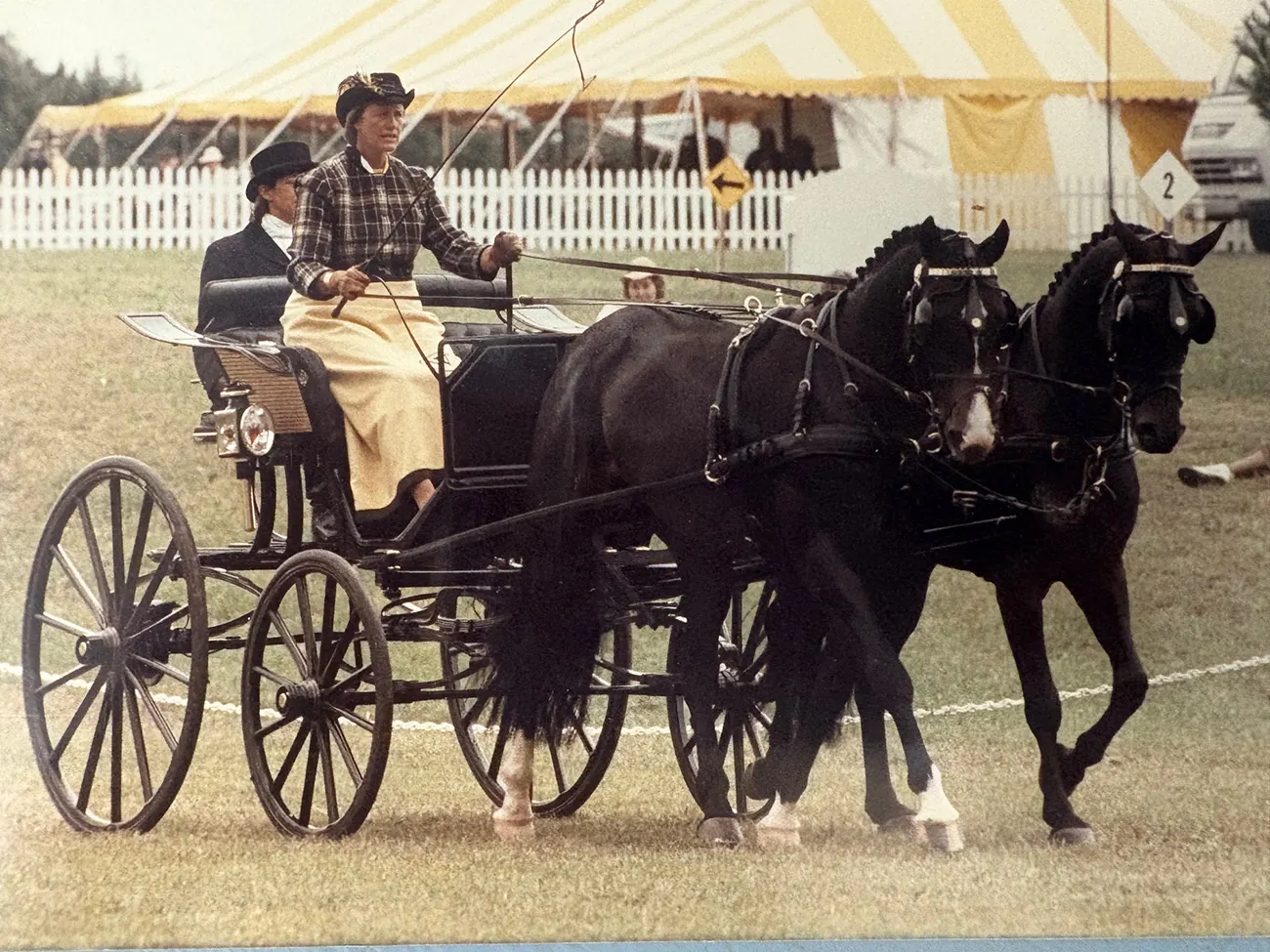
Trefry soon found herself coordinating trips to Europe for horses, carriages and more.
“My strong point was doing the paperwork and the organizing of all that—she was the ‘get out there and know the horse and do the job,’ side of it,” said Trefry with a laugh. “Paperwork was never her strong suit. She was interested in being outside, loving the outside, and loving animals.”
Soon, Wright and Trefry began organizing driving events. Wright designed the hazards personally, and she helped Trefry and others with their construction. She often used her signature yellow and gray jeeps like they were bulldozers. One time, she overheated her Jeep after hay got into the radiator when she was using it to push 450-pound bales onto a dump truck to make a hazard.
“It was so rewarding to her, to design these obstacles so that people would really need to think,” said Trefry. “She put so much thought into it, and people always said they really appreciated her designs. She was a bit of an artist and creator that way.”
In 1991, Wright and her Connemaras competed at the Pairs World Driving Championship in Zwettl, Austria, where the U.S. team earned its first gold medal in history. The victory, in some ways, meant more to Wright than her groundbreaking Olympic appearance, recalls Trefry.
“When she got her medal in the Olympics, she didn’t feel like she earned a medal, even though she did a great thing for women in the sport,” said Trefry. “She never credited herself with earning the Olympic medal [because hers was the drop score].
“When she did the driving—and in each section she earned a place—that medal meant the world to her, because she felt she’d earned it,” she continued. “She didn’t take anything for granted. She worked hard, every day, for everything. Winning that medal was rewarding for her—that was a dancing-on-the-table moment.”
“When she got her medal in the Olympics, she didn’t feel like she earned a medal, even though she did a great thing for women in the sport. … When she did the driving—and in each section she earned a place—that medal meant the world to her, because she felt she’d earned it.”
Diane Trefry
Wright took particular pleasure from the process of conditioning a horse for his job, and she did most of this work herself. She was dismayed that sports she loved—including eventing and combined driving—changed their formats in recent years to reduce the emphasis on endurance.
“It was kind of sad for her, as time progressed and those things were taken away, because conditioning was so rewarding for her,” said Trefry. “So the 100-mile endurance was really the next step.”
Wright, who had previous experience in shorter endurance and competitive trail rides, made her 100-mile endurance debut in Vermont riding a purebred Connemara stallion—and she quickly learned that he wasn’t the right mount for the job. And that was how Wright, a devoted Thoroughbred lover who had once quipped that “she would never have an Arabian come down this driveway,” had to “eat her words,” according to Trefry.
“We joked with her a lot about that,” said Trefry. “After the ride in Vermont, she said, ‘I guess we need an Arabian.’ So we went out and got an Arabian. It didn’t take her long to figure out there are horses that are really bred for it.”
Wright and LL Stardom were selected for the 1999 Pan Am Games in Winnipeg, Manitoba—even though she never specifically verbalized that as her goal—and yet again Wright found herself representing her country on a championship team, in a third sport.
“That’s just the way she was,” remembered Trefry. “Everything she did, she reached for the stars—and she usually reached them.”
A Tradition Of Excellence, Shared
Though Wright may never have set out to be a role model for other women in equestrian sport, her commitment to excellence and success in anything she set her mind to helped shape countless horsewomen—including those who never had the opportunity to meet Wright in person.
“She made things happen, and if she said it was going to happen, she was going to make it happen one way or the other,” said Trefry. “She was an amazing motivator. A person might say no to you or me, but she always managed to get that easy yes. She would never ask you to do something she wouldn’t do. She got down in the trenches, she dug the post holes, she marked the courses.”
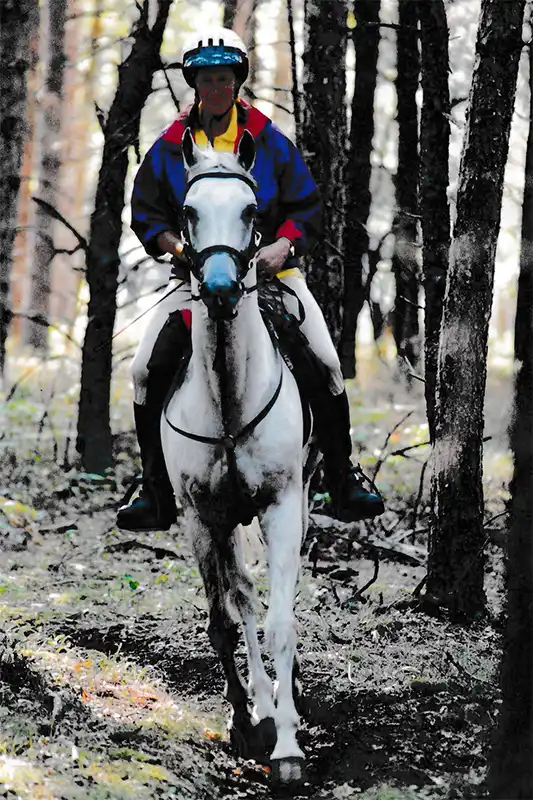
Five-star eventer Sharon White was a teenager when she first met Wright through her daughter Beale. The family embraced White, offering her experiences that changed her life and the arc of her professional career.
“I was so unbelievably lucky to have met them—it’s like you don’t know what you don’t know, and I just happened to end up at an eventing barn when I started riding lessons,” says White, 51, of Summit Point, West Virginia. “I basically knew nothing, and then to be put into Lana’s hemisphere, into her world, was huge. I pride myself on my horsemanship, and so much of what I know I learned from her. Lana has got to be one of the best horsewomen I have met in my entire life.”
White spent time at both Unicorn Farm and Wright’s summer residence in Reading, Vermont. In each place, Wright guided the young people in her orbit, often without saying much at all.
“Lana had a very distinctive voice, and I remember it would get so bemused when I would do something [wrong],” recalled White. “She would say, ‘I don’t know what you’re doing, Sharon.’ She never meant it to be this way, but you knew you were doing something stupid. She was so cut and dry.
“But she was never one to make you feel like you were in the presence of all she had done,” she continued. “She was always so approachable in anything that had to do with horses or horsemanship, and so thoughtful, so dedicated to it. You just felt like she cared so much about the horses, that you could ask her anything about them. It would really matter to her.”
Suzy Stafford made history of her own in 2005 when she became the first U.S. combined driver to win an individual world championship, but as a junior, she was an eventer and a member of the Middletown Pony Club. A serious riding accident in her late teens meant that a professional riding career was no longer in the cards, and it was Wright who helped Stafford start in driving.
“She was certainly an inspiration, and a force to be reckoned with in anything she did,” said Stafford, 48, who is based near Fair Hill, Maryland.
“It was always two hundred percent or nothing. In that sense, being around her at the farm, it was certainly influential in my experience in driving. Watching someone with that level of drive and talent and experience was very inspiring to me.
“She never thought anything she did was special, or significant, or anything like that,” she added, “it was just how she carried on her day: We train horses. We go and win medals. That’s just what we do.”
Stafford remembers that Wright held everyone to the same high standard, and she wasn’t afraid to call someone out if a detail was amiss. But in doing so, she showed each person they were capable of more than they thought.
“It’s rare to find someone with the high standard she held for herself and the people around her,” said Stafford. “In a sense, those were the most important lessons she taught.”
While Wright may continue to be best known for her historic Olympic appearance, perhaps she would prefer to be remembered for her many and varied contributions to equestrian sport, from the grassroots level up.
“She wanted everyone to get the rewards she got,” said Trefry. “She got medals. But she gave way more to the equestrian world than she ever took from it. And she took pleasure from doing that, as well.
“It was about teaching everybody to enjoy the horse, at the lowest level, the medium level, or the highest level—whatever is for you,” she continued. “It made no difference. Anything to enjoy the horse, and learn to care for the horse, and the importance of the horse. For Lana, it was really about appreciating, enjoying, and making the most of your horse or pony, no matter what he was.”
This article originally appeared in the July 2025 issue of The Chronicle of the Horse. You can subscribe and get online access to a digital version and then enjoy a year of The Chronicle of the Horse. If you’re just following COTH online, you’re missing so much great unique content. Each print issue of the Chronicle is full of in-depth competition news, fascinating features, probing looks at issues within the sports of hunter/jumper, eventing and dressage, and stunning photography.
The post Throwback Thursday: Lana duPont ‘Did It Because She Loved It’ appeared first on The Chronicle of the Horse.
]]>The post Emergency Preparedness Planning: Don’t Wait Until It’s Too Late appeared first on The Chronicle of the Horse.
]]>Immediately, the couple sprang into action. Katharine soaked their two barns with a hose, then they grabbed halters from a well-organized rack and moved all of their equines from the track system that lines the edge of their property into a centrally located round yard. This area, made of pipe panel fencing and purposefully kept free of flammable material, provided a secure and relatively fire-proof place for the animals to stay while the blaze was extinguished. By the time wind-blown embers began melting through the electrical tape on the track system, the entire herd was safely relocated, and the doused buildings did not ignite—meaning Katharine and Mark could concentrate on putting out flames elsewhere.
“It was just the two of us there that day, and it went like clockwork,” said Katharine. “We knew which horses were the leaders, the horses the others would follow. Once we had everybody in the round yard, we could start pouring water in the bucket of our big tractor and dumping it on the fires burning on our fences.”
Katharine knew firsthand that without a plan, the outcome that day could have been different. Decades ago, she ran a riding school in northern New Mexico where she cared for 14 horses housed in a traditional wooden barn. One day, a large brush fire that had already blazed through three counties began to approach the property, and Katharine had no choice other than to set the horses loose and hope for the best. Fortunately, all of the animals, including a mare and foal, survived—but she knew they had been extremely lucky. When Katharine had the opportunity to design her new sanctuary from scratch, she did so with disaster-planning in mind.
“It was one of my more terrifying experiences,” Katharine said of surviving the previous fire. “But because I’d been through that, when we were planning here, everything I could think of, we tried to cover and be aware of. Because there is nothing more frightening than not being able to keep your horses safe. We’ve written it up in our evacuation and emergency plan.”
For many equine managers, emergency preparedness planning can feel like a daunting project. Emergencies often develop quickly, and when you have no plan at all, a safe outcome becomes much more difficult.
“When we are in an emergency, we don’t rise to the occasion; we fall down to the level of our preparation, and that is especially true when animals are involved,” explained Bettyann Cernese, a Pepperell, Massachusetts-based certified Equi-First Aid USA instructor who teaches courses on equine facility disaster planning across the country. “We need to have some level of preparedness, because disasters don’t send a warning.”
But there are resources available to help facility managers and owners craft plans uniquely suited to their needs. While we can’t predict every eventuality, knowing the type of incidents most common in your area, identifying and acquiring the necessary resources, and practicing in advance can all help you safely weather the worst of storms.
Know Your Opponent
The first step in creating an emergency preparedness plan is to determine the top three natural disasters or other incidents most likely to affect your area.
From there, evaluate the topography and logistics of your property to identify how these types of events are likely to affect you, and make a list of what would need to happen to mitigate those variables. Are you located in a floodplain on the Gulf Coast that will most likely require evacuation in a hurricane? Are you in a region that frequently experiences high winds, meaning that buildings and equipment storage need to be rated accordingly? Are you in an area that receives heavy snow, and need to plan for clearing loads off roofs in the winter? The types of hazards most often seen in your region will dictate the type of response you need to be prepared to launch.
“We hear about all these disasters happening all over the world, and it’s overwhelming,” said Cernese. “We focus on helping people pick the things most likely to happen. Tailoring the plan to local risk is essential. A barn in California should be preparing for wildfire, and one in Vermont for blizzards and flooding. It’s not a one-size-fits-all situation.”
But planning for the most common natural disasters in your area will also set you up to respond to unique or unusual events that may impact your facility, such as a lightning strike, a barn fire or a lost horse. Traci Hanson is the equine program director for the Global Federation of Animal Sanctuaries, an Arizona-based group that offers certification to organizations around the world caring for equine and other barn animals or wildlife species. All GFAS programs must complete a disaster preparedness plan as part of their certification process, and in doing so, members become ready to handle anything from an escaped animal to a human health emergency to civic unrest.
“We focus mostly on natural disasters, like wildfires or floods, but a lot of the steps taken to prepare for these incidents can apply to other disasters,” said Hanson. “It is about trying to get groups to think ahead, plan ahead, and think about what they can do to get ready.”
When Disaster Strikes
When it comes to navigating a natural disaster, experts share that your emergency preparedness plan needs to be flexible and able to address three different response modes: shelter in place, local evacuation, and long-distance evacuation (see sidebar). Each option comes with its own considerations and planning requirements.
Making the decision to shelter in place is contingent on there being a safe location on the property for human personnel to ride out whatever is occurring, as well as space to store sufficient resources (such as feed, medical supplies and water) to get through a minimum of seven to 10 days. Among these resources, accessing water can quickly become the most critical.
“If you lose power, how will you get water?” said Hanson. “Is there a generator available, or are there ways to collect water prior to the event? We don’t require our groups to have a generator, but we do require they have an alternative, whether that is a cistern or permanent or mobile holding tank.”
When a significant weather event is bearing down on your region, deliveries may be delayed or suspended, making it impossible to stock up on your horses’ essentials. Hanson notes that it is best practice to not let consumable supplies, such as feed, run too low before ordering more.
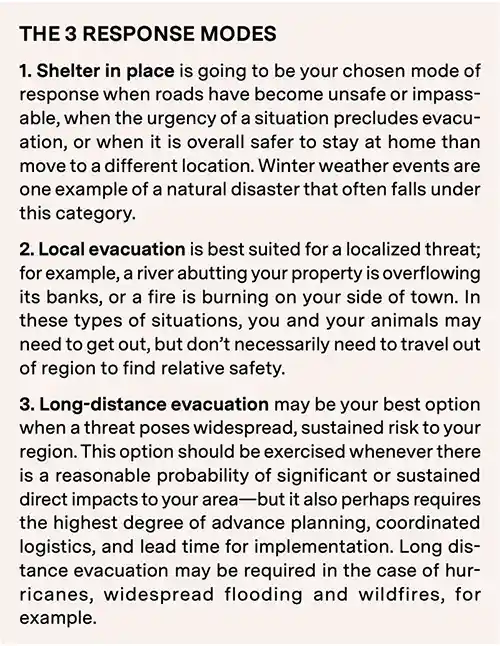
“Don’t wait until your inventory is nearly depleted,” Hanson said. “Say you know 10 bales of hay gets you through five days. Re-order when you get down to five bales, so you have that on hand in case of emergency.”
If you choose to shelter in place, communicate that decision with others—both in your local area, and further afield.
During emergency conditions, internet and phone services are often impacted, and it may not be possible to call for help if conditions deteriorate. Pre-planned emergency contacts who will know that you are still on site can reach out to rescue teams on your behalf for a welfare check if communication is lost.
When it comes to coordinating a successful evacuation—whether local or long distance—pre-identifying critical resources, including both equipment and personnel, is essential. In most cases, you will need access to trailers and pre-arranged locations set up to receive your animals, as well as familiarity with several routes to get there. Tow equipment and trailers must be kept tuned up, gassed up, and should be hitched and loaded with supplies even before the final decision to evacuate is made. Know who you will call to drive a second rig, or who can come to your farm to help you load up.
“You need contingencies for road closures and power loss,” said Cernese. “How many animals do you have, and how much trailer space do you have? If you leave to take some out because you don’t have enough trailer space, how are you going to get back if the roads are closed?”
If you are going to evacuate, you need quick and easy access to each horse’s medical paperwork, including Coggins test and vaccination records, as well as registration papers (if relevant), which can aid in identification. Experts recommend storing these items in paper form in both your tow vehicle and trailer, as well as saving them digitally.
If you are not sure where to start in terms of finding shelters set up to receive large animals in your region, consider contacting your local fire department, veterinary clinics, agricultural extension offices and large-animal savvy neighbors. Further, don’t be afraid to tap into your extended network to locate the resources you need. When designing the Dharmahorse Equine Sanctuary emergency preparedness plan, Katharine invited the local fire marshal for an on-site visit to discuss specific liabilities.
“We talked about storage of flammable materials, wiring in buildings, even what the different color of the fire hydrants meant in terms of the amount of water that comes out of them and which water system they belonged to,” said Katharine. “We talked not just about what to do if a fire comes to you, but how to make it so a fire doesn’t start at your place. He was a great help to me.”
“Even if you are a single barn owner, you need to be connected to facilities in other locations,” noted Cernese. “And if you are a large facility, you still may need to connect with the wider farming community to have assistance with your animals.”
“Every group we work with is a different size, has a different number of horses, and may have different resources available to them,” added Hanson. “For example, maybe they have a donor with land on the other side of town available to shelter horses. But one of your resources could be a neighbor down the road, who has certain equipment and is willing to make it available.”
Regardless of which mode of emergency response you choose, it is smart to individually identify your animals in some manner for the duration of the event. Microchips provide one permanent option, but experts recommend also having a more visible form of identification available for immediate use. Livestock markers, made of a non-toxic, waxy material, often in a bright neon color, can be used to write a phone number on each horse. Some people braid ID tags containing the owner’s contact info into their horses’ manes and tails. Digitally store recent photos of each animal, noting any unique markings, scars, or brands, to assist in proving ownership.
One final, but often overlooked, step is to develop a relationship with your local or state level animal rescue or response team. These groups can have different names depending on where you are located, but should pop up on an internet search. Often, they will have tools available to help you create a plan specific to your region and can help you to identify relevant resources.
Further, when a coordinated emergency response from governmental agencies is required, there is a specific protocol for the deployment of official resources that must occur. If you have a previous relationship with your local or state-level animal rescue team—and they know where you are located, and the number and type of animals you care for—they will be better positioned to get you the timely help you need as part of that coordinated response.
“The key is to not wait until disaster strikes to connect with those people and organizations,” said Cernese.
Practice Makes Perfect
The best written and thought-out plan will do no good if those responsible for executing it are not intimately familiar with each of the steps involved. Not only should your plan be publicly posted and shared with key players—including local emergency responders—experts recommend holding practice drills at least once, if not twice, a year, inviting anyone and everyone who might be called on in an emergency.
“If you have a big facility, and you’re not always there, do the people that are going to be there know your plan?” said Cernese. “Train all the people you possibly can. Do a walk through [to identify] what is working and what is not.”
There are several ways to practice putting your plan into action. Most models involve creating an imaginary scenario, with participants role-playing their response to each variable presented.
This can be done at the facility itself and using the actual equipment available, or as a “tabletop” exercise, using a large map of the facility on which people can point to where resources are located. Often, these drills highlight areas where improvement is needed, and they give planners the opportunity to make corrections, large and small.
“You can act the scenario out as if people are in their actual roles, or you can switch it up, which offers a new or different perspective,” said Hanson. “Another good way to practice is to remove a key person—maybe your barn manager, or executive director—the people everybody goes to for everything. Because if your barn manager is on vacation, and there is an emergency—what are you going to do?”
One excellent way to identify your plan’s weaknesses is to hold an unannounced practice. Instead of proceeding through your facility’s typical routine that day, a mock emergency is announced, and whoever is present is forced to put the emergency preparedness plan into action.
“Yes, it messes up that day, but it is imperative for your team to know, not just in words, what they need to do,” said Hanson. “When you’re acting it out, that’s where you’re going to find the things you didn’t think of. It’s not going to work exactly as you planned—so how do you tweak it? Who are your strong people, and do we need to reallocate those roles? It’s quite telling.”
“Having an emergency plan is not just about the equipment; it’s about being able to make calm decisions under pressure.”
Bettyann Cernese
When she facilitates a mock drill, Cernese sees a range of instinctive responses from participants, even when no actual emergency is occurring.
“We kind of do fight, flight, or freeze responses, or slow processing,” said Cernese. “Some people panic a bit. It really highlights why having situational awareness and emotional regulation is almost as important has having that plan on paper.
“Having an emergency plan is not just about the equipment; it’s about being able to make calm decisions under pressure,” she continued. “Our ability to regulate our own nervous system is one of the most important tools you can bring into a high-stress emergency with horses.”
If evacuation is part of your plan, one additional area of practice is to work with your horses enough that they will load reliably, under stressful conditions, even for someone they may not know. Familiarize your animals with being approached quickly as well as under unusual situations, such as after dark. Be sure to have plenty of appropriately sized halters and spare lead ropes available, at every entrance or exit to your facility.
Plan, Not Paranoia
After their experience with brush fire in 2022, the team at Dharmahorse made a few revisions to their emergency plan.
First, they added more gates to their round yard, so that it was more quickly accessible from anywhere on the property.
Secondly, they prioritized fundraising for a project that was already on their wish list: installing a water line with frost-free spigots around the entire facility.
“It will make you paranoid if you let it, thinking about all the things that can go wrong, but when we had that fire, we knew how to get the horses safe,” said Katharine. “For me, I would rather plan and not need it, than need it and not have planned. Knowing that we’ve been through this before, and it worked, makes me much more relaxed. It kept everybody safe, and it keeps you from panicking in the moment.”
Having a plan—and practicing that plan—can help give equine managers the confidence they need to make the best choices in an emergency, quickly.
“Hope is not a strategy: ‘I hope it never happens to me,’ ” said Cernese. “Having a plan in place isn’t about paranoia; it’s about protecting the lives of the horses we’re responsible for.”
This article originally appeared in the July 2025 issue of The Chronicle of the Horse. You can subscribe and get online access to a digital version and then enjoy a year of The Chronicle of the Horse. If you’re just following COTH online, you’re missing so much great unique content. Each print issue of the Chronicle is full of in-depth competition news, fascinating features, probing looks at issues within the sports of hunter/jumper, eventing and dressage, and stunning photography.
The post Emergency Preparedness Planning: Don’t Wait Until It’s Too Late appeared first on The Chronicle of the Horse.
]]>The post Caring For The ‘Super Senior’ appeared first on The Chronicle of the Horse.
]]>Broadly speaking, caring for geriatric horses will require greater attention to managing dental health, ensuring nutritional needs are being met, maintaining a healthy body condition, and watching for symptoms of several common endocrine disorders. Many times, these issues intersect, and when a horse begins to experience challenges in one area, related problems can follow. Additional concerns include arthritis and pain management, housing considerations, and herd stress.
Increased Need For Dental Care
Equine teeth continuously erupt throughout the course of a horse’s life, meaning sometimes they quite literally outlive the amount of tooth available in their jaw.
Over time, this can cause an array of dental problems, including loose, cracked or lost teeth; a dramatic reduction in available grinding surface on the molars; and the development of diastemata, spaces between the teeth that can become packed with feed particles leading to secondary infections. Geriatric horses can also develop a painful condition called equine odontoclastic tooth resorption and hypercementosis (EOTRH), a progressive syndrome affecting the incisors which may warrant their removal.
Not only can these dental challenges be painful, they also may impede a horse’s ability to safely ingest and chew his food. Partially or incompletely chewed food can result in esophageal choke, impactions in the gut, and poor absorption of nutrients from the feed. Routine dental care can help to mitigate some of these concerns.
“Not every horse is blessed with the same good dentition as the next,” said Toby Pinn-Woodcock, DVM, DACVIM, associate clinical professor at Cornell University’s College of Veterinary Medicine in Ithaca, New York. “They need at least one, ideally sedated, oral exam with a speculum annually to get a really good look at their mouth, all the way to the molars in the back. Some horses might need additional monitoring the older they get, so we can ensure they are as comfortable as possible when prehending and chewing food.”
Despite routine care, geriatric dental issues may eventually become significant enough that the animal can no longer adequately chew traditional sources of fiber, such as long-stemmed hay.
“Older horses, even if they have bad teeth, can often do well while grazing, but the minute the grasses dry up, or you are having to feed hay, or if you see them making quids and spitting them out, you may need to seek alternatives,” said Kathleen Crandell, Ph.D. a nutritionist with Kentucky Equine Research in Versailles, Kentucky. “When they can’t chew well enough to break down the grass, then it’s not going to do them any good because the enzymes and bacteria that digest the grass fiber and cell contents for them can’t do their job efficiently when material isn’t broken down into a small enough particle size.”
Chopped forages are one option for these animals, as their shorter fiber length requires less chewing. Although chopped hay is commercially available, some owners save money by using a leaf mulcher to chop hay flakes themselves.
Hay pellets or hay cubes, usually made of timothy, alfalfa, or a blend, can also be used to replace flaked hay, on a pound per pound dry matter basis, but must be thoroughly and completely soaked before feeding.
“These products can be intermediate steps for horses that aren’t ready to be on pelleted diets only, but need some help due to reduced dentition,” said Emily Berryhill, DVM, DACVIM, assistant clinical professor of equine internal medicine at the University of California-Davis School of Veterinary Medicine in Davis, California.
Once soaked, pelleted and cubed hays magnify in volume; one significant drawback to feeding them is that the horse’s ration will need to be split into at least three or four meals per day, which can be challenging to achieve in some situations. Further, mashes can ferment if left out too long, and it may be necessary to refresh them throughout the day.
Pinn-Woodcock notes that for an extremely old animal that has already lost most of their teeth, the sedation required for a thorough oral exam may be contraindicated as not all geriatric horses tolerate sedation well. Your veterinarian, knowing your horse, will have to make a judgement about whether sufficient benefit can be gained from the procedure.
Feeding The Geriatric Equine
Some erroneously believe that older horses will always have a thinner body condition. But while experts acknowledge some geriatric horses do experience a reduction in nutrient absorption capacity, there is always a cause—and often, it can (and should be) identified and addressed. After managing any dental concerns, a close evaluation of the horse’s diet should be next.
“When I’m trying to formulate a diet plan for a senior horse, the things I would take into account include if the horse is still in work, the horse’s dentition and whether it can still chew forage, and whether the horse has any other health concerns,” said Pinn-Woodcock. “Then I would consider what part of the country the horse lives in, because depending on where you are, all horses—whether they are geriatric or not—might be at risk for certain deficiencies.”
Almost every commercial grain manufacturer will have one (or more) feeds in their line formulated specifically to meet the needs of senior horses. Most senior feeds are processed in such a way that they are both easy for the horse to digest and easy for an owner to turn into a mash. However, it is critical to carefully review both the feed label, which details the product’s guaranteed nutritional analysis, as well as the feeding instructions, to determine if the formulation is the best choice for a specific animal and management system.
“We can do things to the feed stuff itself to improve the bioavailability of nutrients,” said Crandell. “For example, grain can be processed in a way that makes it more easily digestible, such as steam flaking, micronizing or grinding for pelleting or extruding. All of these processes improve digestibility to some degree.”
Feeds labeled as “complete” rations, when fed at the recommended rate, are intended to wholly meet an animal’s nutritional needs, including fiber. This makes them an excellent choice for geriatrics who cannot or should not have hay. Other senior feeds are meant to complement a ration that still includes forage (including in the form of soaked pellets or cubes) and therefore should be fed at a lower rate than a complete feed. It is critical that managers know the difference, as failure to feed each product at the correct rate is a common cause of nutrient deficiency in geriatrics.
Feeding a commercially formulated senior feed is a smart choice for many situations—particularly because the nutritionists creating these products are pulling from the latest research. For example, it was formerly believed that older horses struggled to absorb protein, and senior feeds tended to be higher in this nutrient. But new studies have revealed that it is the quality and bioavailability in the diet of specific essential amino acids (the building blocks of protein) that is most important.
“Unless a senior horse has some reason for damage in the digestive tract, such as heavy parasitic infections, they probably don’t need more dietary protein,” said Crandell. “There are some amino acids the body can make itself, so there is much more focus on making sure the essential ones—which they cannot make—are present in the diet.”
Increasing dietary fat (up to 12 to 15 percent of the total diet) is a good management strategy for older horses struggling to maintain weight. Fat can be an expensive ingredient to supplement, so experts recommend using highly digestible forms, such as soybean or rice bran oil. Fat is also an excellent source of energy, and is safer for horses with metabolic concerns than carbohydrates (more on this later).
As with any class of horse, fiber should still comprise the bulk of your geriatric horse’s diet. Again, changes to dentition and the incidence of metabolic disease may impact your horse’s ability to safely consume enough forage to meet this requirement. Senior feeds often utilize highly digestible forms of fiber, such as alfalfa meal, beet pulp, soy hulls or even coconut meal.
Geriatric horses can sometimes be quite particular about their feed, and palatability is an important consideration. It may be necessary to try several different brands of feed to find one that your horse prefers, but be mindful it is still important to make feed changes gradually.
The Metabolic Trio
Perhaps one of the most challenging aspects of managing geriatrics comes from their propensity to develop disorders of the endocrine system. The incidence of pituitary pars intermedia dysfunction, formerly known as equine Cushing’s disease, increases with age.
PPID is often associated with symptoms including muscle wasting; a long, shaggy, hair coat, often slow to shed; increased drinking and urination; temperature regulation challenges; and increased susceptibility to infection. PPID can occur on its own, or in combination with another endocrine disorder, equine metabolic syndrome, which is found in horses of all ages. EMS is associated with obesity, and its effect on the horse is somewhat similar to Type 2 diabetes in humans.
Both PPID and EMS cause insulin dysregulation, a condition where the body doesn’t respond normally to increased insulin in the blood. Unfortunately, horses with insulin dysregulation are at a much higher risk of developing laminitis.
While the cause of the insulin dysregulation differs between the two syndromes, getting it under control is the top priority in managing them. This is usually achieved through a combination of diet, exercise and medication.
For over-conditioned or obese animals, weight loss—achieved through dietary changes and increased exercise, if tolerated—is essential. Additionally, horses with PPID and/or EMS should be fed a ration that is low in non-structural carbohydrates, better known as sugars and starches.
“Non-structural carbohydrates drive insulin release, and so controlling non-structural carbohydrate intake is critical in managing horses with high insulin,” said Berryhill. “Feeding a diet that is low in non-structural carbohydrates, less than 10 percent on average, is important.”
Horses with PPID and/or EMS often cannot tolerate grazing and may need their hay to be soaked and drained prior to feeding to leach off excess sugars. In situations where grazing cannot be avoided, a muzzle is recommended.
Ideally, hay should be tested to determine its NSC value. For obese animals, grain should be eliminated from their diet, if possible; a ration balancer, fed at the recommended rate alongside forage, can ensure they still receive enough vitamins and minerals.
“There are quite a few feeds on the market now that are high fiber and high fat, and low starch and sugar,” noted Crandell. “A horse with PPID or EMS is more sensitive to dietary sugar and starch, so you want to be much more careful with the level of sugar and starch in the diet.”
Unfortunately, once the process of insulin dysregulation begins, in some horses it can be a hard cycle to break. For obese animals, medications such as levothyroxine, ertugliflozin and metformin can help to boost the metabolism and encourage weight loss. Horses with PPID should be treated with pergolide, which helps to stabilize the increased levels of adrenocorticotropic hormone (ACTH) associated with this condition that in turn leads to the increased insulin in the blood.
“It is the persistently high insulin in these syndromes that is toxic to the laminae in the horse’s foot and results in the development of laminitis,” said Pinn-Woodcock. “The best thing to do is prevent it, because once a horse has had an episode of laminitis, it is not uncommon for it to recur intermittently.”
Other Age-Related Concerns
Geriatric animals of all species have bodies with more miles on them, so to speak, and therefore they are more prone to acquiring conditions related to wear and tear, such as osteoarthritis, requiring long-term management.
“The degree of arthritis older horses develop is somewhat reflective of what they’ve done before and somewhat genetic,” said Pinn-Woodcock. “Owners need to work with their veterinarian to determine whether the horse requires just a systemic anti-inflammatory on an as-needed or daily basis, or other therapeutics, to manage arthritis pain.”
Arthritis in the neck or jaw can make eating in certain positions painful; managers may have to experiment with different feeders to find the best option for an individual horse.
“They have been good to you, so you want to do what you can to make them comfortable in their last few years of life.”
Dr. Kathleen Crandell
Another common geriatric condition is the development of certain types of cancer, such as melanoma in gray horses and squamous cell carcinoma on non-pigmented skin. Cancers are the result of genetic mutations at the cellular level and are best addressed when they are first identified.
“Every animal is exposed to ‘insults’ on our cells that may cause mutations, and as animals age, they have essentially been exposed to more insults with the passage of time,” said Berryhill. “Factors that promote tumor development include UV damage, local inflammation at a site—such as from a burn or chronic infection—as well as some viruses, genetics and other environmental influences.”
Finally, geriatric horses may need adjustments to their living situation to accommodate their evolving needs. For example, arthritic changes can make managing pastures with hilly or rocky terrain more difficult, necessitating relocation to a flatter area. Geriatrics may require access to a location with deeper or more supportive bedding to ensure they lay down to rest. Further, some animals—particularly those in thinner body condition or with PPID—may not thermoregulate as well as they did when they were younger, meaning they may require blanketing in winter and increased access to shelter in all conditions. Lastly, although geriatrics still need to be around other horses, herd dynamics must continuously be evaluated to ensure seniors have sufficient access to shelter, feed, water and other resources.
“As horses age, they often fall to the bottom of the hierarchy in a herd,” said Crandell. “Sometimes, they just don’t have the will to fight for their food. If you have them in a group, you need to be aware of whether they are getting their fair share, or you may need to separate them out for feeding.”
Geriatrics eating a primarily mash diet may also require more time to eat, meaning that inclusion in a large herd setting is simply no longer feasible.
“If the average 1,000-pound horse is eating, at a minimum, 10 to 20 pounds of hay per day, and you are now feeding that either as soaked hay cubes, pellets, a complete feed, or some combination—that is quite a lot to get into a horse in the course of a day in the form of mashes,” said Pinn-Woodcock. “Do you have a management system that supports that? Often seniors need to be given time to eat it slowly, or they pick on it all day long.”
“In general, people should be aware that just because a horse ‘has never had a problem’ in the past does not preclude them from needing adjustments to their housing or feeding as they age,” added Berryhill. “Age is not a disease, but, just like in other species, modifications are needed to support a high quality of life as needs change.”
New research, more effective therapies and better overall attention to long-term health means that we can now reasonably expect more horses than ever to live into their geriatric years. Owners and caretakers should be prepared to accommodate the unique needs of these animals.
“They are not just pets, they are friends, so it is important to do what you can for them,” said Crandell. “They have been good to you, so you want to do what you can to make them comfortable in their last few years of life.”
This article originally appeared in the March 2025 issue of The Chronicle of the Horse. You can subscribe and get online access to a digital version and then enjoy a year of The Chronicle of the Horse. If you’re just following COTH online, you’re missing so much great unique content. Each print issue of the Chronicle is full of in-depth competition news, fascinating features, probing looks at issues within the sports of hunter/jumper, eventing and dressage, and stunning photography.
The post Caring For The ‘Super Senior’ appeared first on The Chronicle of the Horse.
]]>