Flora Baptiston is meticulous by nature, an asset to her work as both an architect and Fédération Equestre Internationale jumper judge. So in 2003, when she was talking to a course designer about volunteer opportunities at the Pan American Games in Santo Domingo, Dominican Republic, course decoration seemed like a perfect fit.
“He said, ‘I’m pretty sure that they could use some help with decoration and landscaping,’ ” Baptiston remembered.
“ ‘You are an architect; you do landscaping. Why don’t you send them an email and volunteer yourself for that?’ ” Baptiston, who grew up in São Paulo, sent the email, and after hearing back that her help was welcome, she booked her own airfare and hotel, excited to have an international competition experience. “For me, it was just [about] absorbing something new,” she said.
So when she arrived at the venue and introduced herself to the ground crew to ask who she would be assisting, she was shocked by their reply.
“They said, ‘You’re not assisting anybody. Here: Your guys are on the trailers, and I’ll show you where your plants are,’ ” she said.
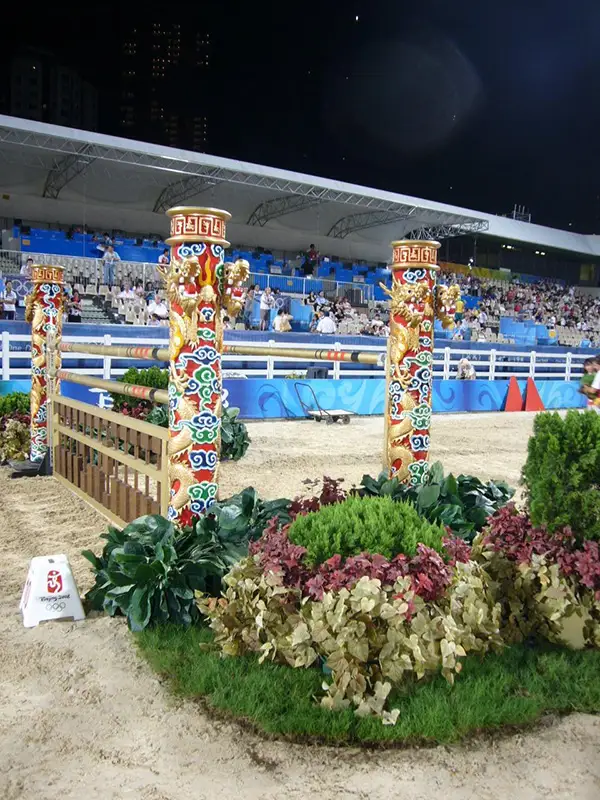
Accustomed to planning every detail of her creative projects, Baptiston had to improvise, learning the specialty on the spot. But by the end of the competition, she’d been asked to help with decorations on the Florida circuit for the upcoming season. Within a few years, Baptiston’s skills would take her all the way to the equestrian sports at the 2008 Olympic Games, held in Hong Kong. Her trial-by-fire in course decorating marked the start of a lasting career.
In the decades since, the veteran course decorator has leaned into her creativity and architecture education, playing with the blank canvases of jumper and hunter courses.
Baptiston likes the challenge that each venue presents, where designers ask her to give a jump a certain personality or purpose within the context of the course. She’s had requests to create everything from sparse styles that incorporate concrete, to greens so lush “you feel like you’re in the jungle.”
For jumpers, she’s often asked to add elements that make a fence more challenging. For hunter courses, her work is to bring in natural, inviting elements that echo the sport’s roots in foxhunting.
“My projects normally start on paper, the same as when I’m designing a house. You plan ahead; you have a conversation with your client, and you know what they need,” Baptiston said. “My clients—or in my case, the course designer—explain: ‘I don’t want the turn here.’ ‘I want this to be inviting.’ ‘Can you extend this down the side of this jump?’ ‘Can we just tuck it in a little bit?’
ADVERTISEMENT
“You need to make it inviting for the horses and pleasant to the eyes for people,” she continued. “So we are trying to comply with both. That’s the beauty of it.”
In addition to the design challenges, Baptiston also comes up against logistics specific to each competition, whether that’s tracking down plants that can survive desert heat or overnight temperature drops, being resourceful on a tight budget, or navigating a language barrier with local vendors—as in Hong Kong, where Baptiston remembers communicating with nursery owners through photos.
Baptiston, who now lives in Querétaro, Mexico, has traveled the globe in her capacity as an FEI judge. But even when she’s on show grounds as an official, she can’t quit thinking about flowers, colors and design. She uses these travel opportunities to absorb the world around her.
“Every year, they give us an appointment as a foreign judge; at all the international shows, one of the judges needs to be foreign,” she said. “It’s good, too, because it gives me the chance to see different things, different environments. I like to see different things and see how I can apply them to the special events that I go to decorate.”
In a collaboration much less spontaneous than her initiation into course decoration, Baptiston teamed up with hunter course designer Kevin Holowack to outfit the ring at the Baran Global Hunter Classic, held in Valkenswaard, the Netherlands, July 11-13.
“Flora is quite famous in the industry,” Holowack said. “I think that as the horse industry knows riders, officials know Flora.”
He says that part of the reason the duo works so well together—in addition to their shared backgrounds in architecture—is that they are equally committed to bringing their plan into reality.
“I’m usually the last one in the ring fluffing a fern or moving a red flower because it’s not in the right place,” Holowack said. “And when you look across the ring, and Flora is still there doing that same thing, you realize, OK, you have someone that has that same vision and will work to the end.
“It truly is a passion, and I think Flora is that same way,” he continued. “That finished look is something that you step back, and you’re proud of. You look at the ring that day, and you say, ‘This was a vision that came together.’ Plus or minus maybe one flower, this was the look that we were going for.”
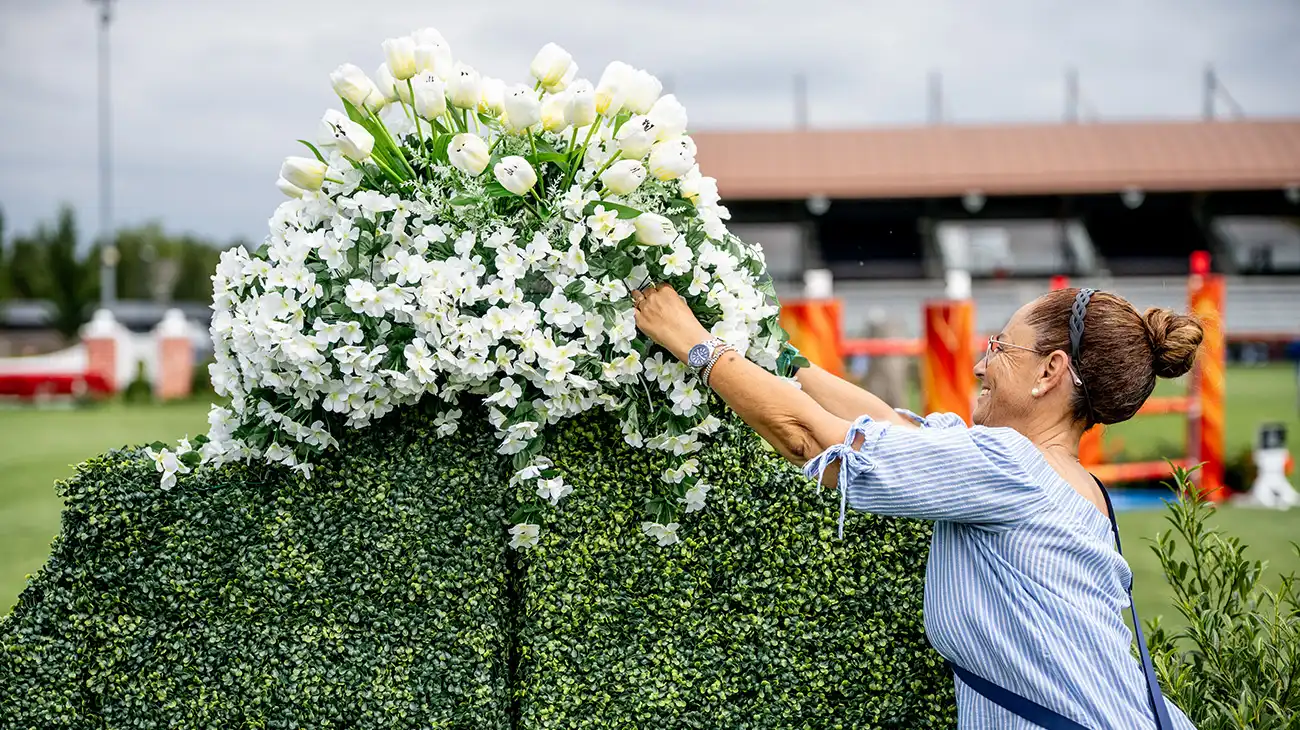
At the Baran Hunter Classic, which was held alongside the Longines Tops International Arena Summer Classic CSI4*, the duo planned a course aesthetic inspired by the country’s trademark tulip.
ADVERTISEMENT
“It’s almost minimalist,” Baptiston said of the design concept. “You work with the beauty of the tulip, and that [was] the look that we were aiming for.”
Behind the scenes, Holowack worked with Baran co-founders Kristen Baran and Andrew Lustig to land on the project’s overall style. He then sent over the blueprint for the jumps and course to Baptiston, and together they collaborated on details around color, vegetation and materials. At the event, Chris Boyle also joined the design team on the ground to assist Holowack and Baptiston in building out the course and finalizing decorations.
What comes together in the arena for one day takes months of preparation behind the scenes, which for the Baran included sourcing live and silk plants, importing custom jumps from different makers around the world, and working with the jumper course designer to create dual-purpose elements that could be turned over quickly for the hunters.
“We pulled pieces from all over the world too, and pieces that we [thought] would go nice together,” Holowack said.
In Baptiston, Holowack says he’s found another creative who can see stripped-down elements—like a forgotten bench or gazebo on the backend of a showgrounds—and incorporate that inspiration into the final look.
No matter the venue, the weather or the budget, there’s always one part of the decorating process that is hardest for Baptiston: walking away. With her careful attention to detail, she can always find one more thing to do before the first round begins.
“I’m a perfectionist,” she said. “Sometimes, I need to just turn around and say, ‘It’s good the way it is.’ ”
This article originally appeared in the August 2025 issue of The Chronicle of the Horse. You can subscribe and get online access to a digital version and then enjoy a year of The Chronicle of the Horse. If you’re just following COTH online, you’re missing so much great unique content. Each print issue of the Chronicle is full of in-depth competition news, fascinating features, probing looks at issues within the sports of hunter/jumper, eventing and dressage, and stunning photography.