The post From Rescue To Ribbons: Chronicle Cover Horse Made Dreams Come True appeared first on The Chronicle of the Horse.
]]>Fylicia Barr may be a five-star eventer now, but she got her start in the sport aboard the most unlikely of mounts. Her first event horse was a gray Arabian gelding named Zanzibar, with whom she did a bit of everything: 4-H, barrel racing, English and western pleasure, and even a little reining. A painting of him—dished nose, delicate ears and kind eyes, standing in a field of flowers—graces the cover of this month’s issue of the Chronicle.
When Barr, 30, first met “Z,” he was an emaciated, rough-looking youngster at a low-end auction in western New York. Barr was just 10 years old, and she had a total of three riding lessons under her belt. Barr’s mother, Shannon Barr, bought Z on an impulse, despite the fact that neither she nor her young daughter had the requisite skills or experience at that time to manage an unknown horse from auction.

However, in the years to come, Z (named by Fylicia in honor of the main equine character in the “Phantom Stallion” series) would pay back his rescuers in dividends. Not only did Fylicia ultimately event him through training level, he carried multiple young riders to 4-H competitions, and later came out of retirement to become the first event horse for Chronicle cover artist Josie Buller, who took him all the way to the 2021 USEA American Eventing Championships.
“It felt like he just wanted to do right by us,” Fylicia, of Unionville, Pennsylvania, said. “We saved him, and I think he knew that, and he always tried to do everything he could for us. There were definitely moments where he could have said no, but he gave us everything he had. We both did a lot for each other.”
We Meant To Buy A Saddle…
On the day Shannon and Fylicia met Z, they had gone to the auction with a friend, intending to buy a saddle. Instead, they bought a horse with an unknown past, paying just $800 for the gelding—one dollar a pound.
“We saw him, and he was so sad, and so thin—he just looked at us, and we knew we had to try to make something happen,” Fylicia said. “It was truly the blind leading the blind. At auction, you don’t get much info on them, and we saw him with a saddle on and assumed he was saddle broke.”

But when they got him home—to a facility Fylicia describes as a “backyard barn sort of set up,” they found out Z was perhaps only 2 or 3 years old.
“He was young, and not really broke at all,” Fylicia said. “It was a bit of a set up for disaster. I didn’t know what I was doing, he didn’t know what he was doing, but we found our way, together.”
Nursing Z back to health required nothing more than correct, basic care. Over the next several years, Fylicia slowly got him started under saddle. Although she took occasional lessons on other horses, she didn’t have much help with Z; looking back, Fylicia admits she made many mistakes.
“Now, as an equestrian professional, I’m horrified at some of the things he put up with,” Fylicia said. “But he never complained. He used to buck me off for sport, but he gave me a really good seat that I still have to this day, and it was always with a smile on his face. It was a game for him, more than him wanting to hurt me. He’d just sit and wait for me to get back on.
“He made me fearless,” she continued. “He made me feel like I could ride anything. He was always a really, really good boy.”
When Fylicia learned about eventing, she was instantly hooked. She and Z debuted in U.S. Eventing Association competition in August 2011 at the Erie Hunt and Saddle Club Horse Trials (Pennsylvania), where they ran beginner novice. At the same competition a year later, they competed at training level. By then, Fylicia was 17 years old and had acquired a mare named Galloway Sunrise, whom she purchased off Craigslist as a semi-feral 2-year-old. Fylicia began thinking it might be time for Z to step down a level as she continued her own progress forward.

“At training level, the jumps got a little big for him,” Fylicia said. “So we leased him to a couple of young riders that did 4-H shows with him. He was the perfect babysitter.”
Although he was sound and in good health, when his final 4-H lease ended, the Barrs took advantage of an opportunity to retire Z to a farm in western New York. For several years, he lived “his best horsey life” there, while Fylicia continued her own eventing journey with “Sunny,” eventually making it all the way to the five-star level. She attributes her tenacity in working with the quirky mare, and other challenging mounts, to the lessons she initially learned from Z.
“He taught me not to give up on the difficult ones,” Fylicia said. “If you put enough time and effort into trying to understand the tricky horses, you can come out the other side with a really quality partner—if you’re patient, and take the time to understand where they’re coming from.”
It was after Fylicia relocated to Unionville and established her business that she met 12-year-old Buller, who wanted to get started in eventing—but who didn’t have a horse. Fylicia immediately thought of Z.
“When Josie came into my program and needed something to ride, I thought, ‘Let me see if the old man has got a little bit left in the tank,’” Fylicia said. “And he absolutely gave her everything.”
From Starter To The Bluegrass
Buller is now an 18-year-old freshman at Hamilton College in Clinton, New York, but she still vividly remembers the day six years ago when Z and his friends moved into the new home of Fylicia Barr Eventing.
“People were putting up white boards by the stalls with the horse’s and owner’s names, and Z’s little white board had my name listed below his, even though I was not the owner,” Buller, of Coatesville, Pennsylvania, remembered. “Fylicia very generously let me do a free lease on him, and act like he was my own horse. The stars kind of aligned, and Fylicia knew Z would be the best teacher for me—and he really was.”

Buller had gotten her start taking lessons a local hunter/jumper program, but when she learned about eventing, decided to shift her focus. Working with Fylicia and Z, she went from being a “rusty” crossrail rider to competing at novice. After gaining mileage at the starter level in schooling horse trials and learning the basics of dressage, the pair moved up fairly quickly. In June 2020, after eight years away from sanctioned competition, Z returned to the sport at the Plantation Field Horse Trials (Pennsylvania) at beginner novice —with Buller in the irons.
“I made a lot of mistakes—I got left behind plenty of times—but he was so, so tolerant,” Buller said. “I always felt untouchable on Z. He’s just the best partner, and we had lots of fun. I’d never really shown, so I did all my ‘firsts’ on Z.”
When Buller was 15, she decided to set a big goal: to qualify for and compete at the 2021 AEC.
“It can get pretty competitive in Area II, and Z, being an Arabian, would stick his head up in dressage, and I didn’t always quite know what to do,” Buller said with a laugh. “But we got a second place at Bucks County [Pennsylvania], and we got to go to AEC.”
Buller describes the experience of competing Z at the AEC, held that year in Lexington, Kentucky, as “magical.” She admits he even was “a little wild” on cross-country after being stalled for so many days. The pair finished 31st of 38 in the junior novice, 15 and under, championship—and earned the best-scoring Arabian award.
“He was the only Arabian in the class,” Buller laughed. “Some people would say, ‘Oh, you ride an Arabian?’ Well, he’s the best cross-country horse you’ll ever find. A horse you truly care about will always give 110% to you.”

Watching her first horse gallop over the Kentucky bluegrass with Buller made Fylicia feel as if Z’s story had come full circle.
“Obviously, Z and I did not make it to the Kentucky five-star,” Fylicia said with a laugh. “That was my dream growing up, even though I was a 10-year-old kid on an Arabian pony we’d bought for nothing. But watching him and Josie go down the ramp into Rolex stadium, and gallop through the Head of the Lake—that was so special. He made her dreams come true, and my childhood dreams came to life through them at that moment, too.”
Although Buller and Z competed one more time that season, the AEC proved to be their swan song together.
“We don’t know his exact age, but he is 20-ish, and he had held himself together,” Buller said. “It felt like he was trying really hard, and he didn’t need to keep competing, where I wanted to keep moving up.”
Inspired by her trainer’s work in producing her own horses, Buller moved on to a former Thoroughbred race horse named Lee, whom she competed through training level. But Z remained in Fylicia’s barn, and Buller would still trail ride him once in a while just for fun.
“Most of the time, I didn’t even bother putting a saddle on him,” Buller said. “I’d just hop on, and we’d get going.”
Behind The Cover Painting
As Buller neared high school graduation, she knew that her time with Z was drawing to a close. Fylicia had made the decision to send him to enjoy a final, official retirement with her mother in western New York, and Buller was preparing to head to college. When she painted a watercolor and gouache portrait of him standing in a field of flowers, which she included in her senior gallery, it was intended as a dedication to the horse who changed her life.
“He absolutely is my heart horse,” Buller said. “Middle school was a pretty rough time for me, and having Z … I went to the barn every day after school, and I felt like I had him in my corner all the time. If I had a really bad day, and I got off the bus in tears, we’d just go out for hours and hours on the great hacking trails around the barn. I kind of felt like every time I stepped into the saddle with him, I got to leave everything on the ground.”
Buller loves floriography, a tradition which looks at the symbolism of flowers and colors. In her tribute to Z, each flower she painted in the field he’s standing in was chosen specifically to convey Buller’s appreciation for all that he means to her—the sweet peas at the front mean “thank you for a lovely time,” the zinnias symbolize everlasting friendship, the heather is for protection, and the Queen Anne’s lace for sanctuary.
When the Chronicle put out a call for submission to its annual Junior Art Gallery (see more submissions from young artists here), she sent it in. Chronicle staff chose the piece to grace the cover of the 2025 Young Rider issue.
“I’m so happy it got on the cover, because if any horse deserves to be on the cover of the Chronicle, it’s Z,” Buller said. “He has given so much, to so many people. He was Fylicia’s first horse, and now she’s a five-star rider. He helped me through so much in middle school and made me into the rider I am today.

“I think it is so important, on so many levels, for all people to know that every single horse deserves a second chance,” she continued. “Horses always seem to give back, especially those who get into a really good situation after having been in a not so great one. They give you their whole heart, and there is a lot of value in having a horse you’re just really close with. With the right people, no matter what their breed, a horse can do anything.”
The post From Rescue To Ribbons: Chronicle Cover Horse Made Dreams Come True appeared first on The Chronicle of the Horse.
]]>The post Twice Rescued, This Ghost’s Story Has A Happy Ending appeared first on The Chronicle of the Horse.
]]>Two years ago, Jenn Wieckowski and her 10-year-old daughter Lizzie were leaving their neighbor’s Forever Echo Farm in Boxford, Massachusetts, when they decided to stop and visit a newly arrived palomino gelding. Neither mother nor daughter could have imagined then that this green 5-year-old Tennessee Walking Horse would not only become Lizzie’s first official event horse, but that he would take her all the way to this year’s U.S. Eventing Association Area I Championships, held Aug. 16-17 in Geneseo, New York.
But perhaps even more shocking was what they learned in the months after they purchased “Ghost.” In his short life, the youngster had suffered severe neglect not once but twice, and if not for the quick-thinking intervention of a stranger, he might not even be alive.
When they met Ghost, the Wieckowskis were absolutely not in the market for a new horse. They already had Lizzie’s older pony, Wills, and her current mount, Max, living at their Wild Meadow Farm, also in Boxford. Jenn knew her daughter’s next mount should ideally have the training and experience to bring her up the eventing levels. But that day, something about the youngster spoke to Jenn, who admits she did not grow up with horses and has been learning alongside her daughter.
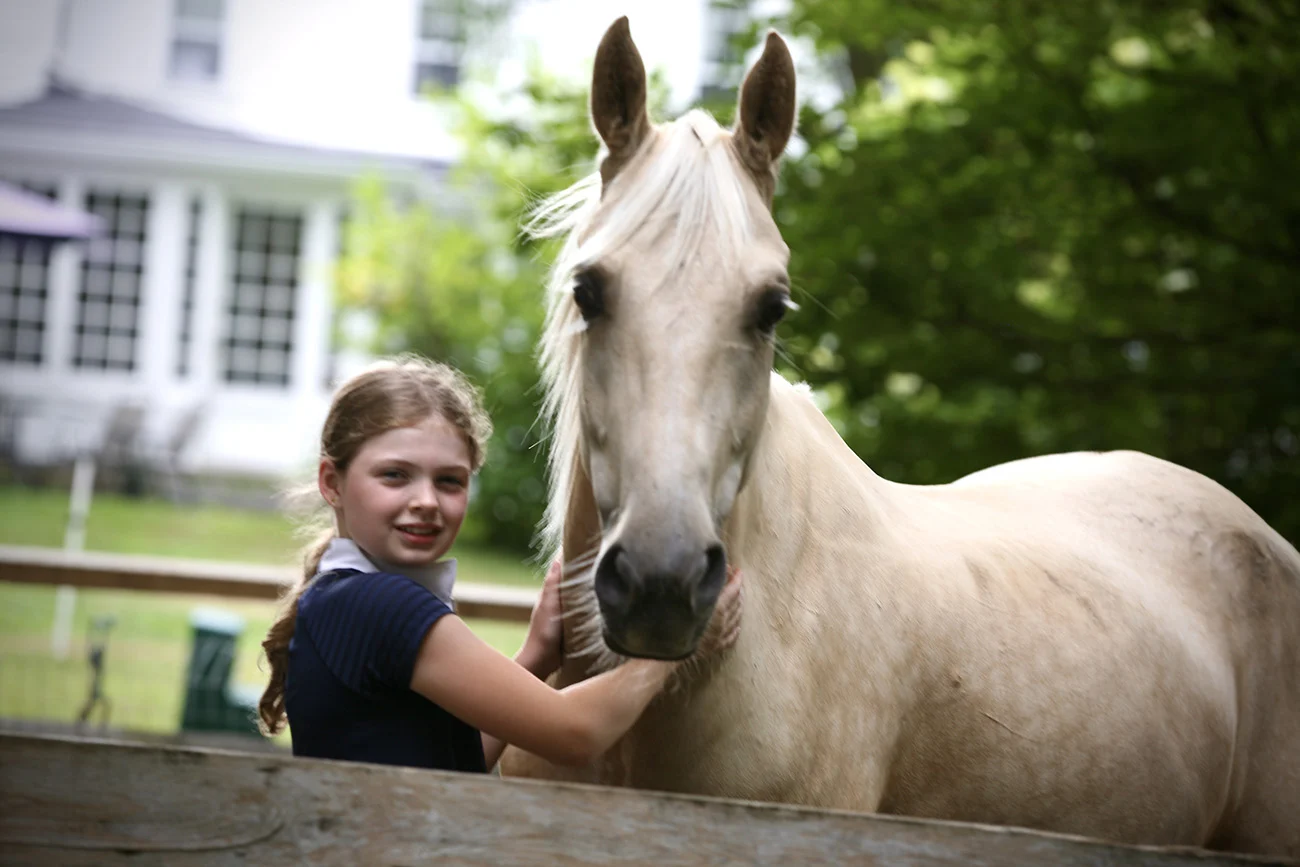
“He was the sweetest thing and so friendly, with the goofiest personality,” Jenn said. “He was like a goofy puppy dog. It was winter, and he pulled Lizzie’s hat off, played around with it, then gave it back.”
A friend of facility owner Melissa Horrigan had sent her Ghost’s sales ad; Horrigan brought him up from North Carolina, sight unseen, for a client, but so far it wasn’t proving to be a perfect match. The youngster had 60 days of basic training down south. He remained spooky and a little anxious, even jumping the 5-foot fence surrounding his paddock one day to get away from another horse. Despite those factors, Ghost pulled on Jenn’s heart.
“We just kind of connected,” Jenn said. “It was just one of those feelings, that we should have this horse. So I told Melissa if her client didn’t want him, we’d be happy to consider buying him.”
A few weeks later, Horrigan reached out and asked if Jenn was still interested.
“We probably shouldn’t have done this, but we threw Lizzie up on him and said, ‘Try him out,’ ” Jenn said. “He was awesome. He was a lovely mover, and he and Lizzie clicked.”
Because no one up north knew much about Ghost’s background, Jenn turned to social media to see what she could learn. Through a series of tags on videos and photos, she ultimately found his previous owner, Melissa Glosson of Oxford, North Carolina. Jenn was scrolling through Glosson’s page when she came across several photos from 2021 of an extremely emaciated, almost skeletal, palomino. She looked closer.
It was Ghost.
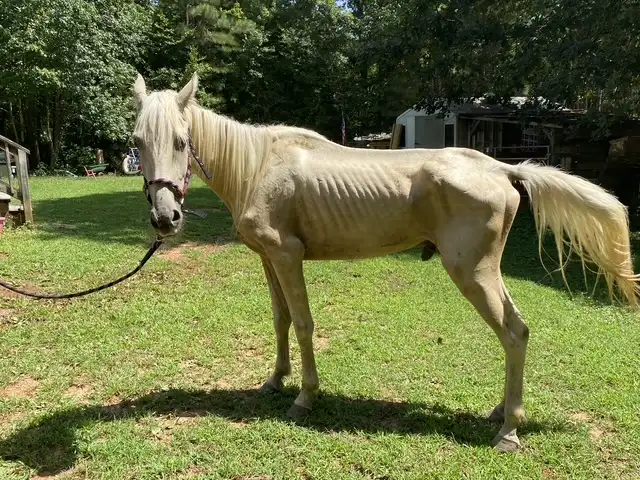
“I was shocked beyond belief when I saw those photos,” Jenn remembered. “I thought, ‘This can’t be him.’ So I reached out, told her that we had Ghost, and asked if she could give me some history.”
Glosson replied right away. She was thrilled to learn that Ghost had ended up with a junior, and she was happy to fill in his backstory.
“I was so glad to hear they’d fallen in love with him,” Glosson said. “Ghost had a run for his money, but he’s ended up where he needs to be.”
He Was Not Staying There
In 2021, Glosson was shopping for a new trail horse and had found a promising lead through an ad on Facebook. In the photos, the Tennessee Walking Horse mare looked “a little underweight” but not so much that Glosson was concerned she wasn’t being cared for. When Glosson arrived to try her out, the first horse she saw was Ghost. Unlike the mare, he was truly emaciated—“literal skin and bones”—and she couldn’t help but speak up.
“I was like, ‘What’s going on with this palomino?’ ” Glosson said. “The guy told me he was 2 years old, and says, ‘I just can’t get him to gain weight; we feed him all kinds of stuff.’ ”
Glosson was skeptical. But when the man’s father came out of the house a few minutes later and threatened to shoot the youngster if someone didn’t take him, she knew she had to act.
“We didn’t care what we had to do, but we were determined he was not staying there that day,” Glosson remembered. “We ended up coming home with both horses. It was one of those ‘ask for forgiveness later’ from my husband moments. They tried to get me to pay for him. I said, ‘You were just threatening to shoot him. I’m not paying you; we’re going to load him on the trailer and take him now.’ ”
It took quite some time to load the mare and gelding—Glosson doubts either had ever been on a trailer before—and an hour and a half to get to her farm. Upon arrival, the youngster collapsed as soon as he unloaded.
“He was so dehydrated and malnourished,” Glosson said. “You could see every bone in his body. His feet were horrible, and he had bite marks all over him. He was just a pitiful mess. It was terrible.”
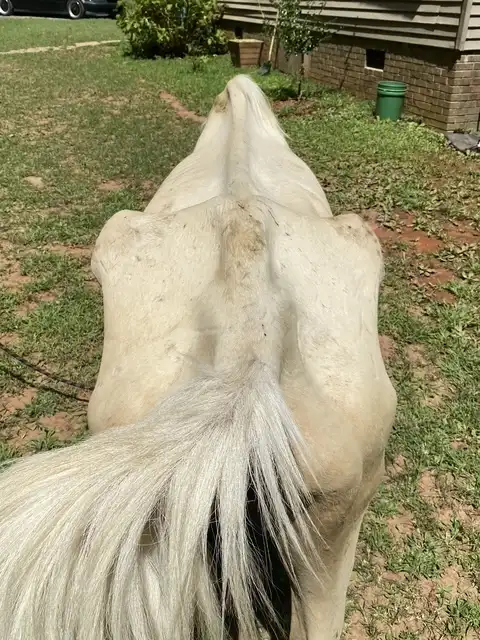
But in the days and weeks to come, Glosson nursed the palomino back to health, offering the youngster many tiny meals, and he quickly gained weight. Although a bit uncertain at first, particularly around men, his sweet personality soon emerged. They named him Ghost, partially due to his pale coat and partially due to his spooky nature.
Glosson, who admits she likes her horses “old and slow,” knew that she wasn’t up for the challenge of starting and training a young horse. Once Ghost’s good health had been restored, she offered him for sale and found what sounded like the perfect buyer.
“She said she had tons of experience, and even that she had Walkers,” Glosson said. “She was so excited.”
Glosson tries to keep track of the horses she has sold, so about a year later, she reached out to the woman to see how Ghost was doing. The woman replied that she was thinking of selling him, because “she had too many horses.” Glosson asked if she could come see Ghost.
“So we drive out there and, well, he wasn’t as skinny as he was before, but he was very thin again,” Glosson said. “His feet were horrible. He didn’t look like he should.”
Immediately, Glosson offered to buy Ghost back. After she got him home, she once again introduced tiny, frequent meals, had his feet taken care of, and nursed him back to health. Glosson notes there was no underlying health condition that contributed to Ghost’s condition; she simply kept hay available 24/7 and fed commercial grain in the recommended amounts for a horse his size.
“He’d put the weight right back on,” Glosson said. “It was like, ‘What is with you people?’ ”
Once Ghost’s health had been restored again, she began handling him more on the ground. It soon became clear that his training had not progressed, so Glosson sent him to friends who are professional trainers to get him started under saddle. But when she tried to ride Ghost herself, he threw her.
“I was like, nope, I’m still not ready for a young horse,” Glosson said with a laugh. “He needed to go to somebody who’s got more experience and can enjoy him. He had more life in him than I could give him, and I didn’t need him just sitting in a pasture.
“I knew it was just about finding the right person for him,” she continued. “I knew I was not that person. I loved him, and I love his goofy personality, but I knew we were not a match. I’m so glad he and Lizzie have bonded the way they have. I absolutely love seeing them do things together.”
Starting From the Beginning, Together
Although there is an old adage in the horse world that “green on green makes black and blue,” Ghost and Lizzie’s journey together perhaps proves there is always an exception to the rule. With the help of several talented professionals—including colt starter Matt Lovejoy, Kat Fish, Jerry Schurink and Dawn Dascomb, among others—the two started from the beginning and have only grown together ever since.
“He knew how to stop, and turn, and how to pick up his leads, sort of,” said Lizzie, 12, of their first rides together. “He didn’t know how to balance himself.”
“He was not fit,” added Jenn. “He was what you’d expect for only being in training for 60 days.”
Although the Wieckowskis have confirmed through DNA analysis that Ghost is, in fact, a purebred Tennessee Walker, he has never moved in a gaited way, either at liberty or under saddle. But that doesn’t mean dressage came easily to him; Lizzie says it is their hardest phase, and she continues to work on building his topline muscles, to improve his connection on the flat, and is learning how to help him stay balanced. However, the first day Lizzie aimed Ghost at a jump, it was clear they had found his niche.
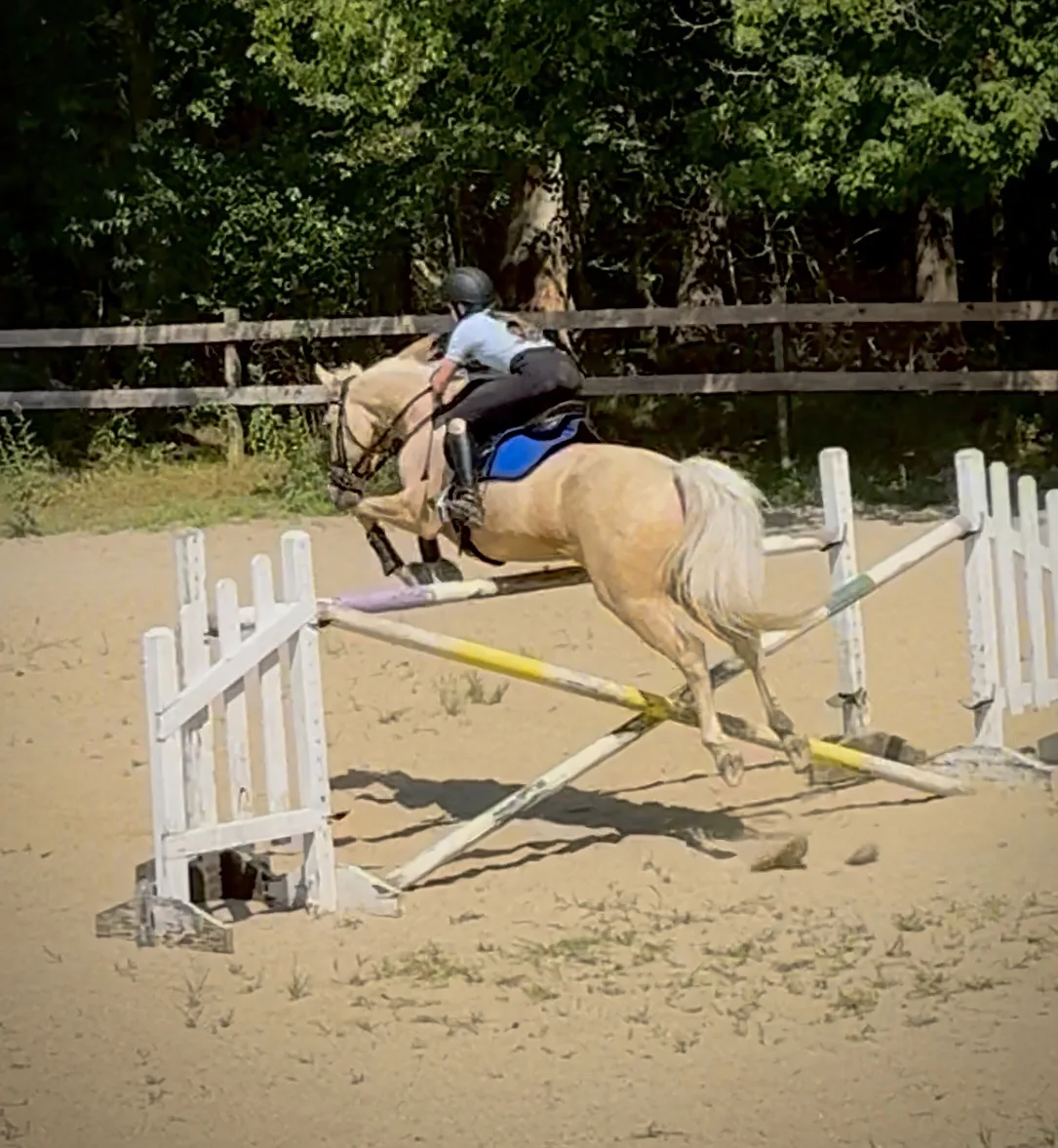
“He just went over the jump by himself,” said Lizzie with a laugh. “I just gave him a little leg, and he popped over it. He was like, ‘I got this!’ He definitely likes to jump.”
As Ghost settled into life with the Wieckowskis, he was still anxious and spooky—at least at first. They could always tell when Ghost was getting worried, because he would chew the side of his tongue. But with 24/7 turnout and the company of a small herd, almost all of those behaviors disappeared.
“It took a few months before he was completely settled,” Jenn said. “But now, he is not anxious at all. He comes up and gives hugs, he’s curious, and he watches everybody. He rarely has an issue that we can’t work through quickly. It’s just a matter of going slow and exposing him—like with any young horse.”
Lizzie says she is not a fan of changing a horse’s name, but as she prepared to enter their first horse show, she felt Ghost deserved to have a show name, like everyone else. They came up with Haunted Blessings—a nod to both his barn name and the fact he had dodged death—twice.
In May 2024, Lizzie and Ghost entered a schooling horse trials hosted by Groton Pony Club in Groton, Massachusetts. Lizzie describes their dressage test that day as being “interesting,” with some bonus moves thrown in that were not part of the pattern. But once Ghost got into the show jumping ring, he found his groove.
“At home, we have limited jumps and space, so I don’t jump too much,” Lizzie said. “When we went in the show jumping ring there, he was like, ‘Game on.’ He overjumped everything and was really forward. He was just like, ‘This is my thing.’ ”
The pair completed the event that day and went on to do several more events and horse shows last season, focusing on jumps set from 2’ to 2’3”. This year, they joined the Triple D Equestrian Pony Club Riding Center, earning their D-2 eventing certification, and entered their first U.S. Eventing Association competitions, showing at the starter level. The Area I Championships, held in conjunction with the Genesse Valley Riding and Driving Club Horse Trials, was their first experience with an overnight competition; their fifth-place finish there has qualified them for the 2026 USEA American Eventing Championships, which they plan to attend.
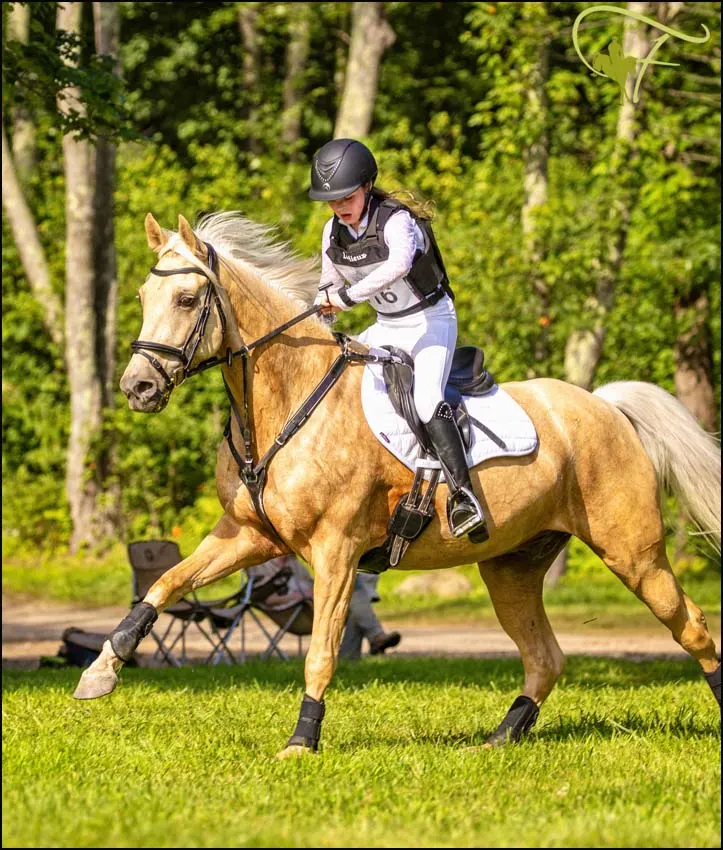
Both mother and daughter acknowledge the process of training a green horse from scratch isn’t always easy, and there have been days when Lizzie was left in tears of frustration. But ultimately, the progress and growth they have experienced over the past two years only motivates them to continue moving forward.
Lizzie has a hard time articulating what Ghost, and his journey, means to her.
“He’s very special to me,” Lizzie said. “We just looked at each other, and we’re the perfect pair. I’ve been working so hard with him, and that’s really special to me, too. I wouldn’t be learning so much about training horses if I didn’t have him.”
“One man’s trash is another man’s treasure,” Jenn said. “He couldn’t be more suited for Lizzie. And when we tell people he’s a Tennessee Walker, we get a lot of, ‘We can’t believe it.’ But you can’t say a horse can’t do something just because of his breed.
“Stories of transformation resonate deeply with others,” she continued. “Seeing a horse transform from abused and neglected to thriving gives people hope in humanity. Their story showcases the resilience and spirit of a horse that was failed not once, but twice, by humans—and who wholly trusts in his new family and gives his all to his little girl.”
The post Twice Rescued, This Ghost’s Story Has A Happy Ending appeared first on The Chronicle of the Horse.
]]>The post From Rescue To Ribbons: Colby’s Crew Rescue Makes A New Start In A New Year appeared first on The Chronicle of the Horse.
]]>When it comes to horses, Gabby Drury is up for just about any discipline, on any mount. The 15-year-old is equally comfortable in an English or western saddle—or no saddle at all—and has dabbled in everything from speed events to jumping to saddle seat. She admits she particularly enjoys riding green, quirky, or “spicy” horses—and values connecting with each individual animal to learn what equestrian sport they most want to do.
As an example, in 2023, Drury began leasing a National Show Horse gelding and planned to compete him in country pleasure and saddle seat classes the next show season, despite being more interested in trying her hand at eventing.
“I was doing it more because I loved that horse, and I wanted to ride that horse, not because it was my favorite discipline,” she said. “I’ve always loved eventing, jumping, dressage—that kind of stuff—but I loved that horse more. That was the horse I was using, and I went with the discipline he was going in.”
When the lease came to an abrupt and unexpected end before they ever set foot in the show ring, Drury was left both horseless and heartbroken. Her mother, Monique Drury, felt her daughter’s pain as if it were her own. So when a friend tagged Monique in a social media post about a potential eventer available for adoption from Colby’s Crew Rescue in Charlottesville, Virginia, she shared it with Gabby.
“I don’t even know what I was thinking—here we are in northern Michigan, and he was way down in Virginia,” Monique said with a laugh. “We don’t have a trailer. But I showed her this post, and her eyes lit up.”
The striking black Dutch Harness Horse gelding, named Watson, was fairly green, approximately 5 years old, and had done a few local schooling jumper shows and one starter horse trial with Colby’s Crew co-founder Ally Smith in the irons. The rescue pulled him from a kill pen late in 2022 and adopted him out a few months later; unfortunately, the partnership didn’t prove to be a match long term, and he was returned to the rescue in late 2023.
“Watson had a ton of talent,” said Olivia Smith, Ally’s wife and co-founder of Colby’s Crew. “We try to get our rescue horses out to shows and events so they are more marketable, and as a young Dutch Harness Horse, he was extremely competitive and flashy. It was clear he enjoyed competing and had a promising future career as a show horse, if his future adopter wanted that too.
“Talented horses also end up in the wrong place at the wrong time, and Watson was one of them,” she continued. “He wasn’t trained under saddle, and had been handled roughly, so he presented as if he was more horse than he truly was. He blossomed in training here.”

What the Drurys didn’t know was that, since returning to Colby’s Crew, the gelding had received more than 500 adoption applications.
“We reached out to Colby’s Crew, and they were looking for a very particular adopter for him,” Monique said. “In my mind, I was thinking there was no way this was going to happen. But we just kept walking through the process.”
On New Year’s Day 2024, mother and daughter made the 13-hour drive from their home in Grawn, Michigan, to meet Watson in person. Gabby admitted she was nervous; she worried rescue leadership would think she was too young and not experienced enough to work with a green horse. But the moment she walked into Watson’s stall, Gabby knew she had found her next equine partner.
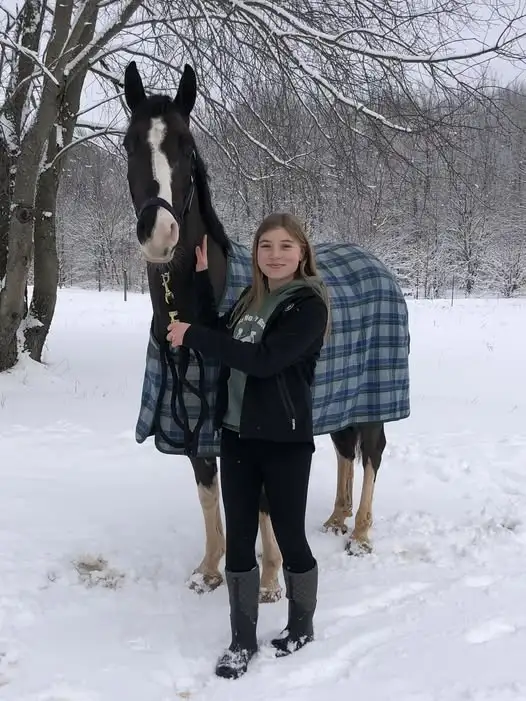
“He was so sweet, and so silly,” Gabby recalled. “I could definitely see us growing together. I helped get him all tacked up, then Ally hopped on first. You could tell he was very forward, and overjumped everything.
“When I hopped on, yes, he was green, but I knew this was the horse I was looking for,” she continued. “I knew I really wanted him, but it was nerve-wracking because I didn’t know how it would all play out.”
When Ally and Olivia watched the pair together, they also knew Watson had found “his” person.
“We wanted someone who would appreciate him,” Olivia said. “The kid sat down on his back and lit up like a Christmas tree. She suited him, and he suited her.”
Welcome To A Winter Wonderland
When the Drurys got the call later that night confirming their adoption of Watson had been approved, they were ecstatic. Just 10 days later, he arrived at The Still Point Farm in Thompsonville, Michigan, a small boarding facility the Drurys own. After his two-day journey, a fully clipped Watson had to adjust to the depths of a snowy Michigan winter; despite the dramatic change in climate, he remained the same sweet gelding they remembered.
“He would jump, and kick, and play in the snow,” Monique said with a laugh. “It was a big life change for him, and he was a little nervous, but he was always so affectionate, adorable, and playful. He was a like a big puppy dog.”
Gabby spent the next several weeks getting to know Watson. With no indoor and wintry conditions prevailing everywhere, instead of riding, she spent hours grooming her new horse and taking him for long hand walks in the snow.
“It was kind of good I couldn’t jump right into riding him, because it gave me time to really connect and bond with him,” Gabby said. “He was so silly and goofy, always looking for things to put in his mouth and chew on. Or he would grab things and toss them around.”
When not at the barn, Gabby learned everything she could about Dutch Harness Horses. Though not registered (and according to the Smiths, most likely cast-off from an Amish breeding program), Watson exemplified most of the defining physical characteristics of the breed: a dark coat, four tall white socks, a wide blaze and a white spot on the belly.
“He is the textbook Dutch Harness Horse,” Gabby said. “They are bred for pulling carts, and they want that white spot on the belly to be seen when they lift their legs as a ‘pop.’ He has a bigger stride, and he holds his head higher, so a lot of people think he is 16 hands plus. But the last time we measured him, he was only 15.2.”
“He just has a big personality,” Monique added with a laugh.
As the youngster continued to settle into his new home, Monique worked to find the right trainers to help Gabby develop a strong partnership with Watson. Monique serves on the board for Horse North Rescue, a non-profit organization based in Interlochen, Michigan; she turned to the group’s training director, Marian Vermeulen, for guidance.
“Marian has worked with a lot of horses that have been rejects, traumatized, and all of that,” Monique said. “So she was very focused on the rescue aspect of his experience, and helping Watson transition to a different life. Her impression was that he had a lot of anxiety, but no real baggage.
“He has always been really friendly with people, and thankfully doesn’t seem to have an abuse history,” she continued. “He was just really green, and a little nervous about the newness of such a different life.”
In fact, the only aspect of Watson’s care and training which proved to be an obstacle related to the shape and quality of his hooves. When Watson first arrived in Michigan, he wore a full set of shoes—but icy conditions dictated he would be safer barefoot, so they pulled the shoes. It was only then that the Drurys realized Watson’s feet would require some careful attention to encourage the growth of better quality hoof.
“His hoof journey has been a big thing,” Gabby said. “We want his hooves in a natural state, where he doesn’t have to wear shoes, and has correct angles. But his feet were flared, almost like duck feet.”
“We have a great farrier, and we have worked through a lot of that,” Monique added. “He’s come along really well, and our farrier has helped Watson correctly grow his feet out. That was the only real ‘problem’ we ran into.”
As the weather and footing improved, Gabby began taking mounted instruction with Josephine Wright, as well as dressage trainer Betsy Morath and jumping specialist Melissa Hirt. With patient handling and training, Watson quickly gained confidence in new situations as he better understood what was being asked.
“He is so willing, and a quick learner,” Monique said. “Even if he doesn’t know what’s going on, the way Gabby has worked with him, he just keeps trying. She is a young rider, and we have a whole team of appropriate trainers, and that’s helped a lot. They are coming along really well.”

“Even if he knocks a jump, he’s game for the next one,” Gabby added. “He’s never given me an ‘I don’t want to do this’ sassy moment. Sometimes he’ll have fun and kick up his heels. But he never says no.”
Into The Show Ring
In May, Watson and Gabby made their show ring debut as part of the Kingsley Equestrian Team, riding for Kingsley High School, where she is a freshman. The show offered everything from showmanship to western and English pleasure to jumping, with each team trying to garner the most points. Gabby competed in saddle seat and English classes, jumping, and for fun, a few speed classes like the flag race.
“It was Watson’s first show, and we did it for fun,” Gabby said. “I was going for the total experience, not the showing or winning aspect of it. If I had to stop in the middle of the round, that was fine by me. I had no idea how it would go.”
From start to finish, Watson was a gentleman, she said, handling a new environment and new tasks with ease. Despite doing all of his speed classes at a trot, Watson’s long stride meant he was as competitive as those horses who cantered tighter turns. Later in the season, the pair entered their second show at the Stepping Stones schooling series, turning heads as they competed in dressage and jumping classes.
“I was trotting down the long side of the warm-up ring, and three people in a row said, ‘I love your horse, he’s so pretty,’ ” Gabby said. “He’s definitely a looker. It’s crazy to think he was destined for the slaughterhouse.”

“It just astounds me he was simply thrown away,” Monique added. “To find this beautiful gem of a horse, who is so sweet and funny and willing—and the joy he has brought to our family—it is remarkable.
“Everywhere we go, there are always people who are struck by him,” she continued. “In fact, one lady commented, ‘Daddy bought her a fancy horse,’ and I just giggled, because I know his story. When people find out he is a rescue, their jaws drop. But the fact he is a rescue is one of the many reasons why we love him.”
At home, Gabby and Watson have enjoyed spending time exploring the trails, and they perhaps dedicate as much energy to “goofing around” as they do to serious training.
“Yes, there is the show world—but it’s also about just throwing a lead rope and halter on, and playing around,” Monique said. “As a parent, it is beautiful to see the time she has invested in him paying off.”
Monique noted that the team at Colby’s Crew have stayed in touch. They are thrilled with how well Gabby and Watson’s partnership is growing.
“He was a much more expensive horse than his adoption fee suggested, and that was set on purpose,” Olivia said. “We wanted a kid or adult who might not necessarily be able to afford that $40,000 horse from a private home to find it in a rescue with a reasonable adoption fee. The fact that it was a horse truly bound for slaughter? Even better. So many people say they are ‘there for a reason’ or ‘have no value’ and it’s just not true.
“The pictures and video updates we receive tell us we chose absolutely correctly,” she continued. “She adores him, appreciates him, and he lives a life that we wish for all of our horses.”
Looking forward, Gabby is hoping that 2025 will bring the opportunity to compete in her first-ever horse trials. While the closest event is more than three hours away, she has plenty of local venues where she and Watson can hone their skills in the jumping and dressage arenas. In the future, Gabby hopes they may even be ready to compete at well-known facilities such as the Great Lakes Equestrian Festival (Michigan) and the World Equestrian Center (Ohio). However, more important than any competition is respecting and growing their partnership.
“I definitely want to keep building our bond, and bringing ourselves together as a team more,” she said. “I’m game for anything, but I’m not going to push him past what he can do. I’m a bold rider, and I’m not afraid of much. He’s a bold horse—so we are a good team, together.”
Do you know a horse or pony who has been rescued from a dangerous situation to become a healthy, trusted competition partner today? If you think you have a good candidate for “From Rescue To Ribbons,” let us know by emailing mwright@coth.com.
The post From Rescue To Ribbons: Colby’s Crew Rescue Makes A New Start In A New Year appeared first on The Chronicle of the Horse.
]]>The post From Rescue To Ribbons: Mare Overcomes A Late Start To Find Her Confidence Eventing appeared first on The Chronicle of the Horse.
]]>Sally Cat was one of a trio of horses surrendered to SEO when her owner entered hospice care after a long period of declining health. The majority of SEO’s intakes come to them via law enforcement, so it was an exception that these animals were all in good physical condition. A homebred, Sally Cat, was by the Oldenburg sire Gatsby, and was an attractive, athletic type, with a refined face, two socks behind, and a big star. Although her original owner had hoped Sally Cat would become her next dressage horse, the woman’s long illness had put the mare’s training on indefinite hold; when she arrived at SEO at the age of 7, Sally Cat had never even been separated from her dam.
“When we went to load her dam, we could put her in the front slot of the trailer,” recalled Kim Mosiman, executive director and co-founder of SEO. “But we had to use some panels and push Sally Cat into the trailer. You could put a halter on her, but I wouldn’t call her halter broke. You couldn’t really lead her.”

Upon arrival at the rescue, Mosiman and her team “pulled the BandAid” and separated mother and daughter for the first time in Sally Cat’s life. The dam, who had previous training and was likely some type of draft or warmblood cross, was soon placed into a new home, leaving Sally Cat at the rescue without the one animal who had always given her a sense of security and support.
“I keep telling people in our rescue that we need to have a name for this type of horse,” Mosiman said. “They’re usually a mother-daughter pair who have never been apart, and never been on their own. Those horses take a lot longer to settle and adopt out, because they are big, insecure, and there aren’t that many people now with the skills to help them.
“I think Sally Cat liked humans, and I’m sure her original owner cared for her,” she continued. “But horses are such herd animals, and if an animal hasn’t been taken out of that herd and out of that security blanket, and you put them on their own in a stall or an arena, all they can think is, ‘How do I get to my herd?’ That was the biggest hurdle for Sally Cat.”

It took nearly a year of groundwork to gain Sally Cat’s trust and improve her bond with people. At that point, she was adopted by a local dressage trainer who seemed to have the necessary experience to continue Sally Cat’s education. Unfortunately, the situation didn’t prove to be a good match, so Sally Cat was returned to SEO and placed in a foster home until they could determine next steps.
“She is a beautiful horse, was always super sweet, and had all the physical potential,” Mosiman said. “But she couldn’t go at the same pace in her training as another horse. I think it was too much for her mentally; she needed to go slower and really work on the foundation a lot longer than you would normally have to do.”
By the time Sally Cat returned to SEO, Mikenna had successfully worked with four other horses from the rescue and participated in the organization’s 2021 Lucky 7 Training Challenge, with plans to do the event again in 2022. Loosely modeled on the Extreme Mustang Makeover, in the Lucky 7 Challenge, trainers have 120 days to work with one of SEO’s horses before returning for a one-day demonstration and competition; afterward, the horses are auctioned off to pre-approved and pre-matched buyers. Knowing that Sally Cat would require a savvy and experienced trainer to help overcome her emotional baggage, in February 2022, SEO reached out to Mikenna, who was happy to give the mare a fresh start.
Upon arrival at Three Beat Farms, Mikenna gave Sally Cat two weeks to decompress, adjust, and gain a little weight—and gave her a new name.
“I thought she looked like a ‘Kitty,’ ” Mikenna said with a laugh. “So we switched her name. At this point, I did not know I would end up with her; I was thinking of her as a restart. I figured I would get her going, and hopefully we’d find her a good home.”
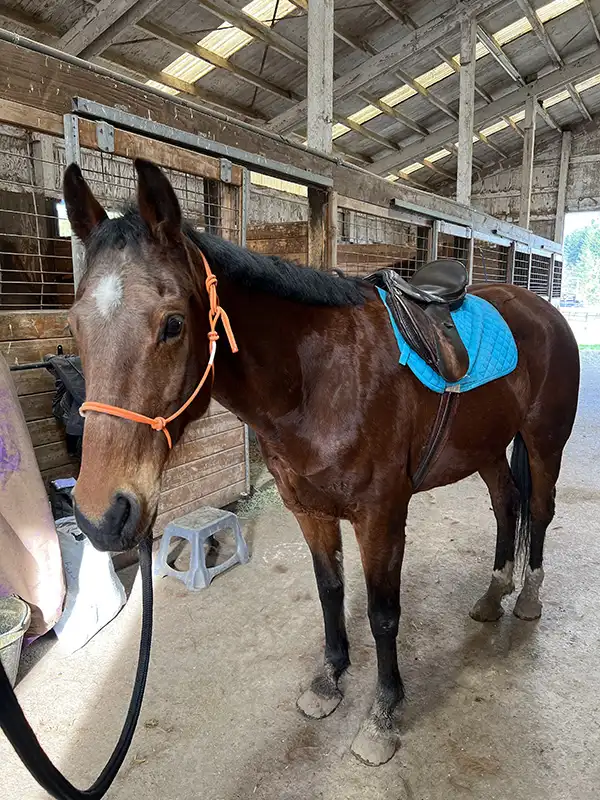
That all changed just a few weeks later, when Mikenna’s husband longed her and Kitty together for the first time.
“We trotted for a bit and then went into the canter,” Mikenna remembered. “We maybe made it around the circle one time, and I looked at my husband and said, ‘This one cannot leave.’ Any horse with a canter this nice, who is in this early stage of getting going again, is going to be a good one.”
By the end of March 2022, with only about three weeks of work under saddle together, Mikenna officially adopted Kitty—and began to gently peel back the layers of her new equine partner. From their first sessions together, Mikenna already recognized that Kitty was extremely sensitive to any pressure in her mouth; initially, she worked the mare only in a rope halter, both on the ground and in the saddle. While Kitty was sweet to have in the barn and easy for the staff to handle, she still displayed signs of nervousness and insecurity when working on her own, away from other horses.
“She was stunted emotionally,” Mikenna said. “You would think she was 4, not nearly 9 years old. But she was essentially not weaned until she was 7, and she had never had to do anything, really, without her mommy’s approval. It was hard to grow up a bit.”
But as Mikenna kept working with her, Kitty’s confidence slowly began to build. Then one day, Mikenna asked the mare to back up—and after just one or two steps, Kitty froze and did a “weird leapy sideways rear.”

“It was like she got stuck,” Mikenna said. “At this point, I realized we maybe had a little bit more baggage than I’d thought.”
She turned to two trusted friends for advice: equine bodyworker Marci Voorhees, and dressage trainer Jenn Mack. Voorhees determined the mare seemed to be experiencing discomfort in her shoulders and carried tension throughout her body, which a regular schedule of bodywork improved over time. Mack proved indispensable in helping Mikenna not only to find a bit the sensitive mare was comfortable in (most of the time, she wears a lightweight Herm Sprenger Duo), but also in helping to deepen the connection between horse and rider.
“Jenn is really in tune with how horses bond, and how that could help put Kitty on the right path not just physically, but also mentally,” Mikenna said. “It’s about learning how you fix some of the traumas these horse have, and help them find relaxation and comfort under saddle.”
“They have to let you in a little, in order for you to get the most out of them.”
Mikenna Hallock
Mikenna has experience in several disciplines and believes it is important to help horses find their best niche, but eventing is her personal passion. In January 2023, Mikenna and Kitty competed at their first horse show, jumping crossrails at a schooling competition hosted by the local Pony Club. Encouraged by Kitty’s performance there, Mikenna began preparing for the Inavale Farm (Oregon) schooling horse trials at the starter level in June. Wearing just a simple leather bit on cross-country, the pair not only completed the event, they walked away with a ribbon.
“She took to cross-country like a fish to water,” Mikenna said with a laugh. “The only silly thing she’d do, instead of just going into water like normal, she characteristically likes to leap in. I have to brace for impact a bit.
“We placed third in her starter division, and it really was her first full-day show ever,” she added. “For me, that was huge: There was still lots to work on, but she did it.”
From there, Kitty and Mikenna completed three U.S. Eventing Association-sanctioned horse trials in 2023—two at starter level, and the last at beginner novice—finishing in the ribbons each time. With each outing, Kitty’s confidence grew, and she seemed to especially enjoy the jumping phases—at least, once she was on course.
“The first year of showing Kitty was definitely the most exciting, as it would be with any green, young horse going out into the world,” Mikenna said. “The only real struggle on cross-country was leaving the whole group of horses in warm-up to go to the field by yourself. But even by the second show, she felt way braver and more confident to be on her own.
“Anything you pointed her at, she was happy to go over it,” she continued. “It didn’t matter how silly it looked. And despite the spookiness and nervousness and all the normal green-horse things, I was so impressed by how hard she tried. No matter what you asked her to do, she would always try, and I appreciate that about her, even to this day.”

Encouraged by the mare’s successful debut season, Mikenna spent the winter polishing up her dressage skills, even competing at a few schooling shows at first level. They started this year at beginner novice, qualifying for the USEA Area VII Championships at their second outing of the season. By early August, Kitty successfully moved up to novice at the Area VII Young Rider Benefit Horse Trials held at Caber Farm (Washington).
“That was not only our first novice, it was the first dressage test I rode where I felt I had her attention on me, and she was relaxed,” Mikenna recalled. “I was excited and shocked to place fourth there, and we qualified again for the championships, now at novice.”
In September, the pair finished their season at Aspen Farms (Washington), earning seventh place in the Area VII novice championships there. And while Mikenna is proud of Kitty’s competitive success (to date, the mare has never had a cross-country fault), she is also appreciative of what she has learned as a trainer through working with this sensitive animal.
“Kitty has taught me so much about, I want to say ‘patience,’ but it is so much more than that,” she said. “It’s about being able to look at a horse, see the paths of tension, and identify where that tension might be coming from, and how to connect with a horse on an emotional level.
“They have to let you in a little, in order for you to get the most out of them,” she continued. “So many people are quick to write off a horse because he doesn’t have the best breeding, or the papers don’t speak for themselves, or they come from nothing. I am so grateful all the stars aligned, and Kitty ended up at my place, because she has been the most wonderful, rewarding project I think I’ve ever had.”
Looking forward, Mikenna plans to continue training Kitty with help from Mack and eventer Sarah Lorenz, with the goal of moving up to training level next season. But regardless of what their future holds, Mikenna hopes that Kitty’s story might inspire others to take a chance on a horse with an unknown or limited background.
“Any horse, despite how rough he may look on the outside, can be useful,” Mikenna said. “A trail horse that is loved by his family and goes on rides once a week is just as valuable to that family as a top-rated eventing horse or show jumper. They all deserve the chance to have someone actually listen to them and figure out what we can do for them.”
Do you know a horse or pony who has been rescued from a dangerous situation to become a healthy, trusted competition partner today? If you think you have a good candidate for “From Rescue To Ribbons,” let us know by emailing mwright@coth.com.
The post From Rescue To Ribbons: Mare Overcomes A Late Start To Find Her Confidence Eventing appeared first on The Chronicle of the Horse.
]]>The post From Rescue To Ribbons: Cow Shed Save Grows Into Easygoing Eventer appeared first on The Chronicle of the Horse.
]]>As recently as last year, Amy Rodriguez’s current ride, Gettin’ Ziggy Wit It, didn’t have a consistent right lead canter. So when the 8-year-old piebald gelding qualified for the U.S. Eventing Association’s Area I Championships at beginner novice this season—his first year of showing—she had zero expectations of a top finish at the event.
“He doesn’t have that big, animated, flashy way of moving that looks so good,” said Rodriguez, 33, of Honeoye Falls, New York. “His dressage is definitely the phase that needs the most work. But I thought it was good enough for a middle of the pack placing, and we can finish on it, and that will be respectable at the championships.”
He did just that at championships, held Aug. 17-18 at the Genesee Valley Riding and Driving Club in Geneseo, New York, producing clear cross-country and show jumping rounds (buoyed by the enthusiastic cheering of Natalia Rodriguez, Amy’s 2-year-old daughter), to move all the way up from eighth to claim the championship rosette on a score of 37.5. The event was just the fourth recognized competition of Ziggy’s career, and from there he headed to the USEA American Eventing Championships for his fifth event.
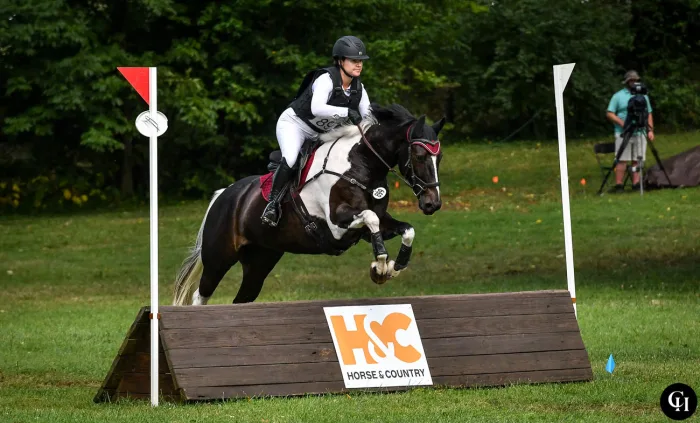
“He has quickly risen to the top of my favorite horse list, ever,” Amy said with a laugh. “He is a no spook, no tricks, easy to ride, snaffle mouth—just the least complicated, happiest horse. He loves to jump, and never looks at anything.”
But in his early years, Ziggy seemed destined for a far less auspicious future. Pasture-bred and unhandled for the first months of his life, Ziggy was living in squalid conditions with his dam and two stallions when volunteers from a then-new organization called Rescue a Horse intervened.
It Takes A Village
Nearly 10 years ago, a group of long-time friends—all equestrians based in western New York—began informally offering assistance to the owners of horses in need. It started with a herd of 30 Morgans, mostly unhandled and in poor condition; the women found funding to geld the seven stallions, and they were able to place nearly all the animals into new homes. Later, they aided an overwhelmed owner in rehoming 20 Saddlebreds; in a separate incident, they assisted authorities with rehoming equines belonging to a hoarder living near Buffalo, who had nearly 600 animals of different types on her property.
By this point, the women (who had been subsidizing their rescue work out of pocket) realized they would be better off as a formal 501(c)3 non-profit organization, and they began the process of establishing Waverly Pond Farm Equine Rescue, doing business as Rescue a Horse. Although the official legal paperwork didn’t arrive until early the following year, by late 2016, the women were starting to think more like a board of directors than an informal gathering of like-minded friends.
One early fall day not long before Rescue a Horse became official, the women learned about four horses living in Wayne County, part way between Rochester and Syracuse. Anyone with horse savvy could see from the road the animals weren’t doing well; they were all thin with rough coats, and the only shelter was a collapsing cow barn. The horses’ owners initially rejected Rescue a Horse’s offer of assistance.
“They were reluctant to release any of the horses, but then decided it was in the animals’ best interest to go to the rescue after all,” Rescue a Horse co-founder Pam Merrick said. “We fundraised among ourselves and gave her $300 for each horse—the two stallions, the mare and Ziggy.”

When the volunteers arrived to transfer the horses to foster homes, they found the animals huddled in the cow barn, taking shelter from a cold, driving rain. Ziggy, still nursing, was perhaps 6 months old and completely unhandled. He was covered in old cow manure up to the level of his belly, and—as they would soon learn—infested with worms. Despite being wary of humans, he fortunately was willing to follow his dam onto the waiting trailer.
As a lover of pinto horses in general and piebalds in particular, Merrick found herself drawn to Ziggy. She hoped that he might one day develop into a pleasure mount she could enjoy on trails. But Merrick admits she is not a horse trainer, so Ziggy was placed in a foster home with colt starter Jamie LaRock, who often volunteered her services to support the women’s rescue efforts. Once settled in, Ziggy was weaned, and LaRock began the process of both restoring his good health and teaching the young horse basic handling skills. His training later progressed to include unmounted skills in the round pen and other foundational groundwork.
“I asked Jamie to tell me if she thought he would be a good fit for me,” Merrick said. “My horse was getting older, and so I thought he might turn out to be a nice adoption project for me. That was the original intention.”
For several years, Ziggy went back and forth between Merrick and LaRock’s farms. As he matured, an additional question was answered—which stallion from the small herd most likely had been Ziggy’s sire.
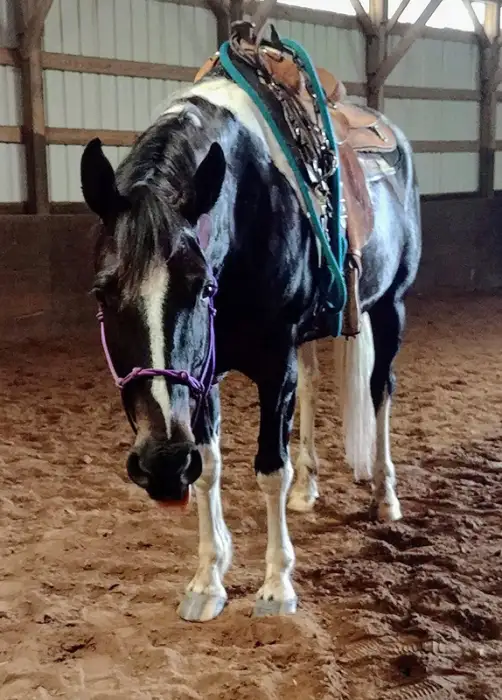
“One was a pony, and the other was a Thoroughbred,” says Merrick. “When he started growing the way he did—he must be 15.3 hands now—we knew he was definitely by the Thoroughbred.”
But his size was only the first indication that Ziggy might not prove to be the right match for Merrick, who prefers smaller mounts. As his training progressed to include the basics of work under saddle, Ziggy also began to show that he might prefer a sportier career than what Merrick had in mind.
“You could tell he was so athletic—he needed to do something more than be my personal horse, because I only trail ride,” she said. “He was really destined to be something else, and he was a bit of a handful when he was younger. He had some spirit to him.”
Reluctantly, Merrick decided Ziggy would be better off finding a different home, one where someone could give him a job and channel his enthusiasm. Fortunately, she knew just the person to help Ziggy get ready to make that transition.
‘I Have Something For You’
Amy Rodriguez grew up riding with Merrick’s daughter in Pony Club; for many years, as Amy built her eventing program, Lear Stables, Merrick would send rescue horses Amy’s way. It had gotten to the point where so many of those horses had successfully been brought along by her students that whenever Merrick called and said, “I have something for you,” Amy automatically said yes. And that was why she was willing to take on Merrick’s barely started 6-year-old gelding as a training project—despite being four months pregnant herself.
“I told her I wouldn’t have very much time to keep working with him, but so long as he wasn’t feral, I would get him started,” Amy recalled with a laugh. “So I got him going walk, trot, canter and over some fences. We did some cross-country schooling, and he was just a really unusually good horse. I mean, point-and-shoot jump, from the second time we ever showed him jumps.”
But despite his progress, none of the handful of potential adopters who came to see Ziggy felt a strong connection with him—and his greenness, which included not having a right lead canter or a show record, was also a deterrent. However, Amy was so impressed with Ziggy’s natural aptitude over fences that she felt her more advanced students could take over his education once she was too far along in pregnancy to continue training him herself. She offered to keep the gelding through the winter, mentor her students, and see how far he could progress.
The longer he stayed, the more attached Amy became. After Natalia was born, Amy resumed working with Ziggy herself. Merrick kept track of their progress; secretly, she had still hoped that Ziggy might end up returning to her, but it wasn’t long before Merrick knew he had found his permanent home.
“Amy loves every horse, but she really fell in love with him,” Merrick said. “I told her, ‘Amy, this horse really needs to be with you.’ We transferred ownership, and she has been doing phenomenally with him ever since.”
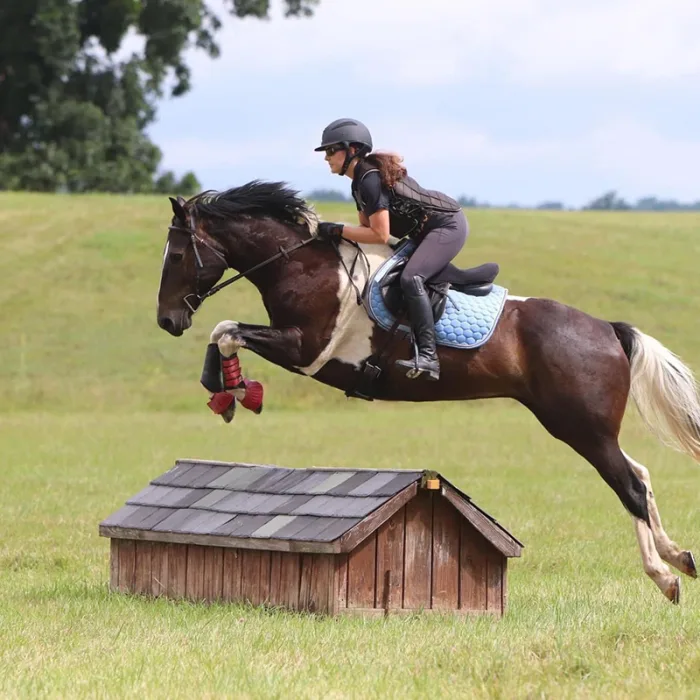
Amy officially adopted Ziggy in spring 2024; thanks to a lot of hard work under the guidance of trainer Karin Alexander, he discovered his right lead, and Amy decided to enter him in a few schooling competitions for mileage. She soon found him to be such an “old soul” that they quickly moved on to recognized events. They made their beginner novice debut in May at the Winona Horse Trials (Ohio), then contested all three recognized events held in Geneseo, New York, which is just 30 minutes from Amy’s home.
“At competitions, he stands with his eyes closed next to the arena, just hanging out and thinking about grazing,” Amy said with a laugh. “Then he picks right up and is ready to go. But he is very chill, very happy to travel. It’s fun to travel with him, because he has no anxiety. He doesn’t come with any stress—he just wants to hang out.”
However, once Ziggy is on task, he is all business—especially on cross-country.
“Our biggest issue at beginner novice has been going too fast on cross-country,” Amy said. “We have to purposely try to trot in places. He wears pony-sized boots, and he has short legs, but he has a really big, forward stride. I’m hoping he can move up to novice after this year, and maybe that will be a more appropriate level for him. He never feels like he’s going fast, then we finish, and you go—oops.”
Thanks to a second-place finish earlier this season, combined with his other completions, Ziggy qualified for this year’s USEA American Eventing Championships, held in Kentucky at the end of August. Amy, who has previously qualified for the AEC but never competed there, decided the opportunity was too good to pass up. The pair finished 29th out of 50 starters in the beginner novice rider division, again moving up from their dressage placing on the strength of two double-clear rounds.
“When I adopted Ziggy, my ultimate goal was to have a nice horse for my lesson program students to ride, but now, I think I will keep him for myself,” Amy said with a laugh. “I have no idea how far he’ll go, but he’s probably been the least complicated, most easygoing horse. We’ve just kind of clicked.”
Although Amy can see a future where Ziggy brings one of her students to a major venue like the AEC, there is another special jockey whom she hopes might take his reins in the years to come.
“He’s Natalia’s favorite horse,” she said. “If I’m riding him, she can spot him from across an entire warm-up ring. She knows which one is him. He’s only 8, so by time she’s ready to ride, he’ll be a nice, seasoned, middle-aged horse. That would be a really fun thing.”
Diamonds In The Rough
After working with so many rescue horses, including Ziggy, Amy thinks it’s important for equestrians to understand that if you are willing to put in the time, these animals can prove to be the perfect entry point to both horse ownership and competition for those on a budget.
“The price tag on horses is so wildly insane,” she said. “For me personally, and for many of my students, there is a feeling that if you don’t have a certain amount of money, you will never be able to horse show, or you will never be competitive. But if you really learn how to train, and you focus on building a relationship with the horse, the only thing that makes the difference between a rescue horse and an expensive, finished horse, is the work that’s been put in.
“It’s important for people to remember that the horses don’t know what you paid for them,” she continued. “They just know how you treat them, and that you trust them. There are a lot of really nice horses that get overlooked, because they didn’t have someone who believed in them enough to put the time in.”
Do you know a horse or pony who has been rescued from a dangerous situation to become a healthy, trusted competition partner today? If you think you have a good candidate for “From Rescue To Ribbons,” let us know by emailing mwright@coth.com.
The post From Rescue To Ribbons: Cow Shed Save Grows Into Easygoing Eventer appeared first on The Chronicle of the Horse.
]]>The post From Rescue To Ribbons: Erna Valdivia Makes Tevis Cup History With ‘Lovie’ appeared first on The Chronicle of the Horse.
]]>Vera Valdivia-Abdallah, founder and director of a major Arabian horse rescue, has helped hundreds of animals recover from dire circumstances. When she learned about a herd of 53 Arabians in Oregon in need of help late in 2020, she mobilized immediately to bring the animals to her Love This Horse Equine Rescue, located about 100 miles north of Los Angeles.
The story of the Oregon horses was one she had heard a version of many times before in her nearly 15 years of equine rescue work: The horses’ owner had passed away, his family had no idea what to do with the animals—many of which had never been handled—and in desperation, they contacted a horse trader to “come and get them.”
“Other than a few older horses who were broke to ride, he never even halter-trained them,” Valdivia-Abdallah said. “The horse trader basically rounded them up and dispersed them to different auctions.”
Because they were mostly unhandled, the majority of the Oregon herd was at risk of being sold to dealers shipping to slaughter. Valdivia-Abdallah began attending regional auctions, looking for them specifically.

One of the auctions the rescue operator attended had seven of the Oregon animals on its manifest. She didn’t have enough money to buy all of them that day, so when a private party stepped forward to purchase a gray 5-year-old from the group, she was happy to know the mare wasn’t going to a dealer.
“But the buyer had the assumption these horses were broke, and they weren’t,” she said.
The buyer tried to ride her new horse, only to learn that it had barely been handled, much less trained to ride. A week after the auction, the buyer gave the mare to the rescue, saying “she couldn’t do nothing with her.”
By the time Valdivia-Abdallah picked up the gray mare, she seemed severely traumatized. But the rescue operator wasn’t discouraged; she had helped many similar horses recover from a rough start and go on to loving homes and felt confident she could help this mare, too. With the input of her then-13-year-old daughter Erna Valdivia (an avid Taylor Swift fan), the new rescue mare was christened Love Story LTH, “Lovie” for short.
Many of Love This Horse’s rescues end up as recreational trail horses or competitive endurance mounts, thanks to the Arabian breed’s natural affinity for these jobs. Lovie hadn’t been at the rescue for very long when Vera realized the horse was not just suitable for endurance, she seemed bred for it. And although the mare still had much to learn, Vera knew just the person to help her succeed: her good friend and endurance rider, Susannah Jones.
‘She Was Repulsed By People’
Jones first met Vera several years ago when she took on one of the rescue’s training projects; the two have remained good friends ever since.
“Susannah is such a knowledgeable, amazing person,” Vera said. “There’s not many people I’d trust to just hand a horse over to, but whenever I’ve had a horse I’ve felt was a 50-miler, I would hand them to Susannah to ride, because I knew she would take amazing care of them.”
Just before Christmas in 2020, Vera told Jones that Lovie would be her next Tevis horse.
“But she didn’t tell me how wild the horse was,” Jones recalled with a laugh.
The Western States Trail Ride, better known as the Tevis Cup, is a one-day, 100-mile endurance race. It starts in Lake Tahoe, California, and ends down in Auburn. The route crosses the rocky, rugged terrain of the Sierra Nevada mountains, over and through the Olympic Valley, and into the Granite Chief Wilderness area. Horses and riders must navigate narrow trails, skirt steep cliff edges, and traverse up and down rugged canyons—all in less than 24 hours, including mandatory rests. It is widely considered the toughest endurance ride in the world.
Jones has completed Tevis four times.
“I didn’t really need another horse,” Jones said, “but I went down to see Lovie anyway.”
On Feb. 14, 2021, Jones made the nearly eight-hour trip from her ranch in Rough and Ready, California, (a small town located one hour northeast of Sacramento) to pick up her new project. The first thing Lovie did upon arriving at Jones’ ranch was jump its five-foot fence—and Jones knew she would need to work to win the mare’s trust before any other training could begin.

“You couldn’t really get near her,” Jones recalled. “She was very bracey, and I just got the feeling she was really repulsed by people. So I spent a long time just studying her, letting her unravel and be herself. I didn’t put any pressure on her at all.”
As Lovie gradually began to trust Jones, she strengthened their bond with playful unmounted activities. But Jones says she “doesn’t start horses, she just gentles them,” so at the end of 2022, she sent Lovie out to a trainer for an introduction to ridden work. Almost immediately, the trainer sent Lovie back, pronouncing her a “dangerous horse.”
After giving the mare a few months to recover from that experience, in March 2023, Jones sent Lovie to another friend, who proved to be a better match. Later that summer, Jones began taking Lovie on solo trail rides. She found the mare to be brave and forward-thinking, ideal qualities for endurance.
“She’s one of the bravest horses I’ve ever ridden, actually,” Jones said.
As their bond and confidence in each other continued to grow, Jones began riding Lovie with other horses—and that was when the trouble began.
“She’s fine most of the time, but every now and then, she’d throw in a buck,” said Jones, 70. “This horse has a buck like a rodeo horse. It’s a big, huge buck, then a twist like a corkscrew. If you get a few of those one after the other, you’re just not going to stay on.”
In October 2023, Jones came off Lovie during a bucking episode, resulting in an injury that would keep her out of the saddle for the next six months.
“She was really upset, because she finally had Lovie in nice condition and was getting ready to start doing some endurance rides with her,” Vera said. “I told her to just bring Lovie back to the orphanage—those were my words—and we’d ride her at the [American Endurance Ride Conference] rides and get her record going. I told her, ‘Once you’re better, you’ll take her back.’ ”
But neither woman expected that Erna, now 17, would fall in love with the mare whom she had helped to name several years earlier—and that it would be her who would partner with Lovie to write Tevis history.
Erna + Lovie
When Lovie first returned to the rescue, Erna said she was a bit intimidated by both the opportunity and the mare herself.
“She is such a big horse, and Susannah had her for so long and put so much training into her,” Erna said. “I felt so much pressure, and I was a bit nervous in the beginning.”
Additionally, Erna knew Lovie could be “spicy” under saddle, especially when asked to do something she didn’t want to do.

“The first time I got on her, I acted like I’d never ridden a horse before,” Erna admitted with a laugh. “I was so scared. But then I got out of my head and started riding her like I do with the rescue horses and used that mindset. And that helped a lot.”
Erna completed her first endurance ride in 2018 on a horse named Daisy, when she was just 11 years old; she has grown to love the sport, always competing on horses saved by her mother’s rescue.
“It’s so fun,” Erna said. “You are going to meet a lot of people, and go to different places and ride on different terrain.
“It’s also a good way to expose the rescue horses to different people, and have people see our horses, too,” she continued. “Endurance rides give them exposure on trail and more experience under their belt.”
Even though Lovie challenged her teen rider at first, Erna knew their partnership was getting stronger when the mare became easier to catch out in the paddock—a persistent challenge throughout Lovie’s career.
Although the mare still occasionally displays “a little attitude” under saddle, she rarely bucks anymore. Erna said Lovie listens to her “most of the time”—and Erna has a special way of letting Lovie know when she has crossed the line.
“I call her Love Story when I’m trying to be firm with her,” Erna said. “When she doesn’t listen to me, or won’t let me catch her, I have to be straightforward and I say, ‘Love Story, knock it off.’ I call her Lovie when I’m trying to be nice and sweet.”
Lovie and Erna made their endurance debut at a 25-mile ride. After successfully completing several rides at that distance, her mother encouraged Erna to try a 50-mile ride.
“The first 50 we did, it was by ourselves,” Erna said. “I was a little nervous, because I’d never ridden Love Story by myself before. But I trusted her, I listened to her, and she did so good.”
What Erna is too modest to say herself is that, in just over six months, she and Lovie earned eight ride completions in eight starts, at rides up to 75 miles long—a strong debut—and finished in the top 10 four times. So far, the pair has racked up over 300 miles in competition.
“She has only been on trail just over a year, and she’s still young,” Jones said of Lovie’s success. “For a rescue horse that was completely unhandled—I mean, you couldn’t touch this horse, couldn’t get near her—she has actually turned out very well.”
Tackling The Tevis Cup
Entering this year’s Tevis Cup wasn’t initially on Erna’s agenda; the idea was her mother’s, and at first, Erna wasn’t sure she and Lovie would be ready.
“It took me a little while to get used to the idea of doing Tevis,” she said. “It had never really crossed my mind. But I warmed up to the idea because it sounded like fun. I decided it doesn’t hurt to try.”
In June, Lovie and Erna participated in the two-day Tevis Educational Ride, a mentored opportunity designed to help potential Tevis competitors better understand horse management strategies, trail tips, and conditions unique to this specific event.
Tackling the Tevis Cup is a huge challenge for any endurance rider. But Erna’s decision to enter also came with the pressure of making Tevis history: Just by crossing the starting line, she would become the first female African-American rider to ever compete there. Fortunately, she would not be doing it alone.

“Susannah and Erna have a really close bond,” Vera said. “When Susannah was injured, she was worried she wouldn’t be able to recover. I kept saying, ‘Poppycock; you’ll be doing Tevis this year.’ Then Erna did so well with Lovie, and we started saying, ‘Let’s do Tevis.’ That really spurred Susannah on to get back in the saddle, because she wanted to help Erna.”
Jones became Erna’s official ride sponsor (a Tevis Cup requirement for all riders under 18), mounted on her previous Tevis partner, Eli Jones.
As the ride day approached, Erna could feel her excitement building—but she was also a bit nervous for the 5:15 a.m. start, when all 139 horses would head out on trail together. Knowing Lovie’s independent streak and the fact that she still sometimes found large crowds of horses exciting, Erna and Jones decided they would try to stick close to one another and pass horses until they found a space of their own.
“All the horses knew exactly what was going on at the starting line—and Love Story, she was confused, she was excited, she had all the emotions,” Erna recalled. “It was fun, and I was excited, but my stomach would not relax. I was a little shaky; I’m surprised I stayed on the horse!
“But after a few miles, I was like, ‘Just relax, you’re fine,’ ” she continued. “As I relaxed myself, Love Story relaxed too, like it was just another ride. I talk to Love Story a lot, and she was a little nervous to pass the other horses. I had to push her through and say, ‘Come on, Love Story.’ As long as I stayed calm and confident, she was fine. I love that horse. She is so good.”
As mile after mile of trail passed by, Erna and Jones stuck to their original plan: stay together, monitor their horses, and make good choices. But Jones says conditions on the Tevis trail this year were the worst she has ever experienced, making an extremely difficult ride nearly impossible.
“I’ve never ridden a Tevis like this,” Jones said. “The heat, the dust, and there were some various other things that happened on trail—it was such a very, very bad day.”
Erna and Jones made it to the 68-mile mark and the mandatory hold at Foresthill; both of their mounts passed the vet check to continue on the ride. But after being in near constant motion for 17 hours, the riders withdrew from the race at 9:36 p.m.
“We decided we would quit while were ahead and not risk any kind of problem,” Jones said. “We did a fantastic day, and we feel very proud of Love Story. To go from untested to the Tevis Cup in one year, it’s just out of this world.”
Erna admitted she had envisioned what it would feel like to cross the finish line and was a little disappointed to end the ride early. But then she looked at Lovie and saw how tired the mare was and knew it was the right decision.
“As soon as we walked back to the trailer, she was eating and munching and all happy,” Erna said. “She knew we were done.”
Repping The Rescues
Erna isn’t certain if a return to Tevis in 2025 will be on her calendar, but she is looking forward to continuing to build on the experience she and Lovie have gained this season and add more endurance miles to their record.
“I’m glad we have Love Story. She needed a lot of rehabbing, mentally,” Jones said. “With a rescue horse, it’s a different emotional experience altogether. It’s more of a challenge but also more rewarding. I think you build a better relationship with them, because you have to really understand them.
“My goal on this Tevis was to support Vera and her rescue, and try to get Love Story along in that ride as best we could,” she continued. “I really want to show that horses that have been thrown away—if people would just spend a bit of time, and take that horse and give it a chance—you can put right the things other people have wrecked in a horse. You’ll be in love with your horse for life.”
Do you know a horse or pony who has been rescued from a dangerous situation to become a healthy, trusted competition partner today? If you think you have a good candidate for “From Rescue To Ribbons,” let us know by emailing mwright@coth.com.
The post From Rescue To Ribbons: Erna Valdivia Makes Tevis Cup History With ‘Lovie’ appeared first on The Chronicle of the Horse.
]]>The post From Rescue To Ribbons: Auction Find Becomes Dressage Ambassador appeared first on The Chronicle of the Horse.
]]>One evening in May 2021, Southern California-based show jumper Tiffany Sullivan was enjoying some Nutter Butter cookies and scrolling online when the sales photo of a petite skewbald Paint caught her attention. The low-end Texas auction house where the gelding was located is notorious for being a final stop before heading across the border to slaughter in Mexico. And although Sullivan, who competes through the grand prix level, certainly didn’t need a down-on-his-luck Paint horse of unknown breeding, soundness, and training, both his markings and the kind look in his eye spoke to her. On impulse, she sent a message to the rescue who had shared his post and made a purchase.
When the allegedly 10-year-old gelding arrived at her facility in Lake View Terrace, just outside of Los Angeles, he was underweight, unhealthy and in need of immediate corrective farrier care. He was also a little head shy, and scars on his face made Sullivan suspect he had suffered burns in the past. Other than that quirk, the gelding seemed to have an easy-going temperament. Sullivan spent the better part of three months restoring him to good health, determined he was closer to 14 or 15 years old than 10, and named him Nutter Butter, a tribute to both his palomino patches and the cookies she was eating on the fateful evening she found him.
“It was worth all the time and the effort,” Sullivan said. “He was as sweet as I had hoped.”
Beyond giving the barely 15-hand “Nutter” a safe place to land, Sullivan didn’t have a specific plan for him. She wondered if perhaps he might be suitable as a guest horse, a mount her friends could hop on to take a leisurely stroll around her ranch. However, with a busy show schedule that frequently kept her on the road for weeks at a time, Nutter’s training was not a top priority, and Sullivan was simply happy to know she had made a positive difference in the life of this one horse.
No one could have predicted that Sullivan’s spur-of-the-moment decision to save Nutter would end up also changing the lives of several aspiring equestrians—and in the process, allow a fellow professional to regain her sense of purpose.
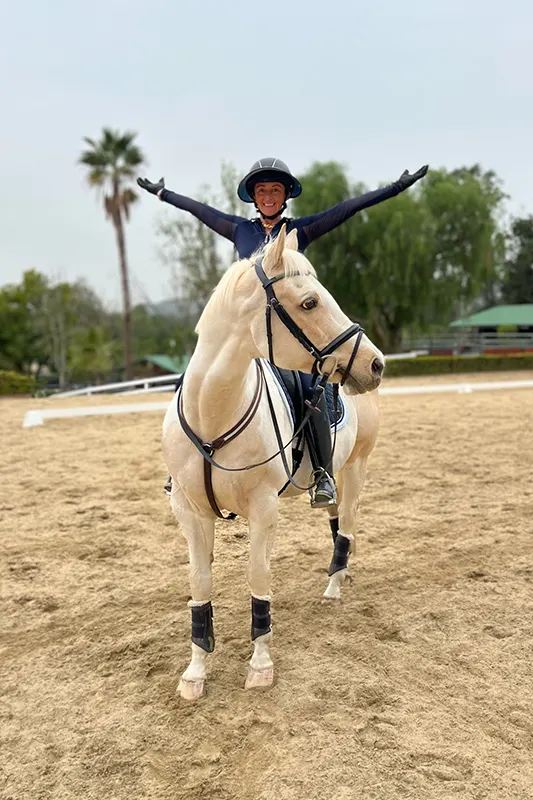
From Cattle Ranch To Dressage Ring
Lifelong horsewoman and dressage trainer Sarahbell Kleinman found her passion for the sport almost by accident. Kleinman grew up on a cattle ranch in Washington state; she has personally gentled and started 32 BLM mustangs, trained Icelandic horses both here and abroad, and along the way, acquired the nickname “Cowgirl Sarahbell” for her ability to handle horses others couldn’t. She was in her 20s and working with Icelandics near San Diego when she was contacted by the owners of a “ridiculously fancy dressage horse” who had injured his rider after bolting under saddle.
“At the time, I knew nothing about dressage,” remembered Kleinman, 41.
But she agreed to work with the horse anyway, and eventually met his regular trainer, dressage rider Elizabeth Ball. Ball introduced Kleinman more formally to the sport of dressage, and almost immediately, she was hooked. After working for Ball for a period, Kleinman went on to groom professionally, first for Olympic team bronze medalist Sue Blinks and later Rebecca Rigdon and David Blake. Although initially hired as a groom by each employer, they all recognized Kleinman’s skills in the saddle, and helped her to find riding and competition opportunities. By 2016, she was competing at Prix St. Georges.
“I think I’m particularly good at one thing, and that is reading a horse’s emotion,” Kleinman said. “I know when to ask, and when to back off. That’s how I’ve gotten so far without growing up doing dressage.”
Kleinman found the San Diego dressage community to be close knit, and both highly supportive and nurturing of her growth as a horseman. But when she relocated to the Los Angeles area in 2016 to join her now husband, Gideon Kleinman, for several years she struggled to find her footing.
“They were so respectful of me as a horseman, and there was a lot of trust there,” Sarahbell said of her employers in San Diego. “I’m so thankful to them for giving me that chance and letting me develop my skill set and my gift. But Los Angeles doesn’t have the same community. It’s so spread out, so separate. It’s just a different vibe.”
Although she found employment with several top dressage riders in Los Angeles, Sarahbell began to doubt her own abilities.
“I really lost myself,” she recalled. “I went backwards, and I wasn’t getting anywhere.”
Thanks To A Friend
Frustrated and depressed, Sarahbell began confiding her doubts with close friends, including Sullivan. To Sarahbell’s surprise, nearly everyone she spoke with encouraged her to strike out on her own. She was skeptical at first, but Sullivan in particular was supportive, offering Sarahbell a place at her Hillside Farms to launch a business of her own.
“I felt like I wasn’t good enough, and Tiffany kept winking at me and said, ‘Yes, you are,’ ” Sarahbell said. “She said, ‘Sarahbell, if you take the risk, it will be OK.’”
With Sullivan’s encouragement and support, Sarahbell finally made the decision to establish her SBK Dressage in August 2021. She and her two horses arrived at Sullivan’s ranch not long after Nutter did, and when Sullivan headed out on the road with her own horses, she asked Sarahbell to work with the Paint.
“Sarahbell is a wonderful person and horse woman, with experience in multiple equestrian disciplines,” Sullivan said. “She also has a unique talent to find the best in any animal, no matter its personality or challenges. It was a no-brainer to consult with her as I started Nutter Butter under saddle. We both loved this challenge, and did a lot together.”
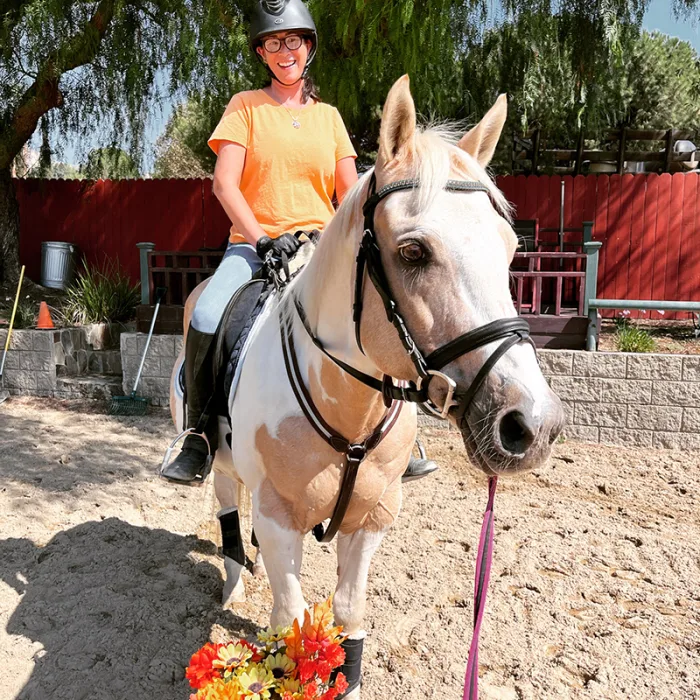
“Tiffany really subsidized my beginnings by having me ride her horses, and giving me work,” Sarahbell said. “When she asked if I would mind riding Nutter, I told her I didn’t care if it was him or her grand prix horse. So I started working with him, and Tiffany and I go back and forth, whether he was broke or not, but I think no way. He didn’t know anything.”
Despite this, Nutter’s inherent good nature meant he was unfazed by having a rider on board, and Sarahbell proceeded to introduce him to essential ridden basics at the walk and trot.
“He is 100% a walk-trot horse,” Sarahbell said. “He is just now, two and a half years later, being able to pick up both leads at liberty. Maybe someday he’ll canter with a rider—but I don’t really see the point. He offers so much value as he is—why push the little dude?”
While Sarahbell worked with Nutter, she was simultaneously shopping for a lesson horse to help build her business. It wasn’t long before she realized she had the perfect fit in Nutter—but after all Sullivan had already done for her, Sarahbell said it took some courage to ask her friend for one more favor.
“And Tiffany just said, ‘Of course I would do that for you,’ ” said Sarahbell, who is now Nutter’s official owner. “She teases me now—she reminds me she has a pasture for him, and he can retire anytime. But I keep telling her she can’t have him back yet, because he seems to keep helping person after person.
“He is bombproof,” she continued. “We have these beautiful boxwood hedges around the arenas, and the worst he is going to do is walk through the bushes with someone. If people aren’t riding back to front, or start pulling on his face, he’ll walk [them] back to the barn like, ‘This isn’t appropriate.’ He tattles on people all day long—he’ll tell me if they’re scared, or if they need to calm down.”
‘Together Their Self-Confidence Grew’
One of Nutter’s first students was Sydney Fraser, a young rider who is also dyslexic and a neurodivergent learner. Her family had recently relocated from Santa Barbara, California, to the Los Angeles area so Fraser, then 12, could attend a nearby school specializing in educating and empowering students with divergent learning styles. But the transition was difficult for Fraser; in the past, she had benefited from equine therapy, and her mother Brandi Fraser was seeking a leasing opportunity that would benefit Sydney’s physical and mental heath. Brandi contacted Sarahbell not long after Nutter joined the SBK Dressage family, desperate to find a good fit for her daughter.
“Both of my parents were special needs teachers,” Sarahbell said. “I have a lot of knowledge and expertise from my mother, Cheri Dietzen, and when I called her, she said, ‘You are the person to do this.’ ”

Nutter and Sydney were a perfect match from the beginning. She was interested and committed to working with a rescue horse, and spent hours with him, ultimately drawing out his personality. As Nutter began to shine, so did Sydney.
“Together, their self-confidence grew, and Sydney went from longe line riding with him to finding the love of dressage through their year of work together—and Nutter learned how to be the best schooling horse and to stay out of the bushes,” Brandi said. “Thanks to her work with Nutter, Sydney is now competing in dressage, and is proudly representing her new school in the Interscholastic Equestrian League.”
“She 100% changed his whole life,” Sarahbell added. “She has a talent I cannot teach anyone. Sydney can tell, if she’s asking something, when the horse understands, and she always softens and gives. She’s been an amazing student.”
Nutter gave Sydney, now 14, so much confidence in the saddle that she soon outgrew what he had to offer—but despite moving on to a new mount, the bond between horse and human remains unbroken. When Nutter was named the official SBK Dressage mascot, Sydney painted his portrait.
“It’s so cute because if Nutter’s person can’t come, I can look at her and say, ‘Can you get Nutter out’?” Sarahbell said. “It’s amazing how well he goes for her, better than anyone else, even if she hasn’t ridden him for a month. She’ll ride him around bareback, and play with him in the round pen.
“That kid is why I’m still doing this,” she continued. “Out of everything I do every day, I feel like that’s a good use of my time.”
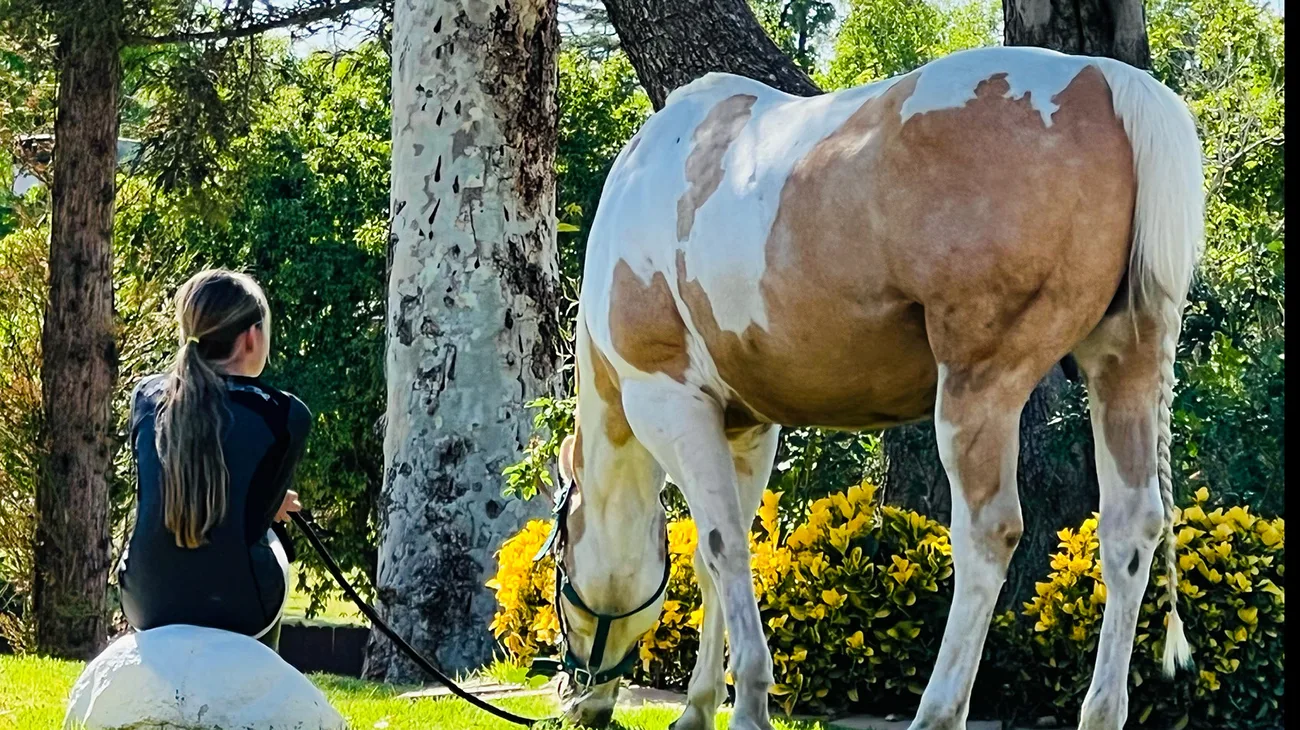
But Nutter wasn’t done making a positive impact. Another of Sarahbell’s clients, who had minimal animal experience of any kind, came seeking lessons before a dude ranch vacation. Not only did Nutter get her ready for the trip, afterward, the client returned and said she preferred riding Nutter to random horses, because she had formed a connection with him. Nutter has helped other clients regain lost confidence, practice the fundamentals of dressage, or simply learn to enjoy riding again.
“It’s been person after person—I’m flabbergasted by the number of people who he’s either built their confidence, or they’ve ridden him and then became completely obsessed with dressage,” Sarahbell said. “Every time I think he’s done everything he can do, he seems to get better and better and stronger and stronger.
“Nutter keeps bringing these people into my life, I think because he is a rescue,” she continues. “The type of person who is happy with that experience has ended up being my ‘people’. Most of them outgrow him within a year and have bought their own horses. He has been this unbelievable gift of a business partner.”
“I love the concept of horses and people rescuing each other,” Sullivan added. “Nutter Butter is a perfect example of these bonds.”
Showing His Stuff
In December 2023, Nutter made his show ring debut, taking two amateurs down centerline at introductory level. Sarahbell admitted she wasn’t sure what to expect from him, but by day two, Nutter proved to be a “total ham.”

“One of my riders came out of the ring and said, ‘He just looks at the judge, perks up, and is totally there for the scene,’” Sarahbell said with a laugh. “I have a fairly fancy show horse, and I’m always trying to get nice pictures of her, and she always looks like a donkey. But Nutter is all about it—you want to take a picture, he poses for the camera. There is something so special about him.
“The judges love him,” she continued. “The best comment I’ve gotten on a test wasn’t on my test—it was on his test. The judge said, ‘Horse seems to enjoy dressage.’ I read that, and I was in tears.”
Nutter has taught Sarahbell that horses like him play an important role in promoting the sport of dressage to a wider audience.
“There has to be an entry point less than an $80,000 horse,” Sarahbell said. “It brings me a ton of joy, working with this particular horse and seeing people getting excited about wanting to show at the lowest levels. Now, they’re part of the local club, they want to work on their geometry, to work on their position. We have this whole new set of people who are willing to show intro or training level.
“There are people who stay home because they feel they have to be good enough to show at a certain level,” she continued. “In my eyes, if you want to be good at dressage, you have to go down centerline, and you have to play the game more than once a year. If you can only go down center line at intro A and B, but you can do it 10 times and get good at your geometry, then you should do that—because why not? I feel a responsibility as a trainer to normalize that, and to make it more welcoming.”
Sarahbell plans to write and illustrate a children’s book about Nutter, and she hopes that his story will inspire someone else to take a chance.
“I think it’s important we’re showing people it’s OK to bring a regular horse along, and they can do well in the show ring,” Sarahbell said. “Are they going to break 70%? Maybe not. Do they put in good quality, accurate tests where it looks like the horse enjoys himself, and the rider isn’t terrified? One thousand percent.
“Nutter isn’t a one-note thing,” she continues. “He’s done so much for me, for Sydney, for this sport, and he is also representing rescue horses. I’m down to be that person who says, let’s make this sport accessible, and also maybe somebody will take another little horse and think, ‘Dressage is good for me and my horse, and I enjoy it—and that’s enough.’ ”
Do you know a horse or pony who has been rescued from a dangerous situation to become a healthy, trusted competition partner today? If you think you have a good candidate for “From Rescue To Ribbons,” let us know by emailing mwright@coth.com.
The post From Rescue To Ribbons: Auction Find Becomes Dressage Ambassador appeared first on The Chronicle of the Horse.
]]>The post From Rescue To Ribbons: An OTTB, A Young Rider, And A Story About Finding Your Heart appeared first on The Chronicle of the Horse.
]]>“Andie Sue is very big on connection,” said Barbie. “Every time she would ride something, she would go, ‘It’s a lovely horse, but I don’t feel anything. And I should feel something when I get on.’ Andie is a great catch rider, and she rides many different horses. But she was looking for her heart horse, not just one to compete on.”
One day, a friend told Barbie about an off-the-track Thoroughbred available for sale in Bakersfield, California, about a four-hour drive south from the Roth’s then-home near San Francisco. Just a month after his final race, Paula Lang, an equestrian professional who ran an equine-themed after school program for at-risk youth, purchased the 8-year-old gelding (Anziyan Royalty—Princess Valentina, Cape Canaveral) from an auction near Los Angeles. Lang later told the Roths she hadn’t planned to come home with a horse that day, but when she saw him in the pen, she felt an instantaneous connection with the gelding, who was still wearing his racing plates. Although she didn’t have a job for him, Lang had no intention of leaving him at the auction to an uncertain fate. She bought him, brought him home, and for over a year, he had hung out in a paddock on her ranch.
“My friend said, ‘I know this horse, and he needs a person,’ ” recalled Barbie. “Paula took great care of him, but she had nothing for him to do.”
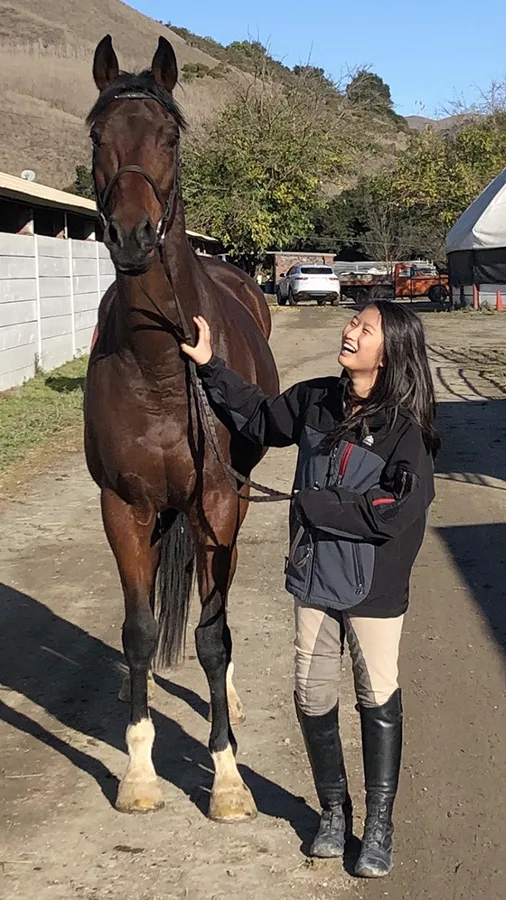
Despite not being overly impressed by his video, mother and daughter went to meet the gelding, then known as “Ragu,” in person. Andie Sue’s first opinion was that Ragu was a cute, willing and totally uneducated project; when she sat on him, he barely steered and had no brakes to speak of. But despite this, Andie Sue looked at her mother and mouthed, “I love him.”
“She looked at me like I grew two heads,” said Andie Sue, 19, with a laugh. “He didn’t know anything, but he did try hard.”
Lang was most concerned about finding Ragu a home with someone who could give him the tools and training he needed to become a good riding partner; she agreed to let the Roths take him on a one-month trial to see if he was a good fit. But after only two weeks, Andie Sue knew she had found her horse.
“He just settled right in,” said Andie Sue. “He was really good and learning quite quickly.”
Making A Change
Not long after officially becoming part of the Roth family and being rechristened with the name “Blue”, pandemic restrictions closed the barn where he was boarded. The Roths own a cattle ranch, and they decided to bring Blue there instead. For the next three months, Andie Sue and Blue trail rode, worked cattle, and strengthened both Blue’s body and their partnership—despite her new mount’s initially skeptical reaction to bovines.
“At first he hated them, but we made him eat next to them,” said Andie Sue. “Eventually, he started sniffing noses with them, so now he thinks they are good old friends.”
But once Andie Sue began developing Blue’s jumping skills, she ran into some trouble. Although she enjoys it, by her own admission, Andie Sue is not the bravest of jumping riders. However, even she was surprised when Blue’s initial reaction to ground poles was to stop with legs spread wide, head dropped, and a terrified expression on his face. With the help of several trainers, including Val Owen and Kyana Sazegari, and later, Meghan Lewis, Andie Sue tried to build Blue’s confidence over fences, eventually getting him to the point where they participated in a few schooling horse trials. Despite this, it wasn’t long before she came to accept that eventing would never be Blue’s niche.
“He was so anxious before and after each jump,” said Andie Sue. “We’d just need to take a run lap and get his energy out. Some Thoroughbreds need that, so I thought I’d keep trying. But after a while, I knew the anxiety was not calming down at all, and he just kept on stopping and stopping. And I said, ‘I don’t know if I want to do this anymore with him.’
“There’s no trust if both partners are anxious,” she continued. “So I started doing more dressage work with him instead.”
Andie Sue confesses that of the three phases, dressage had always been her least favorite. But Blue seemed to have an aptitude for the sport; he proved a much more capable dressage partner than her Morgan had been, and soon, Andie Sue had to admit she was actually enjoying herself.

“Before then, I didn’t fully understand why people do dressage,” Andie Sue said with a laugh. “I truly did hate it with a passion, unfortunately. But he was really trying, and I could tell he was enjoying it as well. He has a lot of power to him, and a lot of natural talent. After that, I was like, ‘oh, that’s why people do it.’
“It was one of those light bulb moments,” she continued. “I was totally on the other side.”
The pair made their recognized dressage show debut in July 2020, and competed several more times that season at training level under Blue’s Jockey Club name, Cape Royal. But before the year was over, Andie Sue’s newfound passion for dressage thanks to Blue led her in a direction she had never previously considered—applying for and receiving a Grade 5 para-equestrian classification.
Although she had always previously competed exclusively alongside able-bodied equestrians, Andie Sue is an amputee and wears a prosthetic to ride. In fall 2020, she traveled to Tryon, North Carolina, and made her para-dressage debut on a sponsored, borrowed horse. After that experience, and meeting other para riders there, Andie Sue knew she wanted to become more involved in para sport.
But back home in California, she continued to work with Blue and showed in open classes. In 2021, they competed at first level, and Andie Sue was named the Thoroughbred Incentive Program Young Rider of the Year by the Jockey Club. In 2022, they had their winningest season yet; concentrating on shows hosted by the California Dressage Society, Blue was named the TIP National Champion at training level and reserve National Champion at first level in the west coast division, and Andie Sue was named the TIP champion junior dressage rider.

“I was pleasantly surprised by how well we did,” said Andie Sue. “I was not expecting that.
“I remember, people would look at me and say, ‘Oh, she’s riding this schoolmaster of a horse,’ ” she continued. “It was actually a very nice compliment, or at least, I took it that way. A couple of years ago, we had no brakes, and we were stopping at jumps, and now, he’s winning championships.”
That’s not to say their progress has always been easy. Like many Thoroughbreds, Blue can tend to get flat and long in his movement, so Andie Sue has worked hard to teach him how to shift his weight back and move in a more elevated way. As she has become more immersed in the world of dressage and para sport, Andie Sue has sought opportunities to ride other horses further along in their training; she then brings what she learns back to Blue.
“Andie is a puzzler, and she loves a challenge, and she loves the underdog, because maybe as a disabled rider, sometimes, she feels like the underdog,” said Barbie. “She’s very challenged by that and motivated to make that not her reality.
“Blue is the same,” she continued. “He is not of the breeding that is typically the high level dressage horse. A lot of Thoroughbreds are misunderstood and mislabeled, and they take a different kind of rider.”
Showing His Heart
At home, Andie Sue balances her time with Blue between practice in the dressage court and leisurely trail rides, these taken sometimes in nothing more than a halter and lead rope. Occasionally, Blue will do a beginner lesson under either Barbie or Andie Sue’s instruction; he has proven safe and reliable for novice riders, whether they are still on the longe line or are moving toward basic independence.
“Even though he’s sensitive, he doesn’t get offended or freaked out by a beginner student bumping around on him,” said Barbie. “He’s very level-headed and a lot more versatile than I thought he would be.
“He’s curious and loving, and he just wants to be in your pocket,” she continued. “We say, ‘He wants to share molecules with you’ all the time.”
In 2023, Andie Sue prioritized pursuing her para-dressage goals, going back and forth from their current home in Sanger, California, to train in Florida with former U.S. Equestrian Federation Para Dressage Development Coach Lisa Hellmer, and traveling to para competitions in the U.S. and Canada. But she is aiming to get Blue back into the sandbox in 2024—hopefully at third level. Additionally, she would like to show him in some para tests and possibly earn a few scores toward the new US Dressage Federation Para-Dressage Athlete Rider Awards. Although Andie Sue has competed in the Grade 5 Grand Prix tests on other mounts, she says she would prefer Blue to make his para debut at a lower level.

“I don’t want to put too much pressure on him, but I think he’ll do well,” said Andie Sue. “We’re going to see where it takes us.”
One of the first coaches who helped Andie Sue with Blue told her that learning how to unlock his potential, without causing him frustration, would be her responsibility as his rider and trainer. She took this lesson to heart and says Blue has taught her to truly evaluate the horse standing before her, and not make a judgment about them based on their breed or level of training.
“You don’t see a lot of Thoroughbreds in the dressage world, but look at him,” said Andie Sue. “It’s good to see this underdog of a horse pull through against those horses bred for the sport, and it’s important to not give up on a horse because they aren’t the exact breed for it.”
Her mother agrees, noting that she believes Blue has been so successful because they took their time with him, and built his confidence by focusing on activities he was good at.
“He feels good about himself, because he’s been given a lot of opportunities to show all his good stuff,” said Barbie. “Thoroughbreds take a knowledgeable and patient trainer, so they can unlock these little idiosyncrasies that make them both difficult and wonderful. I love watching what Andie’s done with him.”
For her part, Andie Sue says that Blue proves a horse’s attitude is more important than any label.
“I’ve seen horses where they check off every single box, and they have the breeding, but they just don’t have the heart to do their job,” said Andie Sue. “Then you see a horse like Blue, who doesn’t check any of the boxes, but they have the heart. Horses don’t really owe us anything, and it’s kind of a miracle they let us on their back to do all these fancy things. If they have the heart to do it, they will.”
The post From Rescue To Ribbons: An OTTB, A Young Rider, And A Story About Finding Your Heart appeared first on The Chronicle of the Horse.
]]>The post From Rescue To Ribbons: Abandoned Morgan Foal Grows Into Sandbox Star appeared first on The Chronicle of the Horse.
]]>In late summer 2014, a well-bred, registered Morgan mare and her 3-month-old foal were taken to an auction in Pennsylvania. Sue-Ray Glory Glory was attractive, trained both to harness and saddle work, and she sold immediately. But neither her buyer nor anyone else bidding at the auction that day had any use for her unweaned black filly. Instead, the buyer and seller shut the filly in a stall as they led her dam away. Panicked and terrified, the filly unsuccessfully tried to escape, lacerating her shoulder in the process.
Luckily for the filly, later named Eclipse, representatives of a rescue organization were also at the auction that day. After the sale, they were able to secure ownership of both Eclipse and another Morgan, a yearling filly. The rescuers put the pair together for comfort; at first, Eclipse was so lost and confused, she attempted to nurse off the yearling.
But soon, both fillies were on their way to a quarantine facility in New York, and later, Solitude Farm Morgan Horse Rescue in Stanardsville, Virginia. There, under the watchful eye of longtime Morgan enthusiast Karen Sansom, the fillies were given time to heal and mature in the rescue’s “nursery.” Eclipse would ultimately spend several years there, until the day a fortuitous conversation between friends helped her find her home for life.

From Warmbloods To Morgans
Amateur dressage rider Wendy Breeden has owned a number of different mounts over the years, including a special 17.2-hand Hanoverian gelding named Waltzing, on whom she earned her U.S. Dressage Federation bronze medal and the fourth level scores needed for her silver. But as a child, her first horse was a liver chestnut Morgan named Pied Piper. Although their partnership got off to a rocky start when he dumped her into a flock of sheep, they later went on to compete in saddleseat, western and dressage. Over the years, Breeden has never stopped holding a soft spot in her heart for the breed.
One day, the retired first-grade teacher was speaking with a former student turned friend, Lillian Fernandez, who assisted with training the horses at Solitude Farm. For decades, the two had stayed in touch, bonded over their mutual love of horses in general and Morgans in particular. At the time, Breeden was feeling frustrated; recently, she had experienced several setbacks with her dressage horses, and she knew she was coming to a crossroads.
“I had had warmbloods and paid a lot of money for a lot of them,” said Breeden, 63. “I had good luck with some, and bad luck with others. I just needed a change. Lillian knew I was into dressage, and she says to me, ‘Wendy, what about a Morgan?’ ”
At first, Breeden wasn’t so sure, but Fernandez encouraged her former teacher to check out the horses available for adoption on Solitude Farm’s website. A few months later, Breeden’s attention was captured by a short video of Fernandez longeing an unbacked 6-year-old mare; the liver chestnut pony had “a lovely trot” and reminded Breeden of her beloved Pied Piper.
“So, like a crazy person, I said, ‘I’ll take her,’ ” Breeden recalled with a laugh. The pony had “one long stocking,” so Breeden named her Pippilotta, “Pippi” for short.
Breeden took Pippi home to her 5-acre farm in Casanova, Virginia, and for nearly a year concentrated on getting her new mount started under saddle. But it wasn’t long before Breeden began to wonder if she should acquire a second horse, “just in case.”
“You always have to have a back-up horse,” she said with a laugh. “That’s why I wanted my own farm years ago. I’m not paying board, and I said to myself, ‘I’d like to have another one.’ So I contacted Lillian and asked her to keep her eyes open.”
In response, Fernandez promptly sent a video of a now 4-year-old Eclipse on the longe line, along with a head shot.
“Oh, that big, beautiful eye,” Breeden remembered of seeing Eclipse for the first time. “It was love at first sight.”
And that was how, almost unintentionally, Breeden returned to her roots with not one, but two, Morgan rescues. The mares share some traits in common: Both are “spicy” and sensitive, and neither was fully started under saddle when she arrived at Breeden’s farm. But even though Pippi, now 13, has successfully competed through second level, it was “Elli” that proved to be a precocious student of dressage.
Getting Accustomed To The Spice
Green as grass when she was adopted by Breeden at age 4, Elli made her show ring debut in the Commonwealth Dressage and Combined Training Association summer schooling series (Virginia) at age 5, and the next season, won the series year-end championship at training level. In 2021, as a 7-year-old, she moved up to first level, and again won the CDCTA year-end title. By 2023, 9-year-old Elli had made her debut at second level, ultimately earning the adult-amateur year-end championship for both CDCTA and the Virginia Dressage Association/Northern Virginia Schooling series, with an average score of 66.42%.
From the beginning, consistently positive feedback from judges and trainers bolstered Breeden’s belief that Elli is truly “something special.” But she also quickly learned that many of the training techniques and systems that had worked well with her warmbloods were not as effective in developing her Morgans, and Elli in particular.
“It was quite a transition,” Breeden said. “I really had to take my time with Elli, because she is ultra-sensitive and ultra-spicy. She’s not dangerous by a long shot, she’s just spicy. I had had a really dull warmblood that you had to make go. I went from that to my hot mares. I needed some help learning how to ride them. At first, I couldn’t figure out how to put my leg on.
“I remember the first time I cantered Elli, I came into the house and said to my husband, ‘I will never be able to sit this canter,’ ” she continued. “And now, it’s divine. Everything just takes time.”

In working with various trainers, Breeden learned Elli responded best to a program in which her natural high energy and enthusiasm could be positively channeled into the work, rather than tamped into submission. Over the past few years, she and Elli have worked most extensively with Allison Spangler in Marshall, Virginia, supplemented by clinics with Aviva Nebesky of Maryland.
“Allison has just been wonderful with Elli. She says her favorite horse is a spicy mare,” Breeden said. “Recently, she said, ‘Wendy, we could have her fourth level next year, because she has the talent, but it would be with tension.’ So, she totally gets Elli.
“Elli can’t really be pushed,” Breeden continued. “It has to be a little bit her idea, and you have to build her confidence and build her body, which you should do with any horse, of course.”
Breeden believes that learning to ride Elli and Pippi effectively has raised the expectations she places on herself as a rider.
“I’ve definitely had to analyze everything,” she said. “Nothing is forgiven on either of these horses. For example, I really couldn’t put my leg on Elli until last year. Of course, Allison reminds me all the time that for the hot ones, you have to put your leg on, and I’d read that and read that and read that. But to do it is a different thing. It’s just a totally different ride from what I was used to.
“The nice thing is, because I’m retired now, I can just focus on it a little bit more,” she continued. “People say, ‘Are you bored now that you’re retired?’ and I just stare at them.”
Silver Medal Ambitions
With the possibility of competing Elli at third level in 2024 on her mind, Breeden is also contemplating some additional goals for her mares. To date, she has shown them primarily at schooling competitions, which Breeden said leaves her with a bigger budget for lessons and clinics. But given Elli’s continued success in the dressage court (showing under the name Glorious Eclipse), Breeden is thinking about entering a few U.S. Equestrian Federation-recognized competitions—which could lead to USDF All Breeds recognition, or even a trip to the National Dressage Pony Cup & Small Horse Championships in Ohio. Both mares would be eligible for the latter show; Pippi just received her USEF pony card, and at 15.2 hands, Elli is an official small horse.

“If you saw Elli at a clinic, you’d probably think she was a miniature warmblood,” Breeden said. “She has more of that modern Morgan look. Pippi, you look at her, and you know she’s a Morgan. She has the wavy mane and tail. She’s short and strong; she has a cresty neck. But with Elli people aren’t so sure.
In the long-term, Breeden hopes that one day Elli will help her to earn the scores she needs at Prix St. Georges to complete her USDF silver medal. But she also believes that when people see her and her Morgans out competing, it helps to promote the idea that the sport of dressage is truly accessible to all.
“Dressage is really seen as an elite sport for rich people—but she is my $1,000 horse, and Pippi was $700,” Breeden said. “Obviously, I’m not going to the Olympics with these horses, but I can still be an ambassador for the Morgan breed, and for rescues, and show you don’t have to be a multi-millionaire and buy a pre-trained horse if you have the skills, patience and help to do it the long, slow way.”
Do you know a horse or pony who has been rescued from a dangerous situation to become a healthy, trusted competition partner today? If you think you have a good candidate for “From Rescue To Ribbons,” let us know by emailing mwright@coth.com.
The post From Rescue To Ribbons: Abandoned Morgan Foal Grows Into Sandbox Star appeared first on The Chronicle of the Horse.
]]>The post From Rescue To Ribbons: Gunshot Survivor Finds New Life On The Polo Field appeared first on The Chronicle of the Horse.
]]>After Emily Smedlund lost her Andalusian cross after 11 years together, she decided to rescue another horse to help ease her broken heart.
“I wanted to give something that didn’t have anyone all this love I had,” explained Smedlund, 41, of Cary, Illinois. “I wanted to save a life.”
Smedlund also hoped the horse she found might be willing to participate in her favorite equestrian sport, polo. A member of the Barrington Hills Polo Club in Wauconda, Illinois, for years she had groomed for others in order to get riding time during matches, taking time off from work and leaving her family—husband Michael Tomkowiak and their two young children—so she could get horses ready. Having her own polo horse meant she could pursue her game without having to do quite as much extra work for others.
After browsing on various social media pages, Smedlund’s attention was captured by a gray gelding being advertised by Kaufman Horses, formerly Kaufman Kill Pen, in Texas. He was advertised as around 5 years old and broke to ride; Smedlund liked his conformation and 15-hand size and thought he might be suitable for playing polo.

Smedlund is originally from Oklahoma, and her parents still live there. They agreed to drive down and provide video confirmation that the horse Smedlund was buying matched the horse in the photo. Due to their relative inexperience with horses, when they told their daughter that the gelding was “difficult to catch,” she didn’t think much of it.
“That’s a yellow flag, not a red flag, for me,” Smedlund said. “I had a plan. I had a friend in Oklahoma, an older lady I’d ridden with forever who had land, and she said she could take him in quarantine. Then I had a friend with a trailer who hauls a lot of horses, and she said she could go pick him up.”
On Dec. 5, 2019, the gelding she named Orion officially became hers.
Not long after arriving at his quarantine farm, Smedlund received a call from her friend: Orion was proving too much for her to handle. As Smedlund made arrangements for the horse to finish his quarantine at a professional facility, she wondered what exactly her friend meant. After completing quarantine, Orion spent the month of February with players at the Oklahoma State University polo club in Stillwater, Oklahoma; they also reported his behavior was difficult.
“I kept thinking, ‘He’s supposed to be broke to ride,’ ” Smedlund remembered. “It just wasn’t making sense.”
In March 2020, just as the COVID-19 pandemic was declared, Smedlund headed out to Oklahoma to retrieve her new horse. Upon getting him home to Illinois, she determined he was older than 5, closer to 8 or 9 years. She also quickly realized that Orion didn’t act like a horse who was familiar with human contact. Although he led cooperatively enough, he flinched whenever he was touched, and became nervous when someone approached him.
“He wasn’t quite feral, but he definitely was not super tame,” she said. “He didn’t trust people at all. He wouldn’t even take treats.”
Smedlund spent about a month working with him—handwalking, grooming and, eventually, introducing him to wearing tack and longeing. One day, a friend was available to hold him, so Smedlund decided to try laying across his back. Orion panicked, and Smedlund immediately backed off.
“I decided, ‘This is not a project I can get into right now,’ ” she said. “I didn’t want to end up in the hospital during COVID.”
Through a friend, she found a trainer in Wisconsin to take Orion for three months, after which she assumed he was ready to ride.
“But as soon as I got on him, I could feel he wanted to explode,” she said. “He wasn’t yet a broke-broke, quiet horse. He was a very attentive, nervous horse.”
One day, an experienced friend offered to take Orion on a trail ride, while Smedlund rode another horse. Orion bucked the friend off three times before Smedlund asked her to stop trying.
“I was starting to get afraid of him,” Smedlund admitted. “I’m usually a pretty brave horseperson, but I was nervous. He scared me, and people were getting in my head. They would say things like, ‘He was in a kill pen for a reason; what do you expect? He’s probably broken.’ ”
But Smedlund remembered her original commitment—to save a horse—and was determined to not give up. With her job on hiatus due to the pandemic, Smedlund had the time to work with Orion at a nearby riding facility every day. At first, she could only bear to sit on him for a few strides before she would get nervous and need to dismount. It took months, but gradually she was able to stay on Orion for longer periods of time. By the end of the year, she started stick-and-ball training with him at the walk and trot, swinging a mallet and tapping the ball from horseback, without other horses around.
That fall, she asked one of Barrington Hills’ professionals, Pedro Manion, for his opinion about Orion’s potential for polo. With Manion aboard, the still-green Orion offered flying changes and smoothly performed other basic maneuvers. Smedlund was encouraged.
By spring 2021, Smedlund felt brave enough to bring Orion to “polo school” at her club—mounted lessons during which play is slow as students learn and practice their technique. When her friend Joan-Carles Brugue, an experienced rider who has introduced many horses to the sport, offered to help with Orion, she jumped at the opportunity. Brugue’s assistance with Orion’s training helped to increase both the horse’s confidence and Smedlund’s faith in his future; Brugue and Smedlund ended up sharing Orion for the season.
“He would play him a chukker, then I would play a chukker,” Smedlund said. “That was Orion’s first season, and it was about just getting out there and trying it. But for a horse, who was not even broke the year before, to jump right into polo and be that good at it—I was really amazed.”
Orion’s second involved several tournaments with Smedlund, both on the grass and in the arena, always wearing her signature pink. But as fall approached, Smedlund’s attention was required elsewhere, and she offered Orion to the Oklahoma State University polo club again. This time, the experience was a positive one.
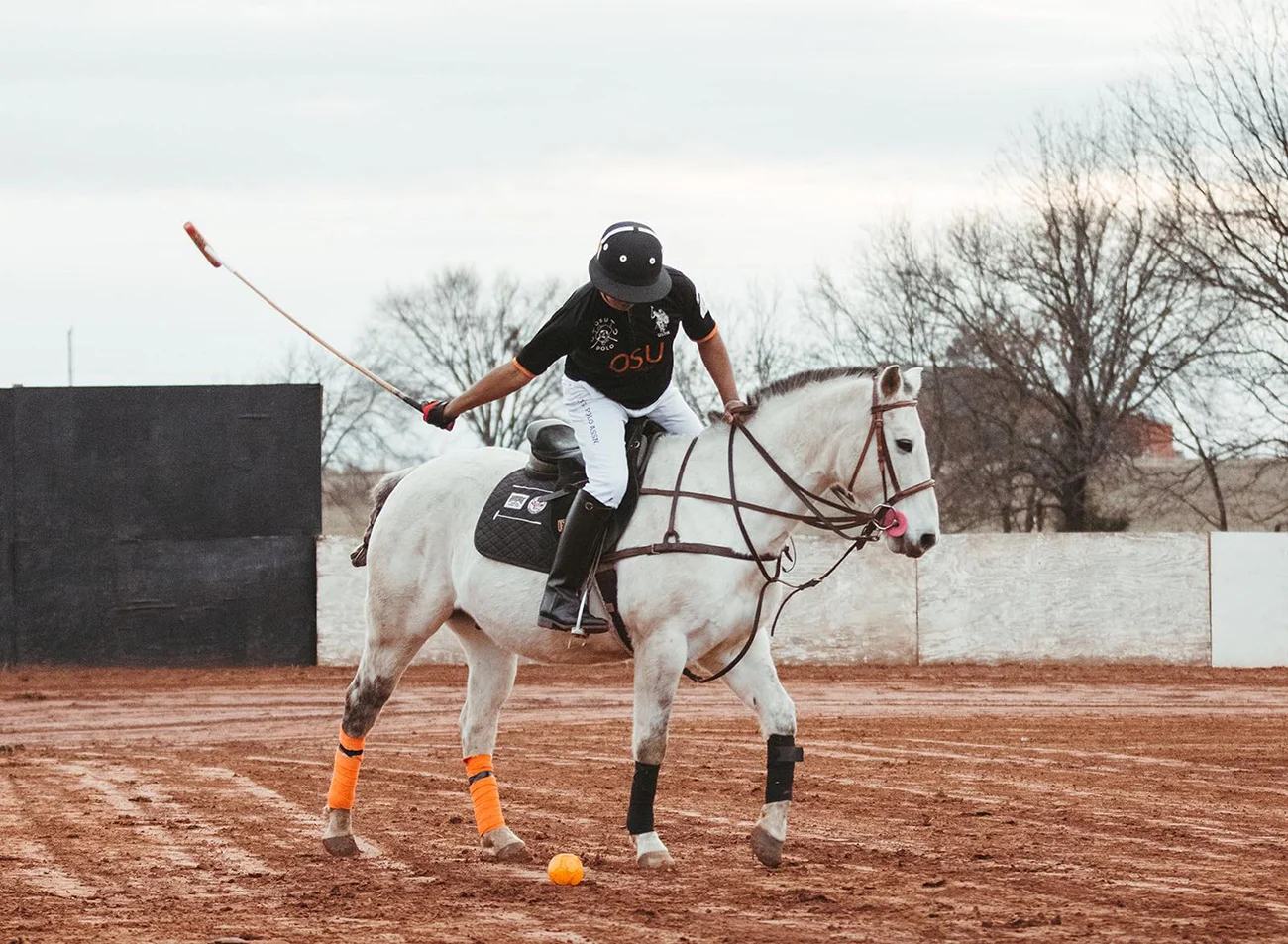
“He was perfect for them,” she said. “He played all their tournaments, including the Fall Fandango, a big arena polo exposition in Texas. He did everything they asked him to, even carting around beginner students. And this was just his second year into polo.”
When Orion returned to Illinois last spring, Smedlund was ready to set some bigger goals with him. He became a regular participant in the Barrington Hills Polo School, even serving as a mount for a physically disabled rider. His confidence on the grass polo field—a venue in which he had still retained some nervous energy—seemed to be increasing. And with each positive experience, Smedlund realized that her own fear was resolving.
“It was like, I’m not afraid of you,” she recalled. “I get you: You are a very sensitive kind of horse, but you’re not a bad horse. I don’t care what these people say about your past—you have put that abuse behind you. You’re trusting me and trusting the people in my life.”
Concurrently with his growth on the polo field, a young woman named Maya Samlan, who helped at Smedlund’s barn in exchange for riding time, asked if she could teach Orion how to jump, and later that year took him to a horse show.
“There were flower boxes, and colors, and people sitting on the bleachers, and horses calling, and he was like, ‘You want me to do this, we’ll do it,’ ” Smedlund said.
He was equally accommodating when Smedlund took him to the biggest event of their career together, the LeCompte/Kalaway Trailowners Cup, a fundraising tournament hosted by her club each year.

“It’s a big event with hats and tents and cars and people everywhere,” Smedlund recalled. “But he didn’t bat an eyelash. He just went in and did his job, and was stoic and calm the whole time. It was like he knew it was important, and stepped up.”
Despite his growth, Smedlund doesn’t think Orion will never be a totally calm horse, and she said she still longes before she gets on, especially if he’s had a few days off. He doesn’t respond well to any sort of rough handling, yet he proved totally trustworthy the day her 10-year-old daughter wanted to play stick and ball with a friend.
“He’s coming around,” Smedlund said. “He does give his heart, and he is trying to trust people. He tries really hard for the people who are trying to give him a chance.”
This fact was driven home when she learned that, at some point in his past, Orion had been shot and still had a bullet lodged in his body, below his right knee. It was discovered by accident, when an x-ray was required for an unrelated injury (and as it seems stable, Orion’s veterinarian decided to leave it in place).
“That, to me, was a testament to how much he’d been through with people, and how much he probably shouldn’t trust people, because they were bad to him,” she said. “At some point, he was shot—but he is still willing to be OK and listen to me.”

Smedlund believes that Orion’s story is common and hopes that sharing it may inspire others to take a chance on a “thrown away” animal.
“I think he was a horse that didn’t have a job, that was in the loose pen when he was auctioned, and they realized he was a little weird, and not broke, so he got tossed around and abused, until he got to the point where he literally was not something anyone wanted,” she said. “But I’m so glad I gave him a chance, because look at him now. He’s a great horse. He’s competitive, he’s fun, he’s great to my kids and my friends. He’s everything I wanted in a polo horse.”
“I think that for these horses that don’t have a person, or have a rocky fate of possibly being slaughtered,” she added, “to give them a chance is so important.”
Do you know a horse or pony who has been rescued from a dangerous situation to become a healthy, valued competition partner today? If you think you have a good candidate for “From Rescue To Ribbons,” let us know by emailing mwright@coth.com.
The post From Rescue To Ribbons: Gunshot Survivor Finds New Life On The Polo Field appeared first on The Chronicle of the Horse.
]]>